

Night shift nutrition made simple: what to eat, when to eat it, and how to time caffeine and meals to avoid crashes and sleep better.
Night shift can make food feel like a constant trade-off: eat too little, and you crash; eat too much, and you feel heavy, sleepy, or nauseous.
Then there’s the hardest part—trying to sleep during the day when your body wants breakfast, not bedtime.
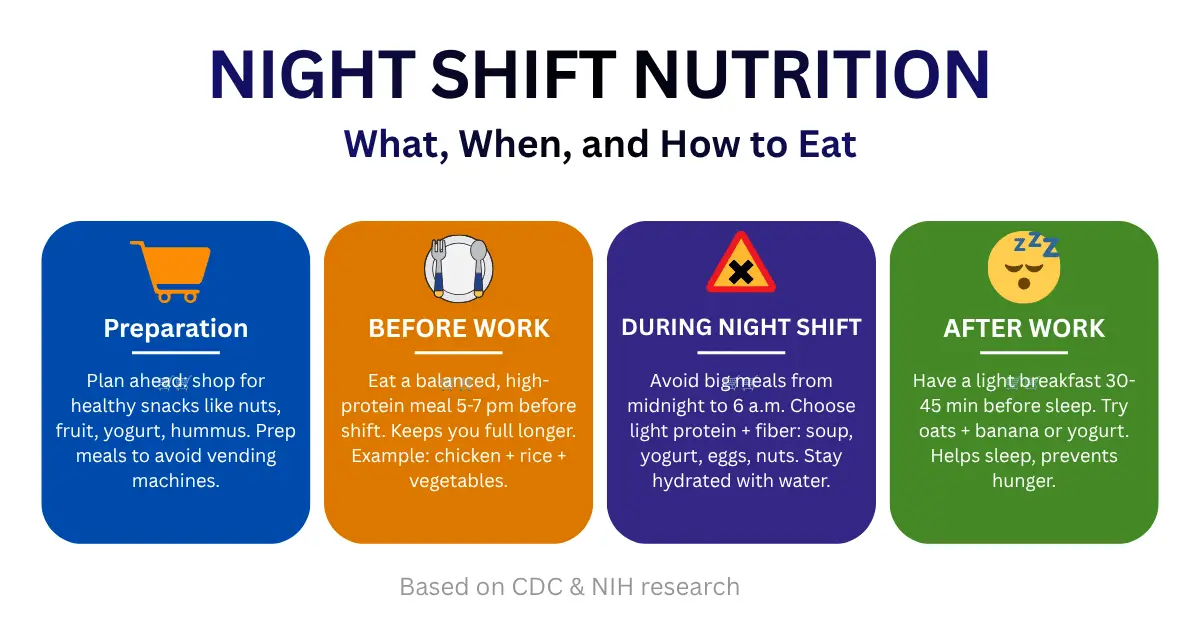
This pillar guide gives you a practical system for night shift nutrition: what, when, and how to eat so you can
- reduce the 3 AM slump,
- lower cravings and “panic eating,”
- support digestion,
- protect your sleep after the shift,
- And build a routine you can actually repeat on busy nights.
No perfection required—just a plan that fits real shift work.
The Main Issue: You Are Following Daytime Rules at Night
You eat oatmeal, salads, and grilled chicken, yet the scale climbs. Acid reflux attacks you at 4:00 AM. Sugar crashes hit during critical tasks, and you wake after daytime sleep feeling bloated, ravenous, and depleted.
The reason is simple: you have been following daytime nutrition rules in a nighttime biological context. Your pancreas, liver, and gastrointestinal tract operate on circadian clocks independent of your work schedule.

When you eat a “balanced dinner” at 2:00 AM, your body treats it as a metabolic insult, storing calories as visceral fat and triggering inflammatory responses that daytime workers never experience.
Your goal: give your body fuel when it can use it and protect sleep when it needs to recover.
What Should You Eat on Night Shift?
Eat your largest meal before your shift (5–7 PM). During the night, choose small protein-and-fiber combos, Greek yogurt with berries, vegetable soup, eggs, nuts, or a whole-grain sandwich.
Avoid big meals, sugar, and fried foods between midnight and 6 AM, and stop eating 2–3 hours before daytime sleep.
Why Your Body Struggles With Night Eating
Two key terms to understand:
- Circadian rhythm — your internal 24-hour clock that tells every organ when to be active.
- Circadian misalignment — when you eat, sleep, or work out of sync with that clock.
Research confirms that eating at night, when your body expects fasting, disrupts metabolism.
An NIH-funded Harvard study found that nighttime eating raised average blood glucose by 6.4% during simulated shift work, while restricting meals to daytime prevented this rise entirely.
Combined with decades of CDC guidance for nurses, the pattern is consistent: timing matters as much as food choice.
Common symptoms of circadian misalignment include bloating, heartburn, the 3 AM energy crash, unexplained weight gain, and poor daytime sleep.
The “3-2-1” Timing Framework
Use this as your daily anchor; adjust it to your shift hours.
- 3 = Three-part eating structure across the shift: pre-shift meal → mid-shift snack or meal → light end-of-shift option
- 2 = Two planned fuel points minimum, so you are never forced into random grazing
- 1 = One cutoff that protects sleep: stop caffeine 6–8 hours before your planned sleep time
When to Eat: Your Full-Time Night Shift Nutrition Guide

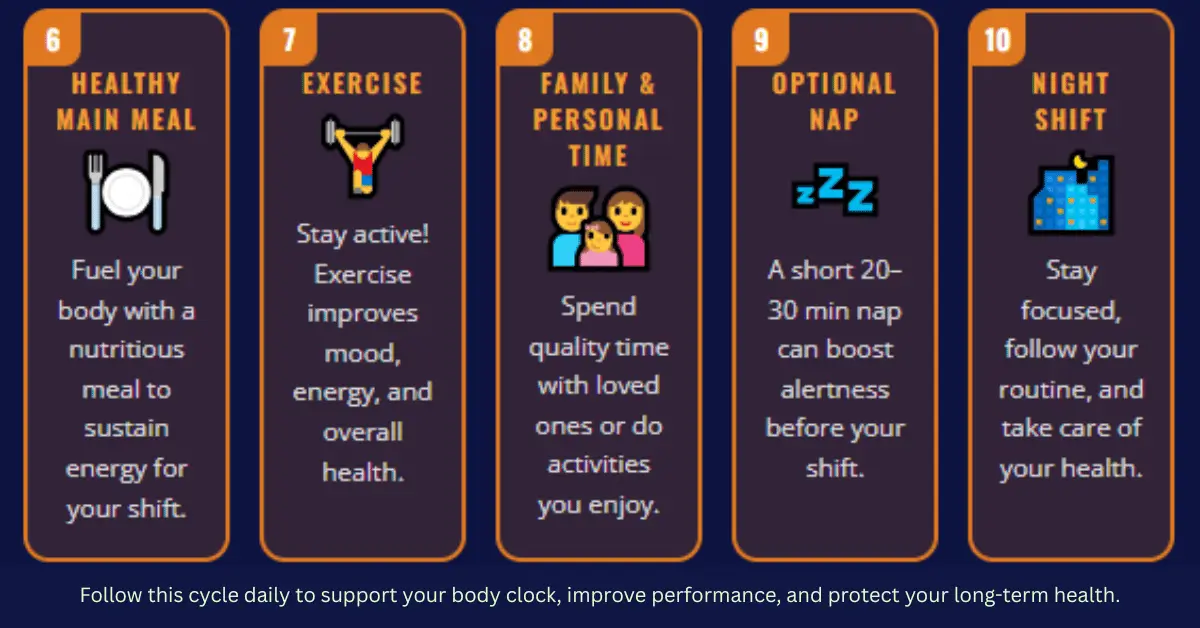
Pre-Shift Dinner (5:00–7:00 PM): Your Anchor Meal
This is your most important meal. Skipping it leads to overeating later, sugar and caffeine dependence, and shakiness during the first half of your shift.
Structure: 30g protein + complex carbs + vegetables
Examples:
- Grilled chicken + brown rice + mixed vegetables
- Turkey wrap with salad + fruit.
- Eggs + oats + berries
Eat this 60–120 minutes before your shift starts.
Early-Shift Top-Up (9:30–11:30 PM)
A small snack if genuinely hungry, not a habitual snack. Keep it under 200 calories, protein-forward.
Midnight to 6 AM Window: The Critical Restriction
CDC guidelines specifically recommend avoiding or reducing food intake in this window. If you must eat, keep it to water, herbal tea, or a small protein snack under 200 calories. Avoid large meals entirely.
The 3 AM decision point, when sleepiness peaks and cravings spike, is where your pre-planning saves you. Have a dedicated snack ready so you are not grabbing whatever is fastest.
Best 3 AM snacks:
- Greek yogurt + nuts
- Cottage cheese + berries
- Hummus + carrots + crackers
- Boiled eggs + fruit
- Tuna packet + crackers
- Edamame
Avoid at 3 AM: heavy, greasy meals; candy or pastries; and coffee alone without food.
Post-Shift Light Meal (7:30–8:30 AM): Sleep Cue
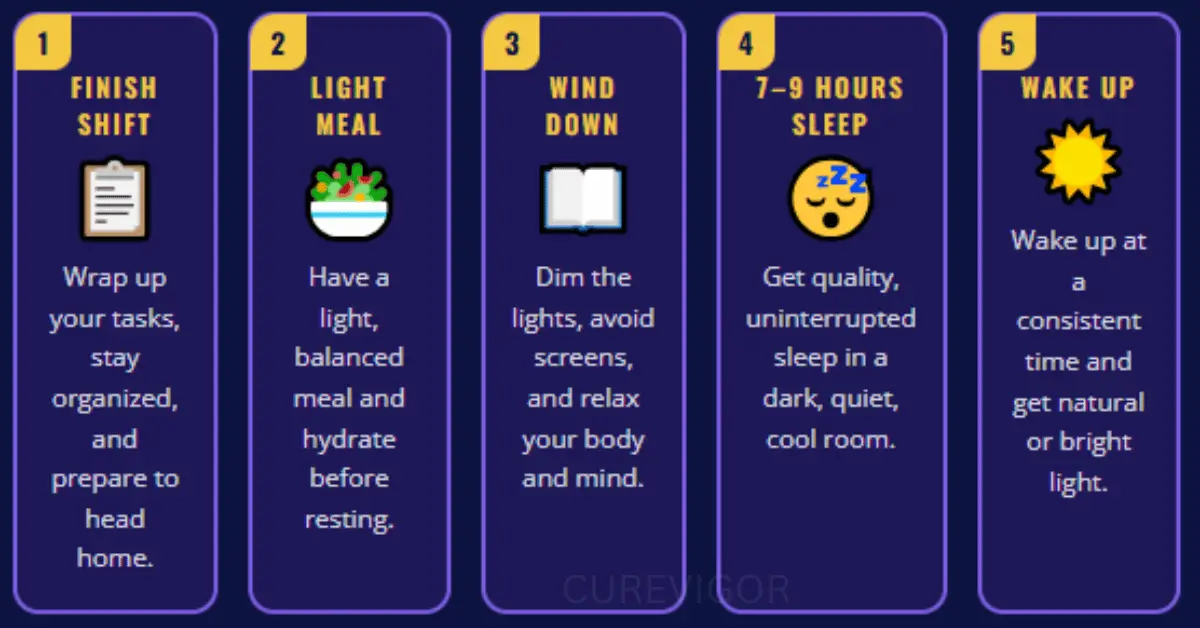
If you are going to sleep soon, choose a small carb-focused option rather than a heavy meal. Large meals worsen reflux and reduce sleep quality.
Good choices: oats with banana, warm milk with dates, yogurt with honey, and a small turkey sandwich.
Avoid: high-fat meals, spicy food, and large portions of anything.
Carbs at this stage help tryptophan cross the blood-brain barrier, supporting melatonin production and better sleep onset.
What to Eat: Building Your Night Shift Nutrition Plate

The 4 Pillars of Night Fuel: Night Shift Nutrition
1. Protein (20–30 g per meal) — slows digestion, stabilizes blood sugar, and reduces “I need sugar now” cravings.
Options: eggs, Greek yogurt, chicken, turkey, lentils, cheese, tofu, tempeh, edamame, tuna or salmon packets, and protein shakes.
2. Fiber-Rich Slow Carbs (Low-GI) — release glucose steadily, preventing spikes and crashes.
Options: oats, quinoa, brown rice, whole-grain bread, sweet potatoes, berries, apples, lentils, and beans.
Carbs that often backfire between 2 and 4 AM: candy, pastries, sugary cereal, sweet coffee drinks, and large portions of white bread or pasta without protein.
3. Hydrating Vegetables and Fruit—combat dehydration, which at night mimics fatigue and hunger.
Options: cucumber, vegetable soup, berries, oranges, watermelon, grapes.
4. Healthy Fats (Small Portions) — Support satiety without heaviness.
Options: almonds, olive oil, avocado, chia or flax seeds, salmon, and nut butters.
Timing note: Fats are better earlier in the shift. Large fat portions near the end can trigger reflux and nausea close to sleep.
Eat This vs. Skip That for Night Shift Nutrition
| Vegetable lentil soup + crackers | Warm, hydrating, high fiber | Fried samosa + chai | Fat + caffeine = reflux and a crash. |
| Greek yogurt + blueberries + almonds | Protein + low-GI + melatonin support | Donut + energy drink | Sugar spike then sleepiness |
| Egg + wholegrain wrap | Portable protein | Instant noodles | Low fiber, high sodium |
| Hummus + carrots | Crunch without heaviness | Chips | Salt triggers thirst and fatigue |

Sample Meal Plans
12-Hour Shift (7 PM – 7 AM)
| 6:00 PM | Pre-shift dinner | Grilled chicken + brown rice + mixed vegetables | Anchor fuel |
| 10:30 PM | Light snack | Vegetable soup + 2 wholegrain crackers | Warm, under 200 cal |
| 3:00 AM | Hydration only | Water + mint tea | Avoid midnight eating |
| 7:45 AM | Post-shift | Oats + banana + 1 tbsp peanut butter | Carbs aid sleep |
8-Hour Shift (10 PM – 6 AM)
| 8:30 PM | Dinner | Daal + quinoa + salad |
| 1:00 AM | Snack | Greek yogurt + berries |
| 6:30 AM | Post-shift | Warm milk + 2 dates |
Rotating Shift
| Wake ~3 PM | Meal 1 | Eggs + roti + vegetables |
| 9 PM (pre-shift) | Meal 2 | Chicken wrap |
| After shift | Meal 3 | Small fruit bowl + yogurt |
Hydration and Caffeine
Hydration Rules
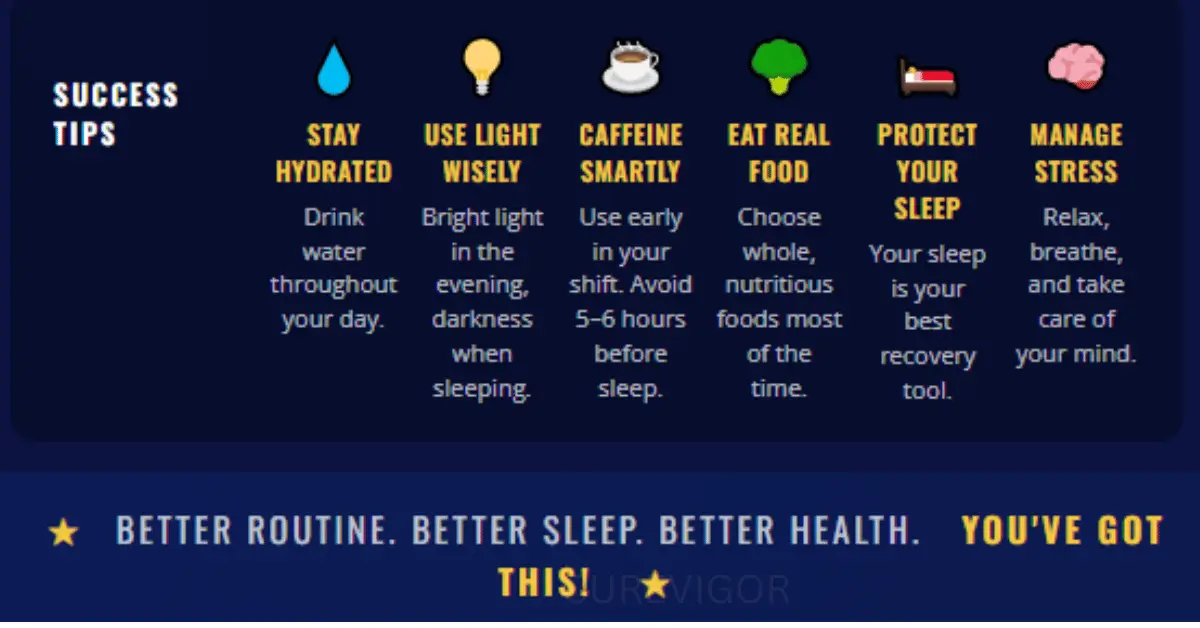
Dehydration feels like hunger at 2 AM. Fatigue, headaches, and cravings can all be dehydration in disguise, especially in dry indoor air or physically active roles.
- Start your shift with 500 ml of water.
- Drink 250–500 ml every 2 hours throughout the shift.
- Alternate each coffee with a glass of water.
- Add electrolytes if you sweat heavily (choose low-sugar versions)
- Target pale yellow urine, not clear, not dark
- Front-load hydration; too much fluid right before sleep causes frequent wake-ups
Caffeine Rules
Caffeine is useful but is also the most common reason daytime sleep falls apart.
Timing:
- 100–200 mg at the start of your shift (one coffee)
- Optional 50 mg top-up before midnight
- Zero caffeine after 3 AM
- Stop caffeine 6–8 hours before planned sleep (if sleeping at 9 AM, stop by 1–3 AM)
Coffee vs. Tea vs. Energy Drinks:
- Coffee: easy to dose; can irritate reflux in some people
- Tea: gentler stimulation, often easier on the stomach
- Energy drinks: combine high caffeine with sugar and acidity, commonly trigger jitters and GI symptoms, and worsen daytime sleep; avoid them
Pair caffeine with food. Caffeine on an empty stomach turns into anxiety, nausea, or reflux. A small protein snack, yogurt, nuts, or eggs, alongside coffee, prevents this.
Night Shift Nutrition for Weight and Blood Sugar

Night workers often gain weight not because they eat “badly” but because they eat during the biological night and sleep too little.
Practical steps:
- Keep your eating window to 10–12 hours, mostly in daylight.
- Make your pre-shift dinner the largest meal of the day.
- Avoid grazing between midnight and 6 AM.
- Walk 10–15 minutes after your pre-shift meal.
- Prioritize vegetables, fruits, whole grains, lean proteins, and low-fat dairy.
- Sleep 7–8 hours in a dark room; poor sleep raises hunger hormones more than any food choice
For blood sugar specifically: choose low-GI foods, keep overnight snacks small and protein-rich, and get regular health screenings. Long-term night-shift work is associated with higher rates of metabolic syndrome; consistent eating patterns are your best defense.

Special Scenarios
No Fridge or Microwave
Build your plan around shelf-stable and cooler-friendly foods: tuna or salmon packets, jerky (watch sodium), mixed nuts with dried fruit (small portions), whole-grain crackers, nut butter packets, roasted chickpeas, apples, bananas, oranges, and oatmeal cups if hot water is available.
A small insulated lunch bag is often the single biggest upgrade you can make.
12-Hour and Double Shifts
Long shifts need full structure: pre-shift meal → mid-shift meal → planned 3 AM snack → hydration strategy → light end-of-shift meal if sleeping soon. On doubles, prioritize steady protein and hydration so fatigue does not drive chaotic eating.
Healthcare Workers With Unpredictable Breaks
Pack for portability: two protein options (bar + tuna packet), two easy carbs (fruit + crackers), and one hydration option (water + electrolytes). This prevents the “nothing all night, then everything at once” pattern.
Rotating Shifts
Focus on structure rather than exact clock times: a meal before work, planned fuel in the middle, and something light before sleep. Your body responds well to predictable patterns even when your schedule is not.
Vegetarian and Vegan Workers
The same principles apply to plant foods. Excellent options: tofu or tempeh bowls, edamame, lentil salads, chickpea pasta with vegetables, hummus with whole-grain crackers, and chia pudding with protein powder. Check that plant-based yogurt alternatives contain adequate protein.
Diabetes, PCOS, and GERD
General strategies that often help: smaller, consistent meals, fewer high-sugar foods between midnight and 4 AM, avoiding heavy or fatty meals close to sleep, and tracking personal trigger foods. For medication timing or glucose targets, clinician guidance is essential.
Common Mistakes and the Fix
Skipping dinner then overeating at 2–4 AM → Make your pre-shift meal non-negotiable. Pack a mini meal if timing is tight.
High-sugar “alertness” snacks → Swap to protein-forward options. Keep sweets as a small add-on, not the main fuel.
Heavy greasy meals mid-shift → Choose a lighter bowl, wrap, or breakfast-style meal. Save heavy meals for when you are not fighting the circadian low.
Not drinking enough water → Drink steadily. Add electrolytes only in sweaty or hot environments.
Eating a big meal right before daytime sleep → Choose a light end-of-shift option, then eat a fuller meal after waking.
“Just coffee” with no food at 3 AM → Pair all caffeine with a small protein snack to prevent jitters and stomach irritation.
Practical Strategy: How to Make This Stick
Prep on your day off:
Cook 2 soups, 2 proteins, and 1 grain base. Pack in glass containers. Rotate sauces and seasonings so meals feel fresh.
Pack a night kit:
a water bottle, 30g of nuts, fruit, yogurt, and one emergency protein bar with under 5g of sugar.
Set phone alarms:
6 PM for dinner, 10:30 PM for snack check, and 3 AM for water only.
Eat mindfully:
Step away from screens. Chew slowly; your gut is already slower at night.
Log for 3 nights:
Note energy at 2 AM and sleep quality. Adjust portion size, not timing.
Track 4 metrics on your phone:
- Energy at 1 AM / 3 AM / 5 AM (scale of 1–10)
- Cravings intensity (1–10)
- GI symptoms (none/mild/moderate/severe)
- Sleep quality after shift (1–10)
This makes your plan personally optimized within two weeks.
7-Day Night Shift Nutrition Reset
Days 1–2: Hydration + Protein
Bring a large water bottle. Add protein to every eating moment. Keep snacks simple and repeatable.
Days 3–4: Timing Consistency
Lock in your pre-shift meal time. Pack one dedicated 3 AM snack you actually enjoy. Reduce random grazing.
Days 5–7: Caffeine Cutoff + End-of-Shift Discipline
Set your caffeine cutoff based on your real sleep time. Replace heavy end-of-shift meals with lighter options. Track sleep quality changes.
Vending Machine Damage Control
Better picks: nuts, jerky, plain popcorn, low-sugar protein bars, peanut butter crackers, sparkling water.
Avoid candy bars as a main meal, large sugary drinks, and pastries without a protein backup.
If the vending machine is the only option, pair whatever carb you choose with a protein and drink extra water to reduce the crash.
Supplements: What the Research Actually Says
Supplements are not a shortcut around poor sleep or bad timing.
But for night-shift workers specifically, emerging science shows that three supplements, melatonin, magnesium, and creatine, have meaningful, well-studied effects worth knowing about.
Here is what the research says, honestly.
Melatonin — The Most Studied Supplement for Shift Workers
Your body naturally creates the hormone melatonin at night to tell you to go to sleep. The problem for night shift workers is that artificial light suppresses this production almost entirely, leaving the body without its natural recovery signal.
What studies show:
A 2024 meta-analysis found that melatonin reduces sleep onset latency by 10 to 20 minutes and increases total sleep time by 30 to 45 minutes in shift workers.
The evidence is stronger for workers on permanent night shifts than for those on rotating schedules, because rotating schedules allow no stable circadian adaptation. Superpower
A 2024 randomized, double-blind, placebo-controlled clinical trial assigned 72 shift workers with sleep disorders to either 5 mg of melatonin before daytime sleep or a matched placebo.
Results showed melatonin supplementation can significantly enhance sleep quality within just one week.
Cognitive function improvement, however, required four weeks, suggesting that shift workers can expect both short-term and long-term benefits from consistent supplementation. Wiley Online Library
Beyond sleep, a newer line of research has uncovered something more significant.
Normal nighttime melatonin production is suppressed in night-shift workers, which compromises the body’s ability to repair oxidative DNA damage, a byproduct of normal cellular processes, and heightens the risk of certain cancers. News-Medical
Researchers from the BC Cancer Research Institute and the University of British Columbia studied 40 night-shift workers in a randomized, placebo-controlled trial.
A 3 mg melatonin dose taken before daytime sleep raised DNA repair markers by 80%.
This was published in Occupational & Environmental Medicine in 2025 and is among the first trials to directly test whether melatonin can counteract a specific biological pathway linked to cancer risk in shift workers. Technology Networks
Practical guidance:
- Doses used in trials range from 0.5 mg to 5 mg.
- Take it before daytime sleep, not at the start of your shift.
- Timing of the dose matters as much as the dose itself.
- Melatonin does not fully reset your circadian rhythm, especially on rotating schedules; it supports sleep quality, not complete adaptation.
- If you are taking additional medications, managing a chronic condition, or are pregnant, consult a clinician.
Magnesium — Sleep Quality and Stress Reduction
The modulation of GABA, the neurotransmitter that promotes relaxation and lowers neuronal excitability, is one of the more than 300 enzymatic processes in the body in which magnesium is involved.
Many adults, particularly those with disrupted sleep, are low in magnesium without knowing it.
What studies show:
A 2024 randomized, placebo-controlled study found that magnesium supplementation notably enhanced sleep quality and reduced stress levels compared to the placebo group over an eight-week period. SCIRP
A 2024 randomized controlled trial on Magnesium L-Threonate found benefits in both objective and subjective sleep quality, along with improved daytime functioning.
Researchers noted that magnesium may have a regulatory role for GABA, which promotes relaxation, and may enhance the brain’s capacity to adapt to emotional challenges and mitigate stress responses. AJMC
While observational research indicates a consistent relationship between magnesium status and sleep quality, interventional trials have shown mixed outcomes, according to a recent systematic review.
However, there is now mounting evidence that magnesium supplementation can improve sleep outcomes, with several more randomized trials published in 2024. Taylor & Francis Online
Practical guidance:
- Magnesium glycinate and Magnesium L-Threonate are the forms most studied for sleep.
- Typically taken in the evening, before sleep.
- Effects are more pronounced in people who are already deficient.
- Results vary significantly between individuals; log your sleep quality over 3–4 weeks to gauge your personal response.
- Does not replace sleep timing; works best alongside a consistent post-shift sleep routine.
Creatine — Cognitive Protection During Sleep Deprivation
Creatine is widely known as a muscle supplement, but research is now documenting something equally important for night shift workers: its ability to protect brain function when sleep is insufficient.
What studies show:
Accumulating research indicates that creatine monohydrate can increase brain creatine stores, which may explain improvements in cognitive functioning, particularly during periods of metabolic stress, including sleep deprivation, mental fatigue, and hypoxia. Hapres.
Research published in Scientific Reports found that creatine helped prevent a decrease in brain pH, reducing cellular acidification during sleep deprivation.
Participants who took creatine experienced less fatigue and drowsiness than the placebo group, suggesting that creatine not only improves cognitive performance but also helps maintain alertness and reduces tiredness.
The effects on brain metabolism and cognitive performance were observed three hours after creatine administration, peaked four hours after administration, and lasted up to nine hours. ICNS Instituto
A follow-up study at lower doses found that creatine mitigated sleep deprivation-induced deterioration in logical and numerical tasks, language-related processing speed, and psychomotor vigilance, all functions critical to night-shift performance. MDPI
One study found that creatine supplementation preserved balance, cognitive performance, and mood during 24 hours of sleep deprivation.
The primary benefits observed were in brain-dependent tasks controlled by the prefrontal cortex, including reaction time, movement planning, and emotional state, which are especially meaningful for roles involving complex decision-making and workplace safety. Dr. Kumar’s Discovery.
Practical guidance:
- Researchers caution that the doses used in initial studies were very high (over 20g), which places strain on the kidneys and is not recommended for regular use. Only if future studies confirm the same cognitive benefits at significantly lower doses (around 5g) could creatine be routinely recommended for long work nights. Medical News Today
- Do not take a single dose the night before a shift and expect results; the brain needs time to build creatine stores.
- If you anticipate a demanding schedule, a loading phase planned a week in advance is the approach supported by current research
- Creatine monohydrate is the form with the most evidence.
- Always consult a clinician before starting, particularly if you have kidney concerns.
The Bottom Line on Supplements
| Melatonin | Faster sleep onset, longer daytime sleep, DNA repair | Before daytime sleep | Dose and timing are critical |
| Magnesium | Sleep quality, stress reduction, relaxation | Evening, before sleep | Results vary; choose glycinate or L-threonate. |
| Creatine | Cognitive protection during sleep deprivation | Requires loading phase in advance | High doses carry kidney risk; research ongoing |
All three supplements show genuine promise for night shift workers specifically. None of them, however, replaces the foundational work: consistent meal timing, hydration, a dark sleep environment, and protecting your sleep window.
Think of supplements as a tool to support that foundation, not a substitute for it.
Medical note: This section is educational only. Always confirm supplement use with a qualified clinician, especially if you are managing a chronic condition, taking medications, or are pregnant.
Night Shift Success Framework
Key Takeaways
- Your body digests best in daylight; respect the midnight-to-6 AM break.
- Front-load nutrition: big pre-shift meal, light early snack, minimal overnight eating
- Build every meal around protein, fiber, and water.
- Caffeine early, hydration always, sugar rarely
- A consistent 3-meal structure within a 10–12-hour window protects energy, sleep, and metabolic health better than any supplement.
- Consistency over 14 days matters more than perfection on night one.
Frequently Asked Questions on Night Shift Nutrition
Q. What should I eat on a night shift to stay awake without crashing?
Eat protein with slow carbs before midnight, Greek yogurt with berries, boiled eggs with whole grain roti, vegetable soup, or a chicken and salad wrap.
Avoid sugar-rich snacks and low-fiber carbs like biscuits, white bread, and soda, which spike blood sugar and increase sleepiness. Stay hydrated every hour.
Q. When is the best time to eat during a night shift?
Eat your main meal between 5 and 7 PM before work, a small snack between 9:30 and 11:30 PM if hungry, and avoid large meals from midnight to 6 AM. Finish your last bite 2–3 hours before daytime sleep.
Q. Is it better to eat at night or wait until daytime?
For metabolic health, waiting until daytime is better when possible. The NIH trial showed nighttime eating raised average glucose by 6.4% during simulated shift work, while daytime-only eating prevented that rise. If you must eat overnight, keep it small and protein-rich, and eat before midnight.
Q. What foods and drinks should night shift workers avoid?
Avoid sugar-rich snacks, fried and fatty foods, spicy foods after 3, low-fiber white carbs, alcohol, and caffeine after 3 AM. Energy drinks combine all problems at once and are best eliminated entirely.
Q. How can I lose weight while working night shifts?
Keep eating within daylight hours whenever possible, make your largest meal the pre-shift dinner, and avoid grazing between midnight and 6 AM. Prioritize vegetables, fruits, whole grains, lean proteins, and low-fat dairy.
Walk 15 minutes after your main meal, and protect sleep; poor sleep raises hunger hormones more than any dietary choice.
Q. What should I eat after a night shift to sleep better?
Choose a small, carb-focused snack 60–90 minutes before bed. Good options: oats with banana, warm milk with dates, or yogurt with honey. Avoid high-fat, high-protein, or spicy foods right before sleep.
Q. How much caffeine is safe on a night shift?
Most adults tolerate 200–300 mg total (about two small coffees) if taken in the first half of the shift. Stop at least 8 hours before planned sleep. If you experience jitters or palpitations, cut back; caffeine does not replace food or sleep.
Q. Can intermittent fasting work for night shift workers?
Yes. A modified time-restricted eating window of 10 hours works well for many shift workers, for example, 2 PM–12 AM or 4 PM–2 AM, keeping most calories before midnight. Do not fast through a 12-hour physical shift without fuel; compress eating to daylight plus early shift hours instead.
Q. What are the best cheap snacks for night duty?
Boiled eggs, roasted chana, a small container of daal, vegetable soup in a thermos, seasonal fruit, yogurt, peanuts (30g), and wholegrain roti rolls with chicken. These match CDC recommendations, cost less than canteen food, and prevent the sugar crash from biscuits and tea.
Q. Does eating at night cause diabetes?
Night eating alone does not cause diabetes, but eating during circadian misalignment raises glucose levels, a known risk factor for type 2 diabetes. Long-term shift work is linked to higher rates of obesity and metabolic syndrome.
Limiting overnight calories, choosing low-GI foods, staying active, and getting regular health screenings significantly lower your risk.
Conclusion on Night Shift Nutrition
Night shift nutrition is not about perfect discipline. It is about working with your biology, not against it. Eat with the sun when you can, fuel smart before midnight, and protect your sleep window.
Start with one change tonight: move your biggest meal to 6 PM and swap the 2 AM chips for a bowl of soup. Your energy at 4 AM will tell you it is working.
Safety note: This guide is educational only. If you manage a chronic health condition, consult a qualified clinician before making significant changes to meal timing or supplement use.
Read more about night shift workers’ health.
You might like: