
Find the optimal caffeine cutoff for night-shift workers to protect their daytime sleep. Learn how caffeine half-life affects rest and how to stop caffeine without crashing.
You made it through the night shift fueled by coffee, but now you are staring at the ceiling at 9 AM, wondering why you cannot sleep. The issue is not how much caffeine you drank, but when you drank it.
Finding the right caffeine cutoff for night shift workers is the secret to getting deep, restorative daytime sleep. Drink it too late, and it wrecks your rest. Cut it off too early, and you crash before your shift ends.
Why Caffeine Timing Matters for Night Shift Workers
How Caffeine Half-Life Affects Sleep After Night Shift
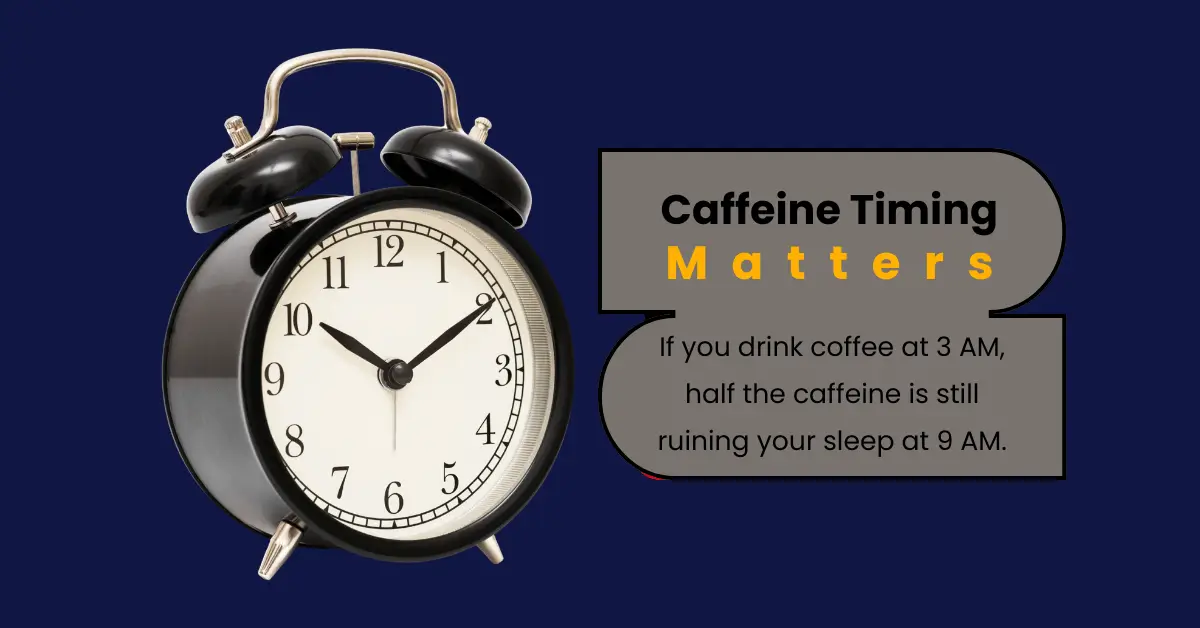
As caffeine has an average half-life of five to six hours, half of it is still in your system six hours later. Only half of the caffeine in a coffee consumed at three in the morning is gone by nine. Your adenosine receptors are still being aggressively blocked by the leftover caffeine, keeping you wired.
If you drink coffee at 3 AM, half the caffeine is still ruining your sleep at 9 AM.
Your liver metabolizes caffeine at a constant rate, but everyone processes it differently due to genetic differences. Some people are fast metabolizers, but most adults are not. Assuming you are a fast metabolizer when you are not is a common mistake that ruins sleep.
Bottom line: The 5-hour half-life means your 3 AM coffee is still very active in your brain when you try to sleep.
Caffeine Cutoff vs Total Daily Caffeine Intake
Cutting off caffeine early matters more than cutting your total intake. You could drink one cup of coffee at 5 AM and sleep terribly. You could also drink three cups before 10 PM and sleep fine. Timing is everything.
Drinking two cups by 10 PM is better for your sleep quality than one cup at 4 AM.
Shift workers often obsess over how much caffeine they consume, but the timing of that caffeine determines whether they sleep. A large early dose is safer than a small late dose.
Bottom line: Stopping caffeine on time protects your sleep more than reducing the total amount you drink.
Circadian Rhythm Disruption From Late Caffeine
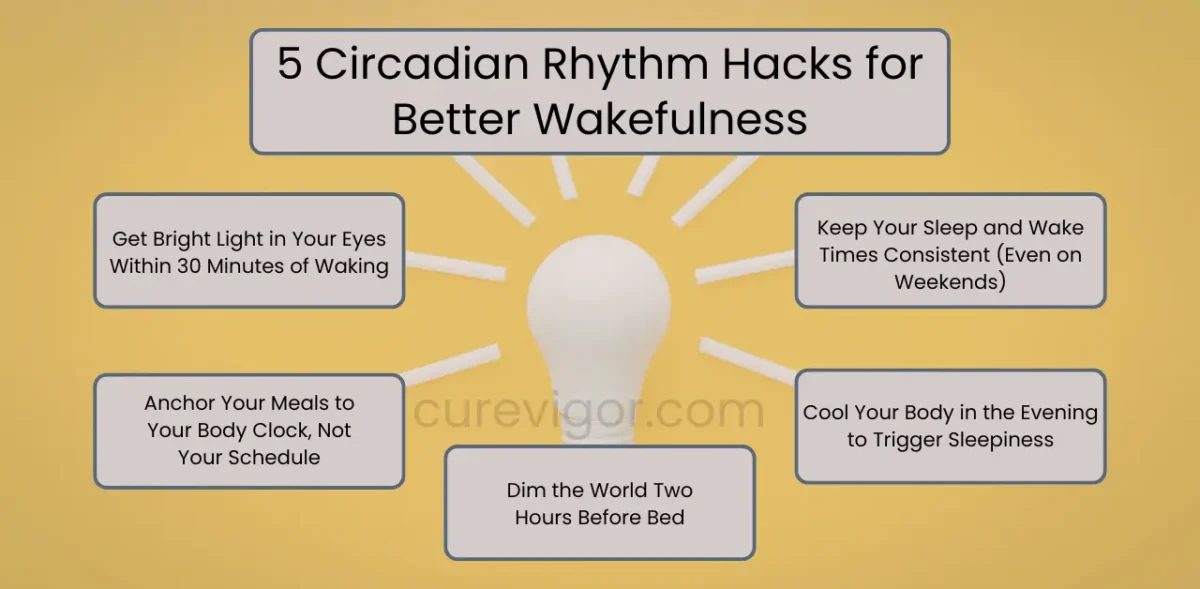
Late caffeine tricks your brain into thinking it is morning, delaying the melatonin release your body needs for sleep.
Caffeine chemically inhibits the release of melatonin, which your brain naturally produces in reaction to darkness. If you drink caffeine right before your daytime sleep window, you are fighting your own biology.
Late caffeine suppresses melatonin, telling your brain it is still time to be awake.
Studies on shift workers show that consuming caffeine within 6 hours of sleep significantly reduces total sleep time and increases sleep fragmentation. Research published by the National Library of Medicine found that caffeine consumed close to bedtime reduces sleep efficiency by up to 20% (NLM, 2019).
Bottom line: Late caffeine delays melatonin release, which is the exact hormone you need to fall asleep during the day.
What is the Best Caffeine Cutoff Time Before Sleep
8-Hour Rule: Stop Caffeine 8 Hours Before Sleep
The gold standard rule is to stop all caffeine at least 8 hours before you plan to sleep. This gives your liver enough time to clear over 75% of the caffeine from your bloodstream. For most night shift workers, this is the safest cutoff to follow without trial and error.
Stop drinking caffeine 8 hours before your planned sleep time to allow your body to fully process it.
If your shift ends at 7 AM and you sleep at 8 AM, your caffeine cutoff is midnight. This means any coffee, energy drink, or even dark chocolate after midnight will affect your sleep.

Bottom line: 8 hours before sleep is the universal caffeine cutoff rule for shift workers.
6-Hour Rule for Slow Caffeine Metabolizers
Some people metabolize caffeine slowly due to genetic differences in liver enzymes, requiring a stricter 6-hour cutoff. If you are a slow metabolizer, your body takes longer to break down caffeine. Slow metabolizers often experience anxiety, heart palpitations, and insomnia from moderate caffeine doses.
Slow metabolizers should stop caffeine 6 hours before sleep, or even earlier.
How to know if you are a slow metabolizer:
- You feel jittery after one cup of coffee.
- Caffeine keeps you awake for 12+ hours.
- You get heart palpitations from energy drinks.
If this sounds like you, use 10 hours as your cutoff. Treat your cutoff time as a hard stop, not a suggestion. For a full breakdown of energy management, read our CureVigor guide to managing night shift fatigue.
Bottom line: Use a 10-hour cutoff if you are a slow metabolizer to avoid insomnia.
How to Calculate Your Personal Caffeine Cutoff for Night Shift Workers
Your personal cutoff is your planned sleep time minus your metabolism speed. Most people do not know their exact metabolism speed, so start with 8 hours. If you are still struggling to sleep, push your cutoff back to 10 hours and adjust from there.
Your cutoff time equals your bedtime minus 8 hours, adjusted based on how you feel.
Calculation Example:
- Planned Sleep Time: 8:00 AM
- Minus 8 Hours: 12:00 AM (Midnight)
- Your Caffeine Cutoff: Midnight
Adjustment Example:
- You slept terribly after the midnight cutoff.
- Shift your cutoff to 10:00 PM.
- Test this for one week and monitor sleep quality.
Bottom line: Calculate your cutoff by working backwards 8 to 10 hours from your sleep time.
Signs Your Caffeine Cutoff is Too Late
Sleep Onset Latency and Fragmented Sleep
The time it takes to fall asleep is known as sleep onset latency, and late caffeine significantly increases it. A normal latency is 15 to 20 minutes. If you are lying in bed for 45 minutes or more, caffeine is likely the culprit. Even if you do fall asleep, caffeine fragments your sleep cycles, waking you up every 90 minutes.
Falling asleep in 45 minutes instead of 20 means your caffeine cutoff is too late.
Fragmented sleep prevents you from hitting deep REM sleep. You wake up feeling exhausted, no matter how many hours you spent in bed. This cycle creates a reliance on more caffeine the next night.
Bottom line: Late caffeine intake delays sleep onset and disrupts deep sleep cycles.
3 AM Wake-Ups and Post-Shift Fatigue
Waking up at 3 PM wide awake is a classic sign of caffeine rebound and poor sleep architecture. Your body crashes from exhaustion, but the caffeine in your system prevents you from entering deep sleep. You spend hours in light sleep, waking up frequently.
Waking up at 3 PM after going to sleep at 8 AM means caffeine is fragmenting your sleep.
This creates a vicious cycle. You wake up tired, so you drink more caffeine earlier the next night. The cycle repeats, and your sleep debt grows.
Bottom line: Late caffeine causes midday wake-ups that leave you exhausted before your next shift.
Tolerance and Needing More Caffeine Each Shift
Needing three cups by midnight to feel awake means your caffeine cutoff is failing your sleep. Tolerance builds when caffeine masks poor sleep, not fixes it. The more tired you are, the more caffeine you need, which in turn ruins your sleep even more.
If you need more caffeine each week, your cutoff isn’t protecting your sleep.
Breaking this cycle requires strict adherence to the cutoff. You might feel sluggish for a few days, but your sleep quality will improve. Once you sleep better, your baseline energy rises, and you will naturally need less caffeine.
Bottom line: Tolerance means caffeine is masking poor sleep, not fixing your energy.
Pre-Workout Options After Your Caffeine Cutoff
Pre-Workout Without Caffeine for Night Shift Gym Sessions
Use a stimulant-free pre-workout after your caffeine cutoff to avoid ruining your sleep. Many night-shift workers hit the gym after their shift, right when their sleep window begins. A standard pre-workout loaded with caffeine will destroy your sleep for the night.
Switch to a stimulant-free pre-workout before your post-shift gym session.
Stimulant-free pre-workouts use ingredients like beta-alanine, citrulline malate, and creatine. These boost blood flow, muscle endurance, and focus without spiking your heart rate or blocking sleep hormones.
Bottom line: A stimulant-free pre-workout gives you gym energy without ruining your daytime sleep.
Low Caffeine Pre-Workout vs Stimulant-Free Alternatives
A low-caffeine pre-workout (under 100mg) is acceptable if your gym session is at least 6 hours before sleep. If you are working out at 9 AM and sleeping at 2 PM, a small dose of caffeine will be mostly cleared by the time you go to bed. However, if you sleep at 10 AM, even a low dose is too much.
A low caffeine dose works only if your workout is more than 6 hours before sleep.
Comparison Table:
| Standard Pre-Workout | 150-300 mg | Pre-shift workouts (Before 10 PM) | High sleep disruption |
| Low Caffeine | 50-100mg | Mid-shift workouts (10 PM – 12 AM) | Moderate sleep impact |
| Stimulant-Free | 0 mg | Post-shift workouts (After 7 AM) | No sleep impact |
Bottom line: Match your pre-workout caffeine level to how many hours you have before sleep.
No Caffeine Pre-Workout Ingredients That Boost Energy Naturally
Look for ingredients like L-theanine, rhodiola rosea, and beetroot powder for natural energy. These ingredients improve endurance, focus, and blood flow without stimulating your central nervous system. They allow you to crush a workout without keeping you awake at 11 AM.
L-theanine and beetroot powder provide workout energy without spiking your nervous system.
Best natural pre-workout ingredients:
- L-Theanine: Promotes focus without jitters.
- Beetroot Powder: Boosts nitric oxide for better pumps.
- Rhodiola Rosea: Reduces perceived fatigue during workouts.
- Beta-Alanine: Buffers lactic acid for endurance.
Bottom line: Natural ingredients like L-theanine give you gym energy without the sleep crash.
Timing Workouts Around Caffeine Cutoff for Night Shift Workers
Schedule your hardest workouts before your caffeine cutoff to maximize performance and recovery. Your body performs best with caffeine in your system for heavy lifting or high-intensity intervals. Save your post-cutoff workouts for lighter cardio, mobility, or stretching.
Lift heavy before your cutoff and do mobility or cardio after your cutoff.
Workout Timing Strategy:
- Pre-Cutoff (Before 10 PM): Heavy lifting, HIIT, intense cardio.
- Post-Cutoff (After 7 AM): Yoga, walking, mobility, light cardio.
Bottom line: Save intense workouts for before your cutoff to maximize the benefits of caffeine.
How to Reduce Caffeine Without Crashing on Shift
Tapering Caffeine Before Setting Your Cutoff Time
Taper your caffeine gradually over one to two weeks to avoid withdrawal headaches and fatigue. Quitting cold turkey at midnight will leave you with a splitting headache by 2 AM. Reducing your dose by 25% every three days allows your adenosine receptors to adjust.
Taper your caffeine intake by 25% every three days to avoid withdrawal crashes.
Taper Schedule Example:
- Week 1: Drink 4 cups per shift.
- Week 2: Drink 3 cups per shift.
- Week 3: Drink 2 cups per shift.
- Week 4: Drink 1 cup before your cutoff, none after.
Bottom line: A slow taper prevents the withdrawal headaches that ruin your shift.
Low Caffeine Pre-Workout Swaps for Morning Energy
Swap your second coffee for green tea or yerba mate to taper caffeine without losing focus. Green tea contains about 30-50 mg of caffeine, less than half as much as a cup of coffee. It also contains L-theanine, which smooths out the energy and prevents jitters.
Green tea gives you a gentler energy boost that is easier to taper off.
Best low-caffeine swaps:
- Green tea (30-50mg)
- Yerba mate (40-60mg)
- Matcha (60-70mg)
- Black tea (40-60mg)
Bottom line: Green tea and yerba mate provide focus with lower caffeine, making tapering easier.
Hydration, Light, and Movement as Caffeine Alternatives
Use cold water, bright light, and short walks to fight fatigue without adding caffeine. One of the main unidentified causes of shift weariness is dehydration. Your nervous system can be awakened just as effectively as a cup of coffee by drinking 16 ounces of cold, electrolyte-rich water.
Drink 16oz of cold water and take a brisk walk to fight 3 AM fatigue without caffeine.
Natural Alertness Tools:
- Cold water: Activates your dive reflex, slowing heart rate and increasing alertness.
- Bright light: Suppresses melatonin and signals your brain to stay awake.
- Your brain receives more oxygen and blood when you move.
Bottom line: Water, light, and movement are powerful, free tools for fighting fatigue.
No Caffeine Pre-Workout Routine for Alertness

Build a pre-workout routine of dynamic stretching, music, and deep breathing to replace caffeine. If you rely solely on caffeine for gym energy, you will struggle on days you cut off early. A 10-minute routine primes your nervous system for work.
A 10-minute warm-up with music and stretching primes your body better than caffeine.
Sample Pre-Workout Routine:
- Minutes 1-3: Listen to high-tempo music.
- Minutes 4-7: Dynamic stretching and mobility work.
- Minutes 8-10: Deep breathing and visualization.
Bottom line: A consistent pre-workout routine wakes up your nervous system without caffeine.
Caffeine Cutoff Cheat Sheet for Night Shift Schedules
Use this cheat sheet to find your exact caffeine cutoff based on your shift. This removes the guesswork from timing your last cup of coffee. Adjust based on whether you are a fast or slow metabolizer.
Stop drinking caffeine 8 hours before sleep to protect your daytime sleep quality.
8-Hour Shift Caffeine Cutoff Examples
Match your shift end time to your sleep time, then work backwards 8 hours.
For an 8-hour shift, your cutoff is roughly 4 hours before your shift ends.
| 10 PM – 6 AM | 7:00 AM | 11:00 PM |
| 11 PM – 7 AM | 8:00 AM | 12:00 AM (Midnight) |
| 12 AM – 8 AM | 9:00 AM | 1:00 AM |
| 7 PM – 3 AM | 4:00 AM | 8:00 PM |
12-Hour Shift Caffeine Cutoff Examples
For a 12-hour shift, your cutoff is roughly 8 hours before your post-shift sleep.
For a 12-hour shift, stop caffeine 4 hours before your shift ends.
| 7 PM – 7 AM | 8:00 AM | 12:00 AM (Midnight) |
| 6 PM – 6 AM | 7:00 AM | 11:00 PM |
| 8 PM – 8 AM | 9:00 AM | 1:00 AM |
Adjusting Caffeine Timing for Rotating Shifts
If you rotate shifts, use your sleep time as your anchor point for caffeine cutoff. Rotating shifts disrupt your circadian rhythm, making the timing of caffeine even more critical. On days you switch from day to night shift, stop caffeine by noon to help your body adjust.
On rotating shifts, use your sleep time as your anchor for caffeine cutoff.
Rotation Strategy:
- Days-to-nights switch: Stop caffeine by noon.
- First night shift: Stop caffeine by midnight.
- Final night shift: Stop caffeine 10 hours before sleep to reset.
Bottom line: Adjust your cutoff based on your sleep time, not your shift start time.
Frequently Asked Questions
Q: What is the best caffeine cutoff for night shift workers?
The best caffeine cutoff for night shift workers is at least 8 hours before their planned sleep time. Slow metabolizers should stop caffeine 10 hours before sleep to fully clear it from their system.
Q: How does caffeine half-life affect sleep after a night shift?
Caffeine has a half-life of about 5 to 6 hours, meaning half of it is still active in your system 6 hours later. Drinking coffee at 3 AM means half the caffeine is still blocking sleep hormones at 9 AM.
Q: Can I drink caffeine after my cutoff if I use a no-caffeine pre-workout?
No, a stimulant-free pre-workout is the only safe option after your caffeine cutoff. Any caffeine consumed after the cutoff will disrupt sleep onset and reduce deep REM sleep.
Q: What happens if I cut off caffeine?
You will likely feel headaches, fatigue, and irritability for the first 2–3 days. These withdrawal symptoms happen because your brain has adapted to caffeine blocking adenosine receptors. Energy levels usually stabilize after day three once your body readjusts.
Your body needs a short adjustment period before you feel normal without caffeine.
Bottom line: Expect temporary withdrawal, then steadier energy on the night shift.
Q: Can quitting caffeine be good?
Yes, quitting often improves your daytime sleep quality and reduces anxiety during shifts. Many night workers notice fewer 3 AM jitters and better focus once the cycle of tolerance breaks. You also avoid the afternoon crash that forces you to have extra coffee later.
Better sleep and steadier mood are the biggest wins from cutting caffeine.
Bottom line: Quitting caffeine usually helps night shift recovery more than it hurts.
Q: Is caffeine bad for high cortisol?
Caffeine can raise cortisol levels, especially when you drink it late in your shift. High cortisol at the wrong time makes it harder to fall asleep after work and keeps your body in a state of stress. Limiting intake helps keep cortisol patterns more normal for night workers.
Late caffeine adds extra stress on top of your already disrupted circadian rhythm.
Bottom line: Cut caffeine early to avoid worsening cortisol and sleep issues.
Q: How long will it take to quit caffeine?
Most people see the worst withdrawal symptoms fade within 3–7 days. A full tolerance reset usually takes about two weeks of consistent low or zero intake. Start by tapering half a cup each day instead of stopping cold.
Plan a gradual cut over one week to make the change easier on the night shift.
Bottom line: Expect 3–7 days of adjustment before you feel steady again.
Q: Will I look younger if I quit caffeine
You may look more rested because better sleep reduces dark circles and puffiness. Caffeine can dehydrate the skin and increase stress hormones, which can affect ageing over time. The improvement comes mainly from deeper daytime sleep, not caffeine removal alone.
Better sleep from cutting caffeine often gives you a fresher appearance.
Bottom line: Improved rest is what makes you look more refreshed, not quitting caffeine directly.
Q: What vitamins are depleted by coffee?
Coffee can reduce absorption of B vitamins, magnesium, and calcium when consumed in large amounts. These nutrients help regulate energy and sleep, which night shift workers already struggle to maintain. Spacing coffee away from meals and supplements reduces the loss.
Heavy coffee intake quietly drains the same nutrients your body needs for recovery.
Bottom line: Limit coffee and eat nutrient-rich foods to protect your vitamin levels.
Q: What can I drink instead of caffeine?
Try electrolyte water, herbal tea, or green tea early in your shift. These options keep you hydrated without blocking sleep later. Adding a splash of lemon or mint makes plain water more appealing during long nights.
Hydration and light movement often replace the need for extra caffeine.
Bottom line: Switch to water or herbal options after your cutoff time.
Q: What is the 2-hour coffee rule?
The 2-hour coffee rule means avoiding caffeine for 2 hours before your planned sleep time. For night-shift workers, this helps prevent the stimulant from remaining active when you try to rest. It is a stricter version of the common 6–8-hour cutoff guideline.
Stick to the 2-hour rule on nights when sleep feels especially fragile.
Bottom line: Give yourself at least two hours caffeine-free before bedtime.
Q: How to stop caffeine addiction?
Taper your intake gradually over several days instead of quitting suddenly. Replace one cup with water or green tea, then track how you feel. Pair the change with better hydration and short walks to ease the transition on shift.
Slow reduction prevents the crash that makes you reach for more caffeine.
Bottom line: Taper slowly and stay consistent to break the habit for good.
Final Recap
If you are too tired to read this whole thing, here is exactly what you need to know. Cut off all caffeine at least 8 hours before you sleep. That is the entire game in one sentence. If you are still struggling, push it to 10 hours.
Taper your intake slowly so you do not get a headache on shift. Use green tea or stimulant-free pre-workouts when you need a boost past your cutoff. Drink cold water, take a walk, or sit under a bright light if you crash at 3 AM.
Sleep determines how you feel, how you perform, and how healthy you stay on the night shift. Caffeine timing is the single biggest lever you can pull to fix your sleep. Get this one thing right, and everything else gets easier.
Conclusion
Most night shift workers think they need more caffeine. They actually need better caffeine timing. A strict cutoff 8 hours before sleep protects your melatonin, deep sleep, and long-term health. Start tonight by moving your last coffee earlier, tapering your dose, and using natural energy tools to replace what you cut out.
Protect your sleep by stopping caffeine 8 hours before bed. Your energy depends on it.
Bottom line: Better caffeine timing beats more caffeine. Cut off 8 hours before sleep to fix your rest and your energy.
caffeine cutoff, night shift sleep, caffeine half-life, stimulant-free pre-workout
Take Control of Your Night Shift Health
Want more actionable strategies to sleep better and feel stronger on night shifts?
Explore CureVigor’s Night Shift Health Hub for caffeine timing guides, supplement reviews, and fatigue-beating tips. Subscribe to our newsletter today and get one practical survival tip delivered to your inbox every week.
Read more about night shift workers’ health.
You might like: