
Poor sleep and fatigue feed each other in a loop; here’s how to break the cycle, with practical, science-backed steps to reset your sleep, energy, and focus for good.
And why is “just get more sleep” true but useless advice?
You’re tired. That part isn’t news. But somewhere along the way, “tired” stopped being the whole story. Thoughts that used to come easily now feel like they’re moving through static. Simple decisions take longer than they should. And underneath it all, there’s a low hum of exhaustion that a good night’s sleep, on the rare occasion you get one, doesn’t seem to touch anymore.
Most people treat fatigue, brain fog, and burnout as three separate problems. They’re not. They’re stages of the same chain reaction, and it almost always starts in the same place: sleep that’s been quietly shortchanged for weeks, months, or years.
Understanding that chain, how one stage feeds the next, is the first real step toward breaking it.
What Sleep Loss Actually Does to Your Brain
Sleep isn’t downtime. It’s maintenance. A few things happen every night that your brain depends on to function the next day, and all of them get disrupted when sleep is cut short.
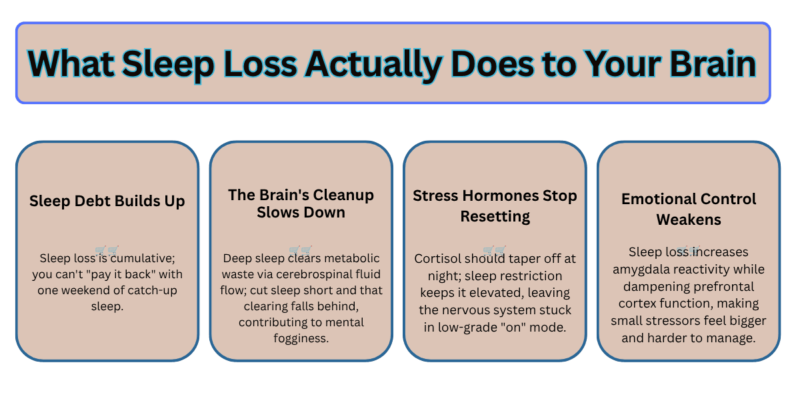
- Sleep debt is cumulative, and it doesn’t wash out on the weekend. Every hour of sleep you miss adds to a running deficit. A common misconception is that sleeping in on Saturday “pays it back.” It doesn’t fully work that way.
One long night does not make up for the deficit accumulated during a demanding week, and the cycle of overcorrecting on weekends and shortchanging sleep on weekdays can make it harder to fall asleep at a regular hour. - Your brain does literal cleanup work while you sleep. During deep sleep, cerebrospinal fluid flushes through brain tissue and clears out metabolic waste that accumulates during waking hours. Skip enough sleep, and that clearing process falls behind, which is part of why sustained sleep loss leaves you feeling mentally clouded rather than just physically tired.
- Stress hormones stop resetting properly. Cortisol, your primary stress hormone, normally follows a rhythm, higher in the morning, tapering off by night. Chronic sleep restriction disrupts that rhythm, keeping cortisol elevated at times it should be winding down. The result is a nervous system that stays in a low-grade “on” state, even when there’s nothing to respond to.
- Emotional regulation gets harder. Sleep loss increases activity in the amygdala, the brain’s threat-response center, while reducing the ability of the prefrontal cortex, the part responsible for reasoning, planning, and self-control, to keep that reactivity in check.
In practice, this means smaller frustrations start to feel bigger, and it takes more effort to stay level.
These four changes don’t happen in isolation. They compound, and they map almost exactly onto the three stages most people experience.
The Three-Step Process: From Fatigue to Burnout
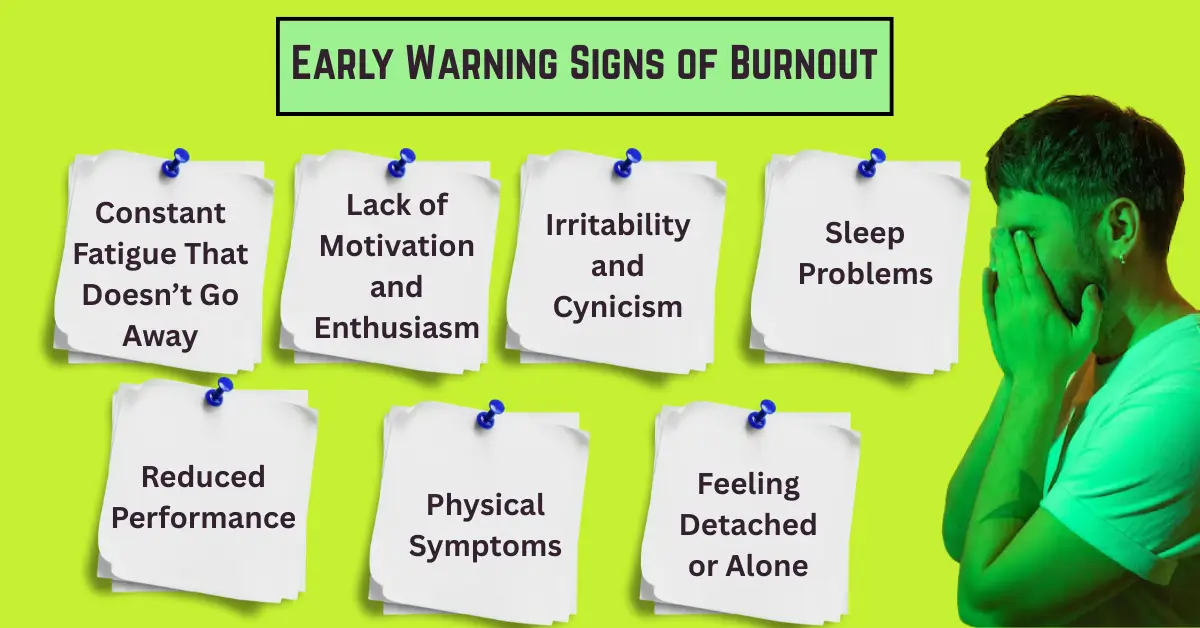
Stage 1: Fatigue—The First Warning Sign
Fatigue is usually the first thing people notice and usually the first thing they dismiss.
It’s worth separating two kinds:
- Physical fatigue: heavy limbs, low stamina, the pull toward the couch instead of the gym.
- Mental fatigue: the sense that thinking itself takes more energy than it used to.
Early on, fatigue is manageable. You reach for coffee, push through, and get by. That’s exactly what makes it dangerous; it’s easy to normalize.
Common early signs include relying on caffeine just to feel functional, dozing off during meetings or while reading, and needing to muster willpower to stay alert during ordinary tasks.
The problem is that fatigue isn’t a plateau. Left unaddressed, it deepens, and once the brain has been running on a deficit long enough, fatigue stops being just a physical sensation and starts affecting how you think.
Stage 2: Brain Fog—When Fatigue Becomes Cognitive
Brain fog isn’t a medical diagnosis; it’s a term for a cluster of cognitive symptoms that tend to show up together: slowed thinking, trouble concentrating, forgetfulness, and a general sense of mental fuzziness.
People often describe it as trying to think through mud, or like their mind is a step behind everything happening around them.
This is where the mechanisms from the sleep-loss section become tangible. Reduced overnight clearing of metabolic byproducts, disrupted communication between neurons, and a stress system that’s stuck partly “on” all show up here as difficulty holding a thought, losing track of conversations, rereading the same paragraph without absorbing it, or blanking on a word you know well.
One important reframe: brain fog is not laziness, and it’s not a character flaw. It’s a predictable output of a brain that hasn’t had enough recovery time.
Treating it as a discipline problem, pushing harder, and working longer tends to backfire because it adds more cognitive load onto a system that’s already behind.
And that’s usually exactly what happens next. Performance dips, so people compensate by working later, sleeping even less, and pushing through the fog instead of addressing its source. That compensation is the bridge into the third stage.
Stage 3: Burnout—Where the Chain Leads
The World Health Organization defines burnout as an occupational phenomenon resulting from chronic workplace stress that hasn’t been successfully managed.
It is characterized by three things: diminished professional performance, increased mental detachment from one’s work or rising cynicism about it, and feelings of energy depletion or tiredness.
Sleep deprivation and burnout feed each other in both directions. Poor sleep drains the resources, emotional regulation, cognitive bandwidth, and stress resilience that would otherwise help someone cope with a demanding workload.
At the same time, burnout’s hallmark features (racing thoughts at night, dread about the next day, and a stress system that won’t power down) make it harder to sleep well in the first place.
The result is a loop: stress erodes sleep, poor sleep erodes coping capacity, and reduced coping capacity generates more stress.
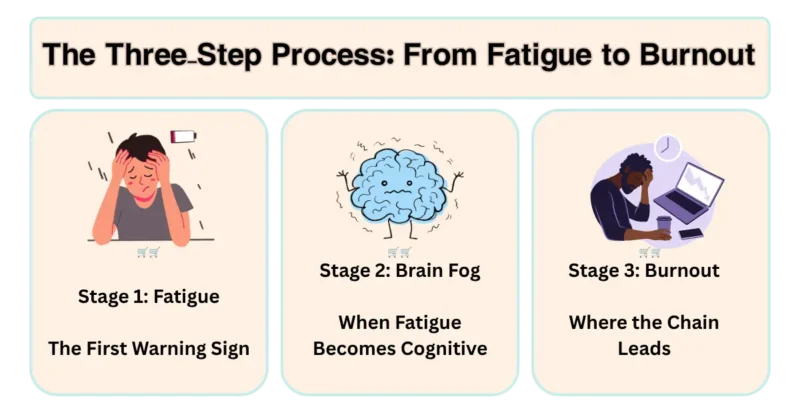
Burnout manifests itself in more ways than just attitude. Physical symptoms include tension headaches, tight muscles, a weakened immune system, more mistakes, slower decision-making, and “presenteeism,” which is the state in which an employee is physically present at work but too exhausted to perform well.
These costs are rarely discussed alongside the personal ones. Sleep-related fatigue and fog don’t just affect how someone feels; they measurably affect How someone performs.
Which Stage Are You In? A Quick Self-Check
Because these stages overlap, it can be hard to tell where you actually stand. Use this as a rough guide, not a diagnosis:
| Normal tiredness | Sleepy after a late night or busy day | Yes, one good night mostly resolves it |
| Fatigue | Persistent low energy, heavy reliance on caffeine, harder to start tasks | Partially; it improves with consistent sleep over days. |
| Brain fog | Trouble concentrating, forgetfulness, thoughts feel slow or scattered | Slowly; needs sustained, quality sleep over weeks |
| Burnout | Emotional exhaustion, cynicism or detachment, reduced sense of effectiveness, and symptoms persist despite rest. | Not on its own, sleep helps, but the underlying stress load also needs to change. |
If rest alone stopped fixing how you feel a while ago, that’s often the clearest sign you’ve moved from fatigue into burnout territory.

What Actually Helps
The basics matter, but they’re table stakes: consistent sleep and wake times, a dark, cool room, and less caffeine and fewer screens in the evening. Most people have heard this. What tends to get left out is what happens next.
Sleep debt is repaid gradually, not in one big weekend. Instead of chasing a single long sleep, aim for small, consistent extensions, 20 to 30 extra minutes a night, sustained over a couple of weeks.
Napping can help or hurt, depending on timing. A short nap (20–30 minutes) earlier in the day can offset acute sleep debt without much disruption to nighttime sleep.
Naps, or longer naps taken late in the day, may make it harder to fall asleep that night, which may worsen the very deficiency you are trying to fill.
Give your nervous system an off-ramp before bed. Slow breathing, light stretching, a short walk, or journaling to offload the day’s mental clutter all help lower cortisol before sleep, directly countering the stress-hormone disruption described earlier.
If burnout is part of the picture, sleep fixes alone won’t be enough. Boundaries around work hours, realistic delegation, and actually using time off matter here, because if the stress load stays constant, better sleep habits tend to erode again within a few weeks.
Real-life constraints deserve real answers. Shift workers, new parents, and caregivers often can’t follow “just get on a consistent schedule” advice.
In these cases, protecting sleep quality during whatever hours are available, a fully dark room, a consistent pre-sleep routine regardless of the clock, and strategic short naps matter more than chasing a textbook schedule that isn’t realistic.
What Recovery Actually Looks Like
Recovery isn’t linear, and it isn’t instant. Mood and energy are usually the first things to improve, often within one to two weeks of more consistent sleep.
Concentration and memory tend to lag, typically taking several weeks of sustained improvement to show real gains. Full recovery from burnout, especially if it’s been building for months, can itself take months, particularly if the underlying stress hasn’t been addressed alongside the sleep.
The throughline is consistency, not perfection. A few off nights won’t undo progress; what matters is the overall trend.
When to See a Doctor
Most sleep-related fatigue and fog respond to the changes above. But some signs warrant a medical evaluation rather than more self-directed effort:
- Insomnia lasting more than two to three weeks
- Loud snoring, gasping, or choking during sleep (possible signs of sleep apnea)
- Extreme daytime sleepiness despite adequate time in bed
- Persistent low mood, hopelessness, or worsening anxiety
- Any symptoms that feel severe, sudden, or unlike your normal baseline
Conditions like sleep apnea, thyroid dysfunction, and chronic insomnia can look identical to garden-variety sleep debt on the surface, and they need a different kind of treatment. A doctor can help sort out which one you’re dealing with.
FAQs on How to Break the Cycle of Poor Sleep and Fatigue
Q. How to function on 4 hours of sleep?
There’s no real hack that fully offsets 4 hours of sleep; the goal is damage control, not optimization. Get bright light exposure immediately upon waking to help suppress lingering melatonin and signal alertness to your circadian system.
Prioritize protein-forward meals over sugar and carbs, which will spike and crash your already-fragile energy. A short 20-minute nap early in the day can help, but avoid caffeine after early afternoon or you’ll compound the debt the next night.
Treat the day as a recovery mission, not a normal one, and prioritize a full sleep window that night.
Q. What happens if you don’t sleep for 36 hours?
By 36 hours awake, the urge to sleep becomes overwhelming and increasingly hard to override through willpower alone. Microsleeps, brief, involuntary lapses into sleep lasting seconds, often begin occurring without your awareness, which is particularly dangerous while driving or operating machinery.
Appetite tends to increase, coordination and judgment decline noticeably, and some people begin experiencing mild perceptual disturbances. Cognitively, this level of sleep deprivation has been compared to functioning at a blood alcohol concentration well past the legal driving limit.
Q. What are the symptoms of a lack of sleep and stress?
Poor sleep and chronic stress produce heavily overlapping symptoms because they drive the same underlying hormonal response: elevated cortisol. Common signs include persistent fatigue, irritability, difficulty concentrating, and a shorter fuse for everyday frustrations.
Physical symptoms often follow: tension headaches, muscle tightness, a racing heart, and a stomach that feels unsettled more often than usual. Because sleep loss and stress reinforce each other in a loop, it’s common for both sets of symptoms to intensify together rather than showing up separately.
Q. Does poor sleep contribute to brain fog?
Yes, sleep is one of the most well-established contributors to brain fog. During deep sleep, your brain clears metabolic waste and consolidates memory; repeatedly cutting that process short shows up as slower thinking, forgetfulness, and difficulty concentrating.
Sleep loss also disrupts communication between neurons, which affects how efficiently information gets processed. Brain fog from sleep deprivation isn’t a permanent state; it typically improves once consistent, quality sleep is restored, though it can take longer to resolve than fatigue does.
Q. What is the Japanese trick to sleep?
The current viral version is called Mokan Undo: lie down, raise your arms and legs, and gently shake them for 1 to 2 minutes before easing into bed. Sleep specialists explain it works partly through heat regulation.
Moving your extremities draws warmth away from your core, mimicking the natural temperature drop your body needs to fall asleep. It’s a genuinely old technique dating back to 1927 that’s resurfaced online. It’s not a substitute for consistent sleep habits, but it can help as a wind-down cue for some people.
Q. What is the forbidden hour of sleep?
It refers to the “forbidden zone for sleep” (also called the wake maintenance zone), a window, typically a few hours before your usual bedtime, when your circadian system produces its strongest alerting signal, making it unusually hard to fall asleep even if you’re tired.
It’s not about a specific clock time universally, but rather about roughly 2-4 hours before your natural sleep onset. Trying to nap or sleep during this window often fails, which is why sleep specialists recommend avoiding forcing sleep then and instead waiting for your natural “sleep gate” shortly after.
The Bottom Line
Fatigue, brain fog, and burnout aren’t three unrelated complaints; they’re a chain reaction that usually starts with sleep quietly getting shorted for too long. Fatigue is the early warning.
Brain fog is what happens when that warning goes unanswered long enough to affect How you think. Burnout is where the chain lands when stress and sleep debt compound over months without a break.
The good news is that the chain runs in reverse, too. Understanding where you are in it and what’s actually driving it makes recovery possible, rather than just another thing to push through.
Read more about night shift workers’ health.
You might like: