
The complete system for building muscle on the night shift: training splits, protein timing, sleep and cortisol management, a 7-day sample plan, and the mistakes to avoid.
Working nights and trying to build muscle at the same time can feel like a fight with your own body. You’re lifting when your body wants to sleep, sleeping when it wants to be awake, and eating on a schedule that doesn’t match what your metabolism was built for.
So can you actually build real muscle on the night shift, or is it a losing battle from the start?

You can. Plenty of nurses, warehouse workers, security staff, and factory shift workers build serious muscle while working nights; they just do it with a system, instead of hoping things work out.
This guide is that system, broken into three pillars: training, nutrition, and recovery, plus a full 7-day sample plan you can copy.
Looking for specific food picks? Check out our companion post: 7 Foods to Fuel Muscle Growth on Night Shift.
Can You Really Build Muscle on Night Shift?
How circadian rhythm and muscle growth are connected
Your circadian rhythm, which functions as your body’s internal 24-hour clock, controls hormone release, body temperature, and the rate at which muscle tissue is repaired.
Much of the deep, restorative sleep where growth hormone is released is tied to that rhythm, not just the number of hours you sleep.

Night shift work forces you to sleep against that rhythm. That’s the real link between circadian rhythm and muscle growth: it’s not that darkness or daylight magically builds muscle; it’s that disrupted circadian signalling can reduce the quality of the recovery your muscles depend on.
The fix isn’t waiting for your circadian rhythm to fix itself; it’s building consistent habits that work with a flipped schedule instead of fighting it every day.
Challenges: sleep and recovery, cortisol management, and meal timing
Three things make night shift muscle building genuinely harder than a normal schedule:
- Sleep and recovery: sleeping during the day is biologically harder, and interrupted or shortened sleep directly reduces muscle repair.
- Cortisol management: Working night shifts often raises cortisol, a stress hormone that, when elevated over an extended period, breaks down muscle tissue
- Meal timing: Without a “normal” day to structure meals around, it’s easy to eat inconsistently, which hurts both energy levels and protein timing for muscle gain.
Why night shift muscle building is possible with the right system
None of these challenges is permanent obstacles; they’re variables you manage on purpose instead of letting your shift schedule manage them for you.
Once you treat training, nutrition, and recovery as three connected pillars rather than three separate things you’re winging, night shifts stop being a disadvantage and just become a different schedule you’re building muscle on.
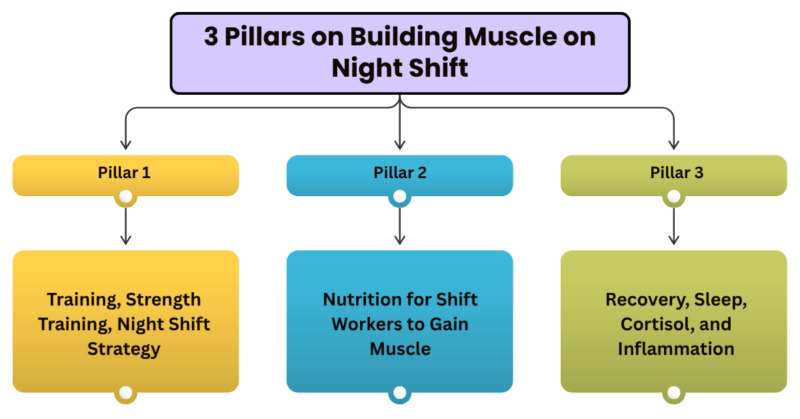
Pillar 1: Training, Strength Training, Night Shift Strategy
Best time to train: before shift vs. after shift vs. days off
There’s no universally “best” time; there’s the best time for your specific shift and energy levels.
- Before your shift: Many night shift workers find this the sweet spot. You’re relatively rested, you can eat and shower afterwards, and training doesn’t interfere with sleep.
- After your shift: Doable, but riskier, training raises adrenaline and core temperature, which can delay sleep if you go straight from the gym to bed. If this is your only option, leave 60-90 minutes between training and sleep, and lean toward a lighter session.
- Days off: Use them for heavier or longer sessions when you’re not fighting fatigue from a shift, but don’t rely on days off alone; consistency across the week matters more than a couple of “perfect” sessions.

Workout plan for night shift workers: 3-day split that fits your schedule
A 3-day full-body split is one of the most realistic workout plans for night shift workers, because it’s flexible enough to move around a rotating schedule without losing training frequency.
- Day 1—Full Body A: Squat or leg press, bench press, bent-over row, overhead press, plank
- Day 2—Full Body B: Deadlift or hip hinge variation, pull-ups or lat pulldown, incline press, walking lunges, core work
- Day 3 — Full Body C: Front squat or goblet squat, dumbbell row, push press, Romanian deadlift, carries
Three sessions a week, spaced out however your shift pattern allows, hits every major muscle group twice and leaves room for recovery.
Progressive overload and avoiding burnout
Progressive overload, gradually increasing weight, reps, or sets over time, is still the engine behind muscle growth on night shift, exactly like anywhere else. Track your lifts so you know you’re actually progressing.
But because you’re already carrying extra recovery stress from disrupted sleep, be more conservative than a well-rested lifter would be: smaller weekly jumps, and don’t be afraid to hold steady or deload during a rough stretch of shifts instead of pushing through.
Micro-workouts during the shift to stay active
If your job allows it, short micro-workouts during breaks—bodyweight squats, resistance band work, and a brisk walk—help offset long stretches of standing or sitting that come with shift work and keep blood flowing without adding meaningful fatigue on top of your main training days.
Pillar 2: Nutrition—Nutrition for Shift Workers to Gain Muscle
Protein timing: How much and when to eat for muscle gain on the night shift
Look for 1.6–2.2 grams of protein per kilogram of body weight per day, spread across three to four meals, during your active hours.
Protein timing matters here specifically because your “day” doesn’t match daylight; space protein intake across your entire shift and the hours before sleep, rather than loading it all into one meal.
Meal timing for shift work to support metabolism and energy
Structure meals around your shift, not the clock on the wall: a solid meal before you start, one or two during, and a lighter, protein-focused meal after you finish, before sleep.
Consistent meal timing for shift work helps stabilize metabolism and energy levels, and it prevents the skip-then-binge pattern that hurts both training performance and recovery.
Calories and macros for building muscle on the night shift
To gain muscle, you generally need a modest calorie surplus, often 200-400 calories above maintenance, combined with adequate protein (as above), moderate fats, and carbs to fuel training and daily energy.
The exact numbers vary person to person, but the principle doesn’t change just because you work nights: consistent surplus plus consistent training equals muscle gain over time.
Best foods for night shift muscle building: lean protein, carbs, and fats
Build meals around lean proteins (chicken, fish, eggs, Greek yogurt, cottage cheese), complex carbs (oats, rice, and potatoes), and healthy fats (nuts, olive oil, and avocado).
Supplements: creatine, protein, vitamin D, omega-3s
- Creatine: supports strength and muscle growth regardless of your schedule.
- Protein powder: an easy way to hit protein targets when cooking isn’t realistic during a shift.
- Vitamin D: worth monitoring for night shift workers specifically, since reduced daylight exposure can lower levels.
- Omega-3s (fish oil): support recovery and help manage inflammation, which tends to run higher with disrupted sleep.
Pillar 3: Recovery, Sleep, Cortisol, and Inflammation
Sleep and recovery: How to get quality sleep after lifting
Sleep and recovery are where most night shift muscle-building efforts quietly fall apart. Aim for 7-9 hours, protected as non-negotiable.
Blackout curtains, a cool room (18-20°C / 65-68°F), and a consistent sleep window, even on days off, do more for muscle growth than almost any other single habit on this list.
Cortisol management to protect testosterone and shift work hormones
Cortisol management matters because chronically high cortisol works against muscle growth and can interfere with testosterone and broader work-hormone balance. Limit excess caffeine, build short wind-down rituals before sleep, and don’t stack hard training on top of already-poor sleep; that combination drives cortisol up the most.
Active recovery, stretching, and inflammation reduction
On rest days, light active recovery, walking, mobility work, and stretching keep blood flow moving without adding fatigue and can help manage the inflammation that tends to run higher with irregular sleep. It doesn’t replace training, but it supports the recovery side of the equation.
Hydration and electrolytes for workout recovery
Dehydration is easy to overlook on night shifts, especially with heavy caffeine use. Proper hydration and, on hard training or hot-environment shifts, electrolytes support workout recovery, energy levels, and even sleep quality.
Sample Plan: 7-Day Guide to Build Muscle on Night Shift
Training days: strength training night shift schedule
- Mon: Full Body A (before shift)
- Tue: Rest / micro-workouts
- Wed: Full Body B (before shift)
- Thu: Rest / micro-workouts
- Fri: Full Body C (before shift)
- Sat-Sun (days off): Optional light session or full rest, depending on how recovered you feel
Rest days: recovery and mobility focus
On rest days, prioritize sleep, hydration, a short walk or stretching session, and hitting your protein target. Recovery days are still muscle-building days; they just don’t involve a barbell.
Sample overnight shift meal plan for muscle gain.
- Pre-shift: Oats, whey protein, peanut butter
- First break: Chicken, rice, vegetables
- Mid-shift: Greek yogurt or a protein shake
- Second break: Eggs and toast, or beans and lentils
- Post-shift, pre-sleep: Cottage cheese or salmon
Night shift muscle-building checklist
- Protein hit across 3-4 meals.
- Training session done, or active recovery on rest days.
- 7-9 hours of protected sleep
- Blackout curtains/mask used
- Caffeine cut off 8-10 hours before sleep.
- Hydration on track
Common Mistakes That Stop You From Building Muscle on Night Shift
Training too hard and skipping sleep and recovery
Pushing hard in the gym while cutting sleep is one of the fastest ways to stall progress or get injured; recovery isn’t optional—it’s part of the muscle-building process.
Poor protein timing and relying on junk food
Chaotic schedules make junk food the easy default. Without deliberate protein timing, you can easily fall well short of your target even while “eating all shift long.”
Inconsistent meal timing and messing up circadian rhythm and muscle growth
Eating at wildly different times every shift keeps disrupting the circadian rhythm and muscle-growth connection discussed earlier; consistency, even an imperfect one, beats a constantly shifting schedule.
Using too much caffeine and alcohol
Both interfere with sleep quality, and alcohol specifically can blunt muscle protein synthesis and disrupt hormone balance, a rough combination on top of an already-disrupted schedule.
Gear and Tools That Help With Muscle Gain Night Shift
Gym setup at home for odd hours
A basic home setup (adjustable dumbbells, a bench, and resistance bands) removes the problem of gym hours not matching your schedule and makes it far easier to stay consistent with training.
Meal prep containers and coolers for nutrition for shift workers
Good meal prep containers and an insulated cooler bag make it realistic to bring several meals to a shift instead of relying on what’s available at 2 AM.
Apps for tracking workouts, sleep, and protein timing
A simple workout tracker, a sleep tracker, and a food-logging app give you visibility into the three pillars—training, sleep, and protein timing—so you manage them with data instead of guesswork.
Build Muscle on Night Shift for Different Goals
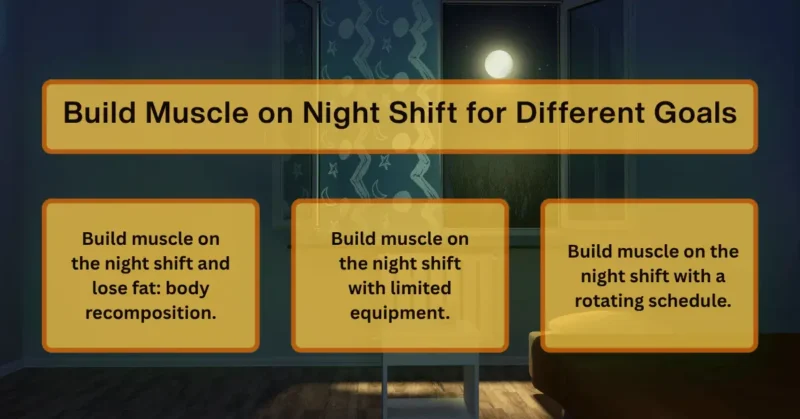
Build muscle on the night shift and lose fat: body recomposition.
With a moderate calorie deficit or maintenance intake, a high-protein diet, and regular strength training, you can achieve body recomposition (growing muscle while losing fat) on the night shift. It is slower than a dedicated bulk, but it is extremely attainable with the same method mentioned above.
Build muscle on the night shift with limited equipment.
With just dumbbells or bands, you can still apply progressive overload through added reps, slower tempo, and reduced rest between sets; equipment limitations affect exercise selection, not whether muscle growth is possible.
Build muscle on the night shift with a rotating schedule.
Rotating schedules make consistency harder but not impossible; anchor your training days to your actual shift pattern each week rather than a fixed calendar day, and prioritize protecting sleep length over sleep timing when the rotation shifts.
FAQ on How to Build Muscle Fast
Q. Can you really build muscle while working night shifts?
Yes. Muscle growth depends on training stimulus, protein intake, and recovery, not on what time of day those things happen. Night shift workers who keep a consistent sleep and training schedule can build muscle at a comparable rate to day workers.
Q. What’s the best time to work out on the night shift?
Whatever time you can repeat consistently, before your shift, during a break, or shortly after, with at least 60–90 minutes before sleep. Consistency matters more than the specific hour.
Q. Does working nights lower testosterone?
Circadian disruption can affect hormone rhythms, and poor sleep can lower testosterone over time. Prioritizing consistent, high-quality sleep is the most effective way to protect hormonal health on a night shift schedule.
Q. How much protein do night shift workers need to build muscle?
Generally, 1.6–2.2 grams per kilogram of bodyweight per day, spread across 3–4 meals to match your active hours.
Q. Will night shift lower testosterone and hurt muscle growth?
Circadian disruption and poor sleep can lower testosterone over time, and shift work can affect it. Prioritizing consistent, quality sleep is the most effective way to protect hormone levels while working nights.
Q. Should I eat before or after my workout on the night shift?
Both matter. A protein-focused meal a few hours after training promotes recuperation and muscle protein synthesis, whereas a balanced meal with protein and carbohydrates one to two hours before training powers the workout.
Q. How many hours of sleep do I need to build muscle on the night shift?
Aim for 7-9 hours of protected sleep, ideally at a consistent time even on days off. Sleep quality (uninterrupted, in a dark, cool room) matters just as much as total hours.
Conclusion on How to Build Muscle Fast on the Night Shift
Building muscle on the night shift isn’t about finding some secret workaround. It’s about running the same three pillars everyone else relies on (training, nutrition, and recovery), just built around a schedule that fights you at every turn instead of cooperating.
Anchor your sleep first, train consistently even if it’s not at the “perfect” time, keep protein and meal timing dialled in across your shift, and manage cortisol like it’s part of your program, not an afterthought.
Do that, and night shift stops being the excuse; it becomes just another schedule you’ve built real muscle on.
Ready to stop letting your schedule call the shots? Pick your 3-day split, lock in your sleep window, and start tonight. Your first shift back is the perfect time to begin.
Read more about night shift workers’ health.