Learn post-shift workout tips. Get simple tips on timing, intensity, and recovery that support better rest for shift workers.
Working nights already messes with your body clock. Add the wrong workout at the wrong time, and your sleep pays for it twice. Here is how to train smart after a night shift and still get real rest.
So, a hard workout right after a night shift can wreck your sleep. The right workout, done the right way, can actually help you sleep better. The difference comes down to timing, intensity, and a short wind-down routine. This guide walks through exactly how to train after a night shift without losing the sleep your body needs to recover.
Why Post-Shift Workout Tips Matter for Sleep
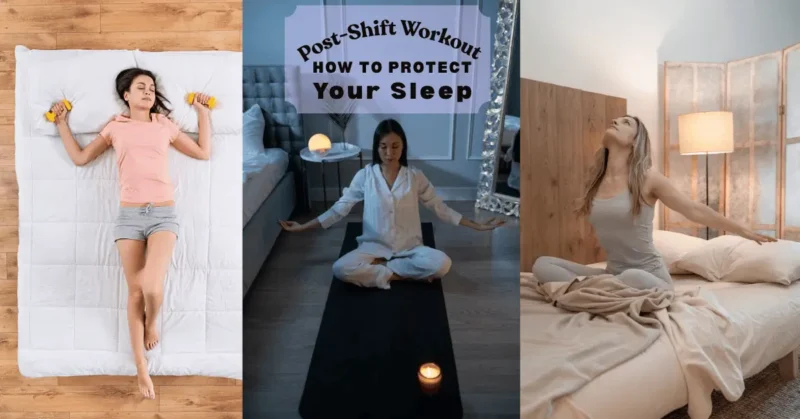
Night shift work already puts your body clock out of sync with daylight. Exercise adds another strong signal to that system. Get the timing wrong, and your body stays alert when it should be winding down. Get it right, and exercise becomes one more tool that supports better sleep instead of blocking it.
Many shift workers skip exercise entirely out of fear it will hurt their sleep. This is often an overcorrection. The goal is not to avoid movement. The goal is to match the type and timing of movement to the demands of an unusual schedule.
How Workout After Night Shift Can Hurt or Help Sleep
A workout after a night shift affects sleep in two directions. Light to moderate movement lowers stress and tires the body in a way that supports rest. Intense training does the opposite.
It raises heart rate, body temperature, and stress hormones right when your body needs those levels to drop. Most exercise-related sleep problems come from mismatched timing or intensity, not exercise itself.
Circadian Rhythm and Exercise: The Timing Problem
Your body uses your circadian rhythm as an internal clock to decide when you should be awake and when you should be sleepy. It runs on light exposure and daily habits, not on the actual time on a clock.
Night shift work forces this rhythm into an unnatural pattern. Exercise sends a strong wake signal to this clock. Used at the right time in your day, it can help train your body into a workable night-shift rhythm. Used too close to sleep, it fights against the rest you are trying to get.
Cortisol and Sleep: Why Intense Exercise Before Bed Backfires
Hard training raises cortisol, the hormone your body releases under physical or mental stress.
Cortisol needs to fall before sleep can start smoothly. A heavy session close to bedtime keeps cortisol elevated for an hour or longer. This is the main reason people report lying awake after an intense post-shift workout, even when they feel physically tired.
Cortisol naturally follows its own daily pattern. It should be highest early in your wake window and lowest before sleep. Night shift work already disturbs this pattern, since your wake window sits at the wrong part of the 24-hour clock.
Adding a hard workout on top of this disturbed pattern gives your body one more reason to stay alert instead of resting.
Does Shift Type Change the Rules
Not every night shift worker has the same schedule, so the rules shift slightly depending on your pattern.
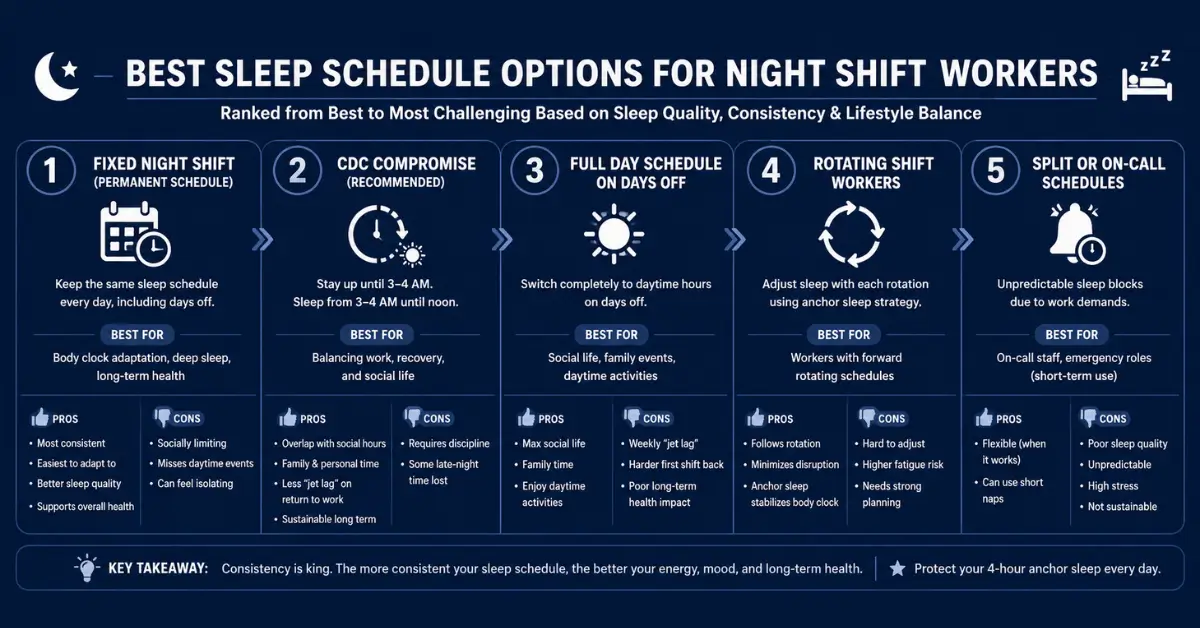
- Fixed night shift: your body eventually adapts to a consistent rhythm. Once adapted, keep your workout and wind-down times the same every day.
- Rotating shift: your body never fully adapts. Favor lower-intensity workouts overall, since your circadian rhythm is under constant stress from changing schedules.
If your schedule changes often, prioritize consistent wind-down habits over a fixed workout time. Consistency in your wind-down routine matters more than the exact time on the clock.
Split shifts and on-call schedules add another layer of difficulty. If you cannot predict your next sleep window, keep every workout on the lighter end of the scale. Save higher effort sessions for days when your schedule is confirmed well in advance.
The 3 Rules to Protect Sleep After Workout
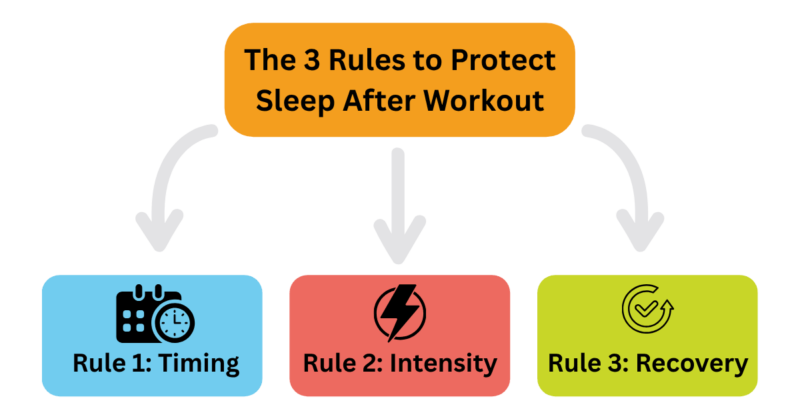
These three rules apply to almost every situation covered in this guide.
Rule 1: Timing
Best time to exercise on a night shift: right after your shift ends, not right before you plan to sleep. Finish your workout at least 60-90 minutes before bed to allow your body to relax.
Rule 2: Intensity
Keep effort low to moderate in the hours before sleep. Save harder training sessions for early in your wake window, or for a day off when you are not trying to sleep soon after.
Rule 3: Recovery
A short wind-down routine brings your heart rate recovery back toward a resting level before you try to sleep. Skipping this step is one of the most common reasons a good workout still leads to a poor night of sleep.

Post-Shift Workout Tips for Better Sleep
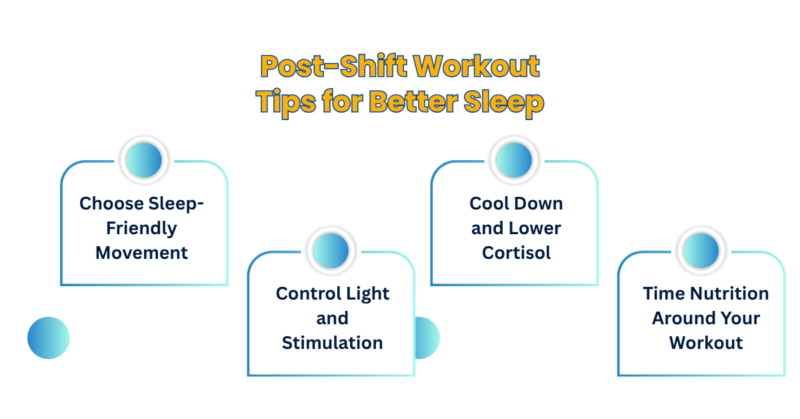
Tip 1: Choose Sleep-Friendly Movement
Walking, stretching, and yoga support muscle recovery without overstimulating your nervous system. These are strong default choices in the hour after a shift ends.
- Walk for 15 to 20 minutes at an easy, conversational pace.
- Do a full-body stretch routine covering major muscle groups.
- Try a slow yoga flow paired with steady breathing.
- Use a foam roller on tight areas like the lower back and calves.
Avoid HIIT and heavy lifting right before bed. Both raise core body temperature and heart rate for too long. Your body needs a drop in temperature to start the sleep process, and intense training delays that drop.
If you enjoy strength training and don’t want to give it up, move those sessions earlier in the day instead of right before sleep. A morning or midday strength session, taken before your final wind-down period, does not carry the same sleep cost as one done in the final hour before bed.
Tip 2: Control Light and Stimulation
Dim lighting protects your natural melatonin release. Blue light and sleep work against each other. Screens, bright gym lighting, and loud music all send alertness signals that delay your body’s shift into sleep mode.
- Dim household lights as soon as you get home
- Avoid screens during your cool-down period.
- Choose calm music over upbeat playlists during your workout.
Tip 3: Cool Down and Lower Cortisol
A five-minute breathing and stretching block speeds up heart rate recovery and helps lower cortisol. Slow nasal breathing is one of the fastest ways to signal your nervous system to relax.
- Sit or lie down somewhere quiet.
- Breathe in for 4 counts, then out for 6 counts.
- Repeat for 5 minutes, then stretch your major muscle groups.
Follow this with a warm shower. Strong sleep hygiene for shift workers depends on a consistent post-exercise routine, not just the workout itself.
Tip 4: Time Nutrition Around Your Workout
Your post-workout meal should support recovery without spiking your energy right before sleep.
- Lean protein paired with vegetables
- A moderate portion of complex carbohydrates
- Steady water intake through your wind-down period
Good hydration and simple whole foods also help manage inflammation, which supports your body through the ongoing demands of shift work.
A simple example works well here. A small serving of grilled chicken or eggs with steamed vegetables gives your body protein for repair without the heaviness of a large meal.
Avoid fried foods and large portions close to bedtime, since digestion competes with your body’s ability to settle into deep sleep.
Workout After Night Shift: What to Do vs. What to Avoid
Use this quick reference before training after a shift.
| Factor | Sleep-Friendly Choice | Sleep-Disrupting Choice |
| Intensity | Low to moderate | High intensity or HIIT |
| Timing | Right after the shift ends | Right before bedtime |
| Light | Dim and calm | Bright or blue light |
| Fuel | Water and whole food | Caffeine or pre-workout |

The Best Post-Shift Workout Plans Based on Your Goal
For Sleep: Gentle Yoga and Mobility Flow
A slow 15-minute yoga flow paired with deep breathing works well when sleep is the main priority.
For Energy: 15-Minute Bodyweight Circuit
Place this earlier in your wind-down window, not right before bed. Squats, push-ups, and light core work keep effort at a moderate level.
For Muscle Recovery: Light Strength Plus Stretching
Pair light resistance work with a full stretch session and a protein-rich meal to support overnight muscle repair.
Typical Errors That Affect Sleep After Exercise
- Working out too close to bedtime. This keeps cortisol and heart rate elevated right when your body needs both to drop.
- Skipping the cool-down. Going straight from a workout to bed leaves your nervous system on alert.
- Using caffeine or pre-workout to push through fatigue. Stimulants stay active in your system for hours and can delay sleep onset well past your workout.
- Training in a bright, high-energy gym environment. Loud music and bright overhead lighting work against the wind-down signal your body needs after a shift.
- Ignoring hydration. Even mild dehydration can raise your resting heart rate, making it harder for your body to settle into a restful state.
7-Day Post-Shift Workout Plan to Protect Sleep
Days 1 to 3 After Consecutive Night Shifts: Recovery Focus
Stick to walking and stretching only during this stretch. Your body needs extra recovery time after several shifts in a row, and lighter movement supports that without adding stress.
Days 4 to 7: Build Consistency Without Hurting Sleep
Add light resistance training two to three times this week. Keep every session in the low-to-moderate range, and stick to the same wind-down routine each day.
How to Track Sleep Quality and Adjust Intensity
Rate your sleep each morning on a simple 1-to-5 scale. If your score drops for two mornings in a row, lower your workout intensity and move your session earlier in your wind-down window.
A basic notebook or phone note works fine. Write down your workout type, the time you finished, and your sleep score the next morning. After two weeks, patterns usually become clear.
Most people find one specific habit, often training too close to bedtime, is behind most of their poor sleep mornings.
When to Talk to a Doctor
Most shift workers can manage sleep through timing and routine changes alone. A few situations call for professional guidance instead of self-adjustment.
- You are new to night shift work, and sleep has not improved after several weeks.
- You have been diagnosed with a sleep problem, such as sleep apnea or insomnia.
- You have a heart condition or other health issue that affects safe exercise intensity.
A doctor or sleep specialist can help tailor these general guidelines to your specific health situation.
FAQ: Protect Sleep After Workout on Night Shift
Q. How to sleep better after working a night shift?
When you get home, start a wind-down routine instead of eating a big meal or scrolling your phone. Wear sunglasses on your drive or walk home to limit morning light hitting your eyes.
Keep your bedroom fully dark with blackout curtains and cool, around 65 degrees Fahrenheit. A consistent pre-sleep routine matters more than any single trick.
Q. How to sleep better after working out?
Finish exercise at least 60 to 90 minutes before bed so your heart rate and body temperature have time to drop.
Add a short cool-down with slow breathing instead of stopping abruptly. Keep post-workout meals light and low in caffeine. A warm shower after training also helps signal your body that rest is coming next.
Q. How to improve sleep quality after the night shift?
Protect a full uninterrupted sleep block by turning off phone notifications and asking household members to stay quiet during your sleep hours.
Use blackout curtains or a sleep mask to block daylight completely. Keep your sleep and wake times consistent, even on days off. Avoid caffeine within six hours of your planned bedtime.
Q. How to survive 3 night shifts in a row?
Prioritize a consistent sleep schedule across all three days, rather than sleeping at different times each day. Keep meals light and hydration steady through each shift to avoid energy crashes.
Save any hard workouts for after the stretch ends, not during it. Rest and recovery matter more than pushing extra activity during back-to-back shifts.
Q. Is 4 hours of sleep enough after a night shift?
No, four hours is generally not enough for most adults, even after a night shift. Most people need seven to nine hours of quality sleep to recover physically and mentally fully.
Short sleep like this can add up to a sleep debt over several shifts. If four hours becomes a regular pattern, review your sleep environment and schedule.
Q. Is 10 pm to 6 am a good shift?
This shift is generally easier to adapt to than rotating or split schedules because it stays consistent. It also aligns more closely with natural nighttime hours than shifts that start later.
Whether it works well still depends on your individual sleep needs and home environment. Consistency in your sleep and wake times matters more than the specific hours chosen.
Q. Does the night shift age you faster?
Research has linked long-term night shift work to higher stress hormone levels and disrupted sleep patterns over time.
These effects can contribute to visible signs of fatigue and slower recovery, though this is not the same as accelerated biological aging in a strict sense.
Good sleep hygiene, nutrition, and stress management can reduce much of this impact. Regular health checkups are a good idea for long-term shift workers.
Take the Next Step
Pick one rule from this guide and apply it after your next shift. Track your sleep for three nights and adjust from there. Small, consistent changes protect your sleep far better than a perfect routine you cannot keep up with.
Read more about night shift workers’ health.