

To manage shift work sleep disorder naturally, adjust your light exposure by wearing dark sunglasses on your commute home, blocking all sunlight with heavy curtains for daytime rest, keeping a strict sleep schedule even on days off, and timing caffeine strategically alongside short naps.
Struggling with shift work sleep disorder? Discover natural, effective ways to reset your sleep cycle, boost energy, and reclaim restful nights—without medication.
Shift Work Sleep Disorder (SWSD) affects millions of individuals working non-traditional hours. It may have serious effects on both physical and mental health. We present a comprehensive, evidence-based guide to managing SWSD naturally, without dependence on medication. This guide will benefit healthcare professionals, night shift workers, and rotating shift employees.
What Is Shift Work Sleep Disorder?
Shift Work Sleep Disorder (SWSD) is a clinical circadian rhythm sleep disorder characterized by significant insomnia, excessive sleepiness, or both, directly linked to a work schedule that overlaps with the normal sleep period.
This condition occurs when a person’s work hours are mismatched with their body’s natural biological clock. It is not simply “feeling tired” after a long shift. Instead, it is a persistent inability to sleep soundly during the day, combined with an overwhelming, uncontrollable drive to sleep during work hours.
To meet the diagnostic criteria for SWSD, these symptoms must cause significant distress or impair essential areas of your daily functioning, such as your performance at work, your mood, or your safety while driving—and must typically persist for at least three months.

Why Night Work Can Disrupt Sleep
To understand why shift work causes such profound sleep disturbances, it helps to understand how your brain tracks time.
The Circadian Clock
Inside your brain sits a master clock called the suprachiasmatic nucleus (SCN). This internal clock regulates your circadian rhythm, the natural 24-hour cycle that controls sleepiness, wakefulness, hormone release, and body temperature.
The SCN is extremely light-sensitive. Melatonin, a hormone that encourages sleep, is suppressed when light enters your eyes because it tells your brain that it is daytime.
Working When the Body Expects Sleep
When you work a night shift, you must stay awake and alert while your circadian clock signals your body to wind down, lower its core temperature, and release melatonin. You are essentially fighting against millions of years of human evolutionary biology.
Sleeping When the Body Expects Wakefulness
Conversely, when you try to sleep during the day, your environment tells your brain to do the opposite. Sunlight, morning temperatures, and daytime noise signal your biological clock to stay alert.
Even if you are able to fall asleep, you typically miss out on the deep, healing stages of slow-wave and REM sleep because your sleep architecture is fragmented.
Common Symptoms of Shift Work Sleep Disorder
SWSD symptoms can vary from person to person, but they consistently center on a mismatch between your schedule and your biological needs. Common experiences include:
- Excessive sleepiness: An overwhelming urge to sleep while on shift, during commutes, or during times when you need to be awake.
- Difficulty falling asleep (insomnia): Lying awake for hours in bed during your designated daytime sleep window, despite feeling physically exhausted.
- Difficulty staying asleep: Waking up after only three or four hours of sleep and being unable to fall back asleep.
- Poor concentration and brain fog: Finding it difficult to focus on tasks, remember details, or make decisions.
- Irritability and mood changes: Experiencing heightened anxiety, low mood, or a short temper due to chronic sleep loss.
- Reduced alertness: Slower reaction times, which can compromise safety.
- Chronic fatigue: A deep, persistent lack of physical energy that does not go away after a single sleep session.
Note: Experiencing these symptoms does not automatically prove that you have shift work sleep disorder. Only a licensed medical practitioner can assess your full health profile and make an appropriate diagnosis.
How Is Shift Work Sleep Disorder Diagnosed?
Diagnosing shift work sleep disorder requires a careful, comprehensive medical evaluation. A single blood test or scan cannot diagnose the illness.
If you suspect you have SWSD, a healthcare professional or sleep specialist will typically evaluate several factors:
- Your Work Schedule: The exact timing, consistency, and rotation of your shifts.
- Sleep-Wake Patterns: When you sleep, how long you sleep, and your overall sleep quality on both workdays and days off.
- Symptom History: The specific nature of your insomnia and daytime sleepiness and how long you have experienced them.
- Detailed Sleep History: Information about your sleep habits, caffeine consumption, alcohol use, and lifestyle.
- Sleep Diaries: You may be asked to keep a detailed log of your sleep and wake times for two to four weeks.
- Actigraphy: In some cases, a doctor may ask you to wear a wrist device that tracks your movement to monitor your sleep patterns objectively over several weeks.
What Can a Healthcare Professional Evaluate?
Consulting a professional is vital because many SWSD symptoms overlap with other medical and sleep conditions. A doctor will work to rule out or identify other underlying issues, such as
- Insufficient Sleep: Simply not allocating enough time in bed to get adequate rest.
- Sleep Apnea: A common disorder where breathing repeatedly stops and starts during sleep, leading to severe daytime fatigue.
- Primary Insomnia: Chronic difficulty sleeping that is unrelated to your work schedule.
- Medication Side Effects: Certain medications can cause daytime drowsiness or disrupt nighttime sleep.
- Mental and Physical Health Factors: Conditions like depression, thyroid disorders, or chronic pain can mimic or worsen sleep problems.
- Other Circadian Rhythm Disorders: For example, delayed sleep phase syndrome.
Natural Ways to Manage SWSD
Naturally, managing shift work sleep disorder (SWSD) requires a multifaceted strategy that addresses your surroundings, diet, lifestyle choices, and internal clock. Natural methods, rather than pharmacological ones, aim to safely and sustainably restore the body’s circadian rhythm.
The following methods are comprehensive and useful and have been shown to enhance alertness, improve sleep quality, and support the overall well-being of shift workers.
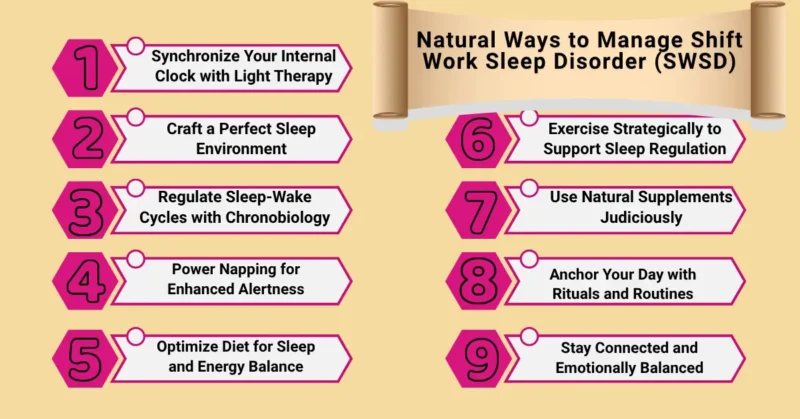
1. Synchronize Your Internal Clock with Light Therapy
Light is the most potent environmental cue affecting our circadian rhythm. Controlled light exposure at the right times can reset your body’s internal clock.
- Before your shift: Use a 10,000 lux light box for 20–30 minutes to reduce melatonin and increase alertness. It works best when used 1–2 hours before starting a night shift.
- During your shift, keep your workspace well-lit with bright, white, or blue-enhanced lighting to stay focused and alert.
- After your shift, wear amber or blue-light-blocking glasses when leaving work in daylight. It helps your body recognize when it’s time to relax and prepare for sleep.
Consistent light management helps your brain adapt more smoothly to unconventional sleep schedules.
2. Craft a Perfect Sleep Environment
Environmental factors significantly affect sleep depth and continuity. Creating an optimal sleep sanctuary is essential.
- Use blackout curtains or a sleep mask to block sunlight and boost melatonin production.
- Keep your room a chilly 60–67°F (15–19°C) to simulate nighttime and signal to your body that it’s time to sleep.
- Eliminate noise pollution using white noise machines, earplugs, or calming nature sounds.
- Keep electronics out of the bedroom to prevent electromagnetic stimulation and distractions.
The goal is to create a nighttime setting, no matter what time you go to bed.
3. Regulate Sleep-Wake Cycles with Chronobiology
Chronotherapy is a natural technique that gradually adjusts your sleep schedule to align with your work hours. By adjusting sleep and wake times in 15–30-minute increments over several days, you can realign your circadian rhythm with your shift pattern. This approach works best for rotating or transitioning schedules.
- Even on days off, maintain regular sleep and wake hours.
- Incorporate morning or evening rituals to signal to the brain that it’s time to sleep or stay awake (e.g., tea, a warm bath, or breathing exercises).
4. Power Napping for Enhanced Alertness
Strategic napping is a scientifically supported way to combat fatigue and restore alertness during or before shifts.
- Pre-shift nap (90 minutes or 20 minutes): Increases alertness and performance.
- Mid-shift nap (if allowed): A short 15–20 minute nap during breaks can boost memory and reduce reaction time.
- Avoid napping close to bedtime, as it may delay your sleep onset.
Power naps are more effective when combined with caffeine immediately before napping (the “caffeine nap”), which enhances wakefulness after the nap.

5. Optimize Diet for Sleep and Energy Balance
What and when you eat influences your ability to stay awake or fall asleep.
- Before your shift: Eat a balanced meal with lean proteins, healthy fats, and complex carbs.
- During your shift: Choose light, frequent meals or snacks (e.g., yogurt, almonds, boiled eggs) to avoid energy crashes.
- After your shift, avoid heavy or sugary foods and opt for foods that boost melatonin, such as cherries, bananas, or oats.
Hydration is crucial—dehydration increases fatigue. However, reduce your fluid intake close to bedtime to prevent waking up during the night.
6. Exercise Strategically to Support Sleep Regulation
Physical activity can naturally reset your body clock and improve sleep quality if done at the right time.
- The best times for exercise are before your shift or early in the morning.
- Avoid heavy workouts within 2–3 hours of bedtime, as they can delay sleep.
- Include stretching or light yoga in your wind-down routine to promote relaxation and ease muscle tension.
Regular movement also combats the sedentary nature of many shift jobs, reducing the risk of obesity and metabolic issues.
7. Use Natural Supplements Judiciously
Certain natural supplements can help ease the transition into sleep without the risks of habit-forming.
- Melatonin (0.5–3 mg): Helps initiate sleep when taken 30–60 minutes before bedtime.
- Valerian root: It shortens the time it takes to fall asleep and soothes the nervous system.
- Magnesium: Supports deep sleep by regulating neurotransmitters.
- L-theanine is present in green tea and helps people relax without causing drowsiness.
- Glycine: An amino acid that improves sleep latency and sleep quality at doses of 3 grams before bed.
Always start with the lowest effective dose and avoid mixing supplements without consulting a healthcare professional.
8. Anchor Your Day with Rituals and Routines
Routines create a psychological signal that your body is preparing for certain activities, especially sleep.
- Before sleep, create a calming ritual, such as sipping herbal tea, reading, practicing deep breathing, or meditating.
- After waking: Use bright light, move your body, and eat a light, energizing meal.
- Anchor sleep schedule: Maintain at least 4 core hours of consistent sleep time daily (e.g., 3 a.m.–7 a.m.), even on days off.
A consistent routine promotes predictability, reducing anxiety and improving sleep efficiency.
9. Stay Connected and Emotionally Balanced
Social isolation is common among shift workers and can exacerbate symptoms of shift work sleep disorder (SWSD).
- Schedule regular time with family or friends during your most alert hours.
- Join online communities or forums for shift workers to share strategies and support.
- Consider talking to a sleep specialist or therapist if emotional distress or chronic insomnia continues.
Strong social support plays a key role in long-term adaptation and emotional resilience.
Lifestyle Adjustments That Support Better Sleep

- Limit screen time before bed.
- Avoid alcohol as a sleep aid—it disrupts REM cycles.
- Track your sleep quality and quantity by keeping a sleep journal.
Social and Psychological Support
Isolation is common in shift workers. Foster social connections:
- Join shift worker support groups.
- Schedule “anchor sleep” overlapping with family time.
- Seek counseling if your mood or motivation suffers.
Recommended Natural Sleep Hygiene Routine
- Pre-shift (1–2 hours before work)
- Light exposure
- Short walk or exercise
- High-protein meal
- During shift
- Hydration
- Bright, blue-enriched lighting
- Caffeine (early in shift only)
- Post-shift
- Blue-light blocking glasses
- Light breakfast
- Wind-down routine (shower, stretch)
- Sleep period
- Cool, dark room
- No electronic devices
- An optional melatonin supplement
Prevention: How Employers Can Help
Organizations can:
- Rotate shifts clockwise (morning → evening → night)
- Limit consecutive night shifts
- Provide nap areas and educate workers on sleep hygiene
- Encourage regular medical check-ups for shift workers
FAQs on Managing SWSD Naturally
Q. What are the common sleep problems experienced by night shift workers?
Night shift workers may have difficulty falling asleep, staying asleep, or getting enough total sleep.
Some experience excessive sleepiness during work, especially in the early morning hours.
Poor concentration, irritability, headaches, and unrefreshing sleep are also common.
These symptoms do not prove shift work sleep disorder and may have other causes.
Q. How to set a sleep schedule after the night shift?
Keep your sleep and wake times as consistent as possible, even on days off.
Sleep in a dark, cool, quiet room and limit bright light on the way home.
Use caffeine only early in the shift, and consider a short planned nap before work.
Change your schedule gradually rather than switching abruptly between night and day sleeping.
Q. Should night shift workers take melatonin?
Melatonin may help some people adjust sleep timing, but it is not suitable for everyone.
Its effectiveness depends partly on when you take it, not simply on taking it at bedtime.
It may interact with medications, worsen certain medical conditions, or make you sleepy.
Ask a healthcare professional before using melatonin regularly or before driving after taking it.
Q. Why can’t I sleep on the night shift?
Your circadian rhythm promotes alertness during the day, making daytime sleep lighter and easier to interrupt.
Sunlight, household noise, caregiving duties, caffeine, and changing shifts can make the problem worse.
Late meals, alcohol, stress, and an uncomfortable bedroom may also interfere with sleep.
A healthcare professional should assess persistent insomnia to check for other sleep disorders.
Q. Does shift work sleep disorder go away?
Symptoms may improve when the work schedule changes or when you better manage sleep timing and light exposure.
Some people continue to struggle, particularly with rotating or frequently changing shifts.
You can’t confirm SWSD from tiredness alone because insufficient sleep and other conditions can cause similar symptoms.
Seek professional advice if sleepiness or insomnia persists, affects functioning, or creates driving or workplace safety risks.
Q. What vitamins are recommended for night shift workers?
No specific vitamin has been proven to prevent or treat shift work sleep disorder.
A balanced diet is usually the best way to obtain nutrients needed for energy and overall health.
Supplements such as vitamin D, iron, or vitamin B12 should generally be used only when a deficiency is confirmed or a clinician recommends them.
Avoid high-dose supplements, because they can cause side effects and may interact with medicines.
Summarized Thoughts
Managing shift work sleep disorder naturally requires realigning your internal clock and optimizing your daily habits. You can manage symptoms with strategic light exposure, a sleep-friendly environment, timed caffeine and meals, and a steady routine. For detailed clinical perspectives, you can read the Sleep Foundation Guide on Shift Work Disorder.
Light and Environment Control
- Block daylight: Wear dark wrap-around sunglasses on your commute home after a night shift to signal your brain that it is time to wind down.
- Darken your bedroom: Install heavy blackout curtains or wear a comfortable eye mask so outside light cannot wake you.
- Drown out noise: Use foam earplugs or turn on a white noise machine to block daytime household or neighborhood sounds.
- Brighten your workspace: Use bright artificial lights while working your night shift to stay alert and mimic daytime.
Sleep and Napping Habits
- Keep a steady schedule: Go to bed and wake up at the same times every single day, even on your days off.
- Take strategic naps: Sleep for 20 minutes for a quick energy boost, or aim for a full 90-minute sleep cycle right before your shift starts to avoid grogginess.
- Keep your room cool: Set your bedroom temperature on the cooler side to help lower your core body temperature for deeper rest.
Diet and Stimulant Timing
Skip alcohol: Do not use alcohol to unwind, as it destroys sleep quality and causes middle-of-the-night awakenings.
Cut off caffeine early: Stop consuming coffee or energy drinks at least 4 to 6 hours before your planned daytime sleep.
Avoid large or greasy meals right before bed: If you are hungry, have a small snack before bed.
Read more about night shift workers’ health.
You might like: