
Personal productivity isn’t about cramming more tasks into your day. It’s about creating genuine value while preserving your mental energy and well-being.
Thank you for reading this post, don't forget to subscribe!Many people confuse being busy with being productive, which can lead to burnout and frustration.
This comprehensive guide will show you how to work smarter, not harder, using proven strategies that transform your approach to daily tasks.
What is Personal Productivity?
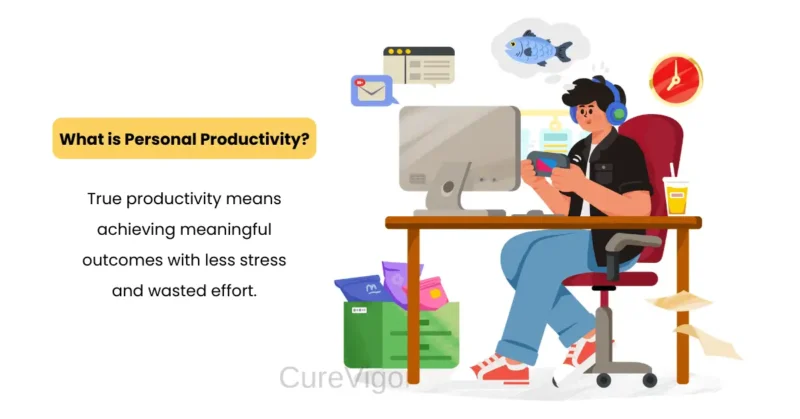
True productivity means achieving meaningful outcomes with less stress and wasted effort. It’s the art of focusing your time and energy on activities that move you closer to your important goals.
Unlike simple efficiency, which focuses on speed, productivity emphasizes results that matter. When you master personal productivity, you create more value in less time while maintaining your quality of life.
Defining Work Efficiency vs. Productivity
Why “doing more” isn’t always the answer. Efficiency measures how quickly you complete tasks, while productivity measures how well those tasks contribute to your goals.
You might efficiently answer 50 emails in an hour, but if only three were truly important, your productivity was low.
This distinction matters because many people exhaust themselves being efficient at the wrong things. Real productivity starts with choosing the right activities before optimizing how you do them.
The modern workplace often rewards visible busyness over meaningful contributions. People fill their calendars with meetings and their days with urgent but unimportant tasks.
This creates an illusion of progress while important projects stagnate. Breaking this cycle requires a fundamental shift in how you evaluate your daily activities.
The Value-First Mindset
How to shift from being busy to achieving meaningful goals.
The value-first mindset asks one critical question before every task: “Will this create meaningful progress toward my important goals?”
This simple filter eliminates countless time-wasting activities that feel productive but deliver little value.
Instead of measuring success by hours worked, you measure it by meaningful outcomes achieved. This mental shift transforms your relationship with work and personal projects.
Starting each day with clarity about your most valuable activities prevents the drift into reactive busyness. You become intentional about where you invest your limited time and energy.
This approach reduces stress because you stop feeling guilty about saying no to less important requests. Your confidence grows as you see consistent progress on projects that truly matter to you.
Prioritize Tasks for Maximum Productivity
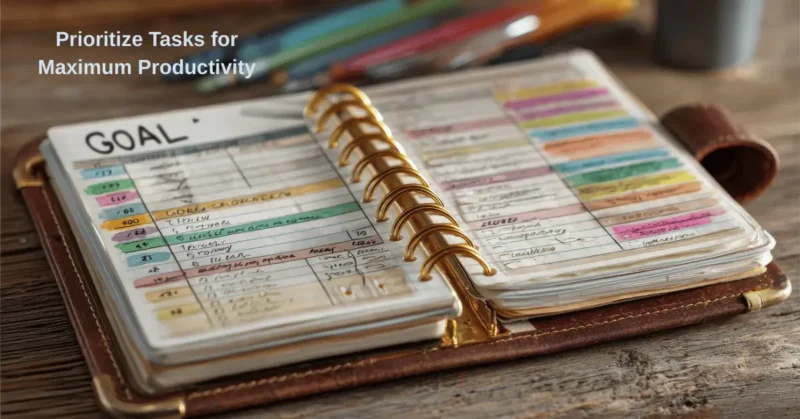
Effective prioritization separates high-performers from busy people who struggle to make real progress. Most people operate under an overwhelming task list with unclear priorities.
Learning to identify and focus on high-impact activities can dramatically improve your results. Smart prioritization means doing fewer things better rather than doing everything poorly.
Identify High-Impact Tasks for Productivity
How to spot the 20% of work that yields 80% of your results.
The Pareto Principle reveals that roughly 20% of your activities generate 80% of your valuable results. Identifying these high-impact tasks requires honest evaluation of your work’s actual outcomes.
Look at your recent accomplishments and trace them back to the specific activities that created them. You’ll likely discover that a small number of focused efforts produced most of your meaningful progress.
High-impact tasks often feel more challenging or uncertain than routine, busy work. They might involve difficult conversations, creative problem-solving, or learning new skills.
These activities require deeper thinking and sustained focus, which explains why people often avoid them. However, consistently tackling high-impact work creates exponential improvements in your professional and personal results.
To spot high-impact tasks, ask yourself which activities would produce the most significant positive change if executed perfectly.
Consider the long-term consequences of different activities rather than their immediate appeal.
Tasks that build systems, strengthen relationships, or develop valuable skills typically offer higher returns than reactive maintenance work.
Use the Eisenhower Matrix for Productivity
A simple framework to sort tasks by urgency and importance.
The Eisenhower Matrix divides all tasks into four categories based on urgency and importance.
Important and urgent tasks require immediate attention, but shouldn’t dominate your schedule. Important but not urgent tasks represent your highest-leverage activities for long-term success.
Urgent but not important tasks should be delegated or eliminated when possible. Neither urgent nor important tasks are simply distractions that waste your valuable time.
This framework helps you escape the tyranny of urgency that keeps many people trapped in reactive mode.
Most people spend too much time on urgent tasks while neglecting important long-term activities. The matrix makes these trade-offs visible, helping you consciously choose where to invest your energy.
Regular use of this tool trains your brain to automatically evaluate tasks through this lens.
Implementing the matrix requires honest assessment of what truly qualifies as important versus what merely feels urgent. Many seemingly urgent tasks lose their urgency when examined closely.
The key is scheduling dedicated time for important but not urgent activities before urgent matters consume your entire day.
The “Eat the Frog” Rule
Why tackling your hardest task first eliminates mental friction
“Eating the frog” means completing your most challenging or important task first thing each day. This strategy leverages your peak mental energy when your willpower and focus are strongest.
Difficult tasks become even harder as the day progresses and decision fatigue accumulates. By tackling them early, you ensure they receive your best thinking and effort.
The psychological benefits of this approach extend beyond task completion. Finishing a challenging task early creates momentum and confidence that carries through your entire day.
You eliminate the mental drag of procrastination and the anxiety of important work hanging over your head.
This positive start often leads to higher overall productivity throughout the rest of your hours.
Mental friction occurs when you repeatedly postpone difficult tasks, creating internal resistance that saps your energy.
Each time you think about the task you avoided, your brain spends mental resources on worry rather than on productive work.
Eliminating this friction through early completion frees your mind to focus fully on subsequent activities without background stress.
Time Management Techniques for Productivity
Effective time management isn’t about squeezing more activities into your day. It’s about creating structure that supports focused work on your most valuable activities.
The best time management techniques help you maintain high energy and sharp focus throughout your working hours.
These methods work together to create a sustainable rhythm that prevents burnout while maximizing your output.
Apply the Pomodoro Technique for Productivity
How to Use Focused Sprints to Maintain High Energy.

The Pomodoro Technique uses 25-minute focused work sessions followed by 5-minute breaks to maintain peak concentration.
This approach works with your brain’s natural attention cycles rather than against them. Short, intense focus periods prevent the mental fatigue that comes from trying to maintain concentration for hours.
Regular breaks provide opportunities to recharge and prevent the gradual decline in performance that longer work sessions can cause.
During each 25-minute sprint, you commit to working on a single task without interruptions.
This means closing email, silencing notifications, and resisting the urge to check other projects. The time constraint creates urgency, helping you stay focused and avoid perfectionism that can slow progress.
Many people discover they accomplish more in these focused sprints than in much longer, unfocused work periods.
The technique also provides natural opportunities to reassess your priorities and adjust your approach.
Each break allows you to step back and evaluate whether you’re working on the right task in the most effective way.
This regular review prevents you from spending hours going down unproductive paths before realizing you need to change course.
Block Time for Important Tasks for Productivity
Transitioning from a reactive to-do list to a proactive schedule
Time blocking involves scheduling specific time blocks for different types of work rather than working from a simple task list.
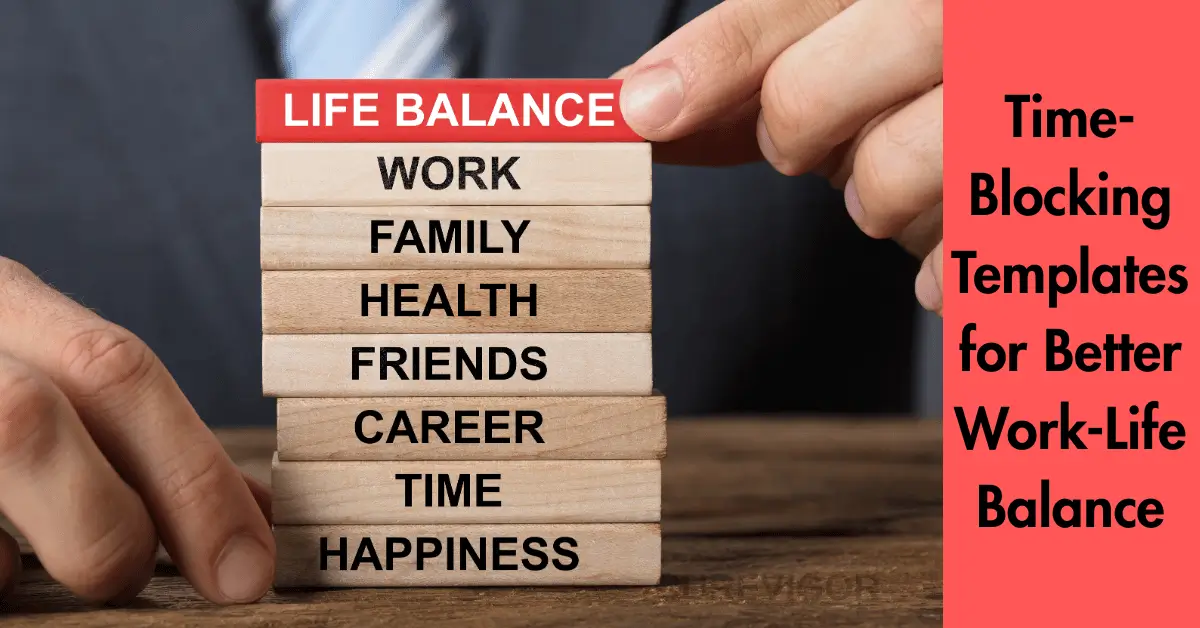
Time-Blocking Templates Download
This proactive approach ensures your most important activities receive dedicated time slots when you’re mentally prepared for them.
Instead of hoping to find time for important work between urgent interruptions, you protect these activities with scheduled boundaries.
Effective time blocking matches different types of tasks with your natural energy patterns throughout the day.
Creative work might be blocked during your morning peak-energy hours, while routine tasks are scheduled during natural low-energy periods.
This strategic scheduling maximizes the quality of work you can produce in each time block rather than treating all hours as equivalent.
The practice also helps you become more realistic about time requirements for different activities. When you must assign specific time blocks to tasks, you’re forced to estimate accurately rather than optimistically.
This improved time awareness helps you make better commitments and reduces the stress of overloaded schedules that were never realistic in the first place.
Limit Multitasking for Productivity
The hidden cost of “task switching” and how to stay in deep work.
Multitasking creates the illusion of efficiency while actually reducing your overall productivity and work quality.
Each time you switch between tasks, your brain requires time to refocus and remember the context of the new activity.
This switching cost accumulates throughout the day, leaving you feeling busy yet accomplishing less than focused single-tasking would.
Research shows that people who multitask take significantly longer to complete their work while making more errors.
Deep work requires sustained attention on cognitively demanding activities without distractions.
This focused state produces your highest quality output and often leads to breakthrough insights that shallow, scattered attention cannot achieve.
Protecting blocks of time for deep work on your most important projects creates disproportionate value compared to reactive task switching.
Creating boundaries around focused work time requires deliberate strategies to minimize interruptions.
This might mean working in a different location, using website blockers, or establishing communication protocols with colleagues about when you’re available for questions.
The investment in protecting focused time pays dividends through dramatically improved work quality and faster task completion.
Boost Focus and Concentration for Productivity

Modern environments assault your attention with constant distractions that fragment your focus and reduce work quality.
Developing strong concentration skills becomes a competitive advantage in a world where most people struggle to maintain attention for extended periods.
These strategies help you achieve mental clarity, enabling sustained focus on important work.
Eliminate Distractions for Productivity
Practical ways to curate a workspace that triggers “Flow.”

Your physical and digital environment significantly influences your ability to maintain focus and enter flow states.
Flow occurs when you become fully immersed in challenging work that matches your skill level.
Environmental distractions break this immersive state, forcing you to restart the focus-building process repeatedly.
Curating your workspace to minimize distractions creates conditions that support sustained high-performance work.
Digital distractions pose the greatest threat to modern focus because they’re designed to capture and hold your attention.
Social media notifications, email alerts, and news updates create a constant stream of interruptions that prevent deep thinking.
Taking control of these digital intrusions through notification management, app blocking, and designated offline periods protects your mental space for important work.
Physical workspace design also affects your ability to concentrate effectively. Clutter creates visual distractions that occupy mental processing power even when you’re not consciously aware of them.
A clean, organized workspace with minimal visual noise helps your brain allocate more resources to your actual work.
The investment in creating an optimal environment pays returns through improved focus, quality, and duration.
Use Mindfulness for Productivity
How staying present reduces anxiety and sharpens your professional focus.

Mindfulness means maintaining awareness of your current experience without being overwhelmed by it.
In productivity contexts, mindfulness helps you notice when your attention drifts and gently redirect it to your chosen task.
This awareness prevents unconscious attention wandering, which reduces work quality and creates a feeling of mental fog.
Regular mindfulness practice strengthens your ability to sustain attention on demanding activities.
Workplace anxiety often stems from your mind jumping between current tasks, future worries, and past concerns.
This mental time travel prevents full engagement with present activities and creates background stress that saps your energy.
Mindfulness techniques help you anchor your attention in the current moment, reducing anxiety while improving the quality of your immediate work.
Simple mindfulness practices can be integrated into your workday without requiring separate meditation sessions.
Taking three conscious breaths before starting important tasks helps center your attention.
Periodically checking in with your physical sensations and mental state throughout the day increases self-awareness and helps you make adjustments before stress accumulates to problematic levels.
Take Regular Breaks for Productivity
Using the “Science of Rest” to recharge your mental battery.
Your brain requires regular rest periods to maintain peak performance throughout the day.
Continuous work without breaks leads to steadily declining cognitive function, increased errors, and mental fatigue.
Strategic breaks actually increase your total productive output by maintaining high performance levels rather than grinding through diminishing returns.
Understanding how different types of breaks affect your mental state helps you design optimal rest periods.
Active recovery through light physical movement offers benefits different from passive rest, such as browsing social media.
Walking, stretching, or other gentle physical activity increases blood flow to your brain and helps process stress hormones that accumulate during focused work.
These active breaks often lead to creative insights and problem-solving breakthroughs that don’t occur during continuous work sessions.
The timing and duration of breaks significantly affect their restorative value.
Short, frequent breaks prevent the deep mental fatigue that requires longer recovery periods.
However, occasional longer breaks allow for a more complete mental reset and can provide perspective on larger projects.
Experimenting with different break patterns helps you discover what works best for your natural rhythms and work demands.
Achieve More with Less Effort (Systems & Scaling)
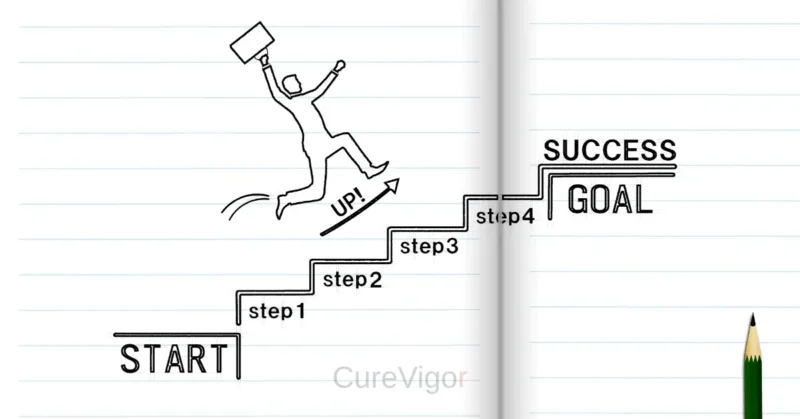
The highest levels of productivity come from creating systems that multiply your efforts rather than just optimizing individual tasks.
These approaches help you achieve better results while working less hard. Smart systems and strategic thinking replace brute-force effort with elegant solutions that scale over time.
Delegate Tasks for Productivity
Identifying what only you can do and offloading the rest
Effective delegation starts with honestly identifying activities that require your unique skills, knowledge, or authority.
Everything else becomes a candidate for delegation to others who can handle it competently.
Many high achievers struggle with delegation because they believe they can do tasks faster or better on their own.
However, this mindset creates a bottleneck that prevents growth and overwhelms your capacity.
The delegation process requires clear communication of expectations, deadlines, and quality standards.
Taking time upfront to explain tasks thoroughly and answer questions prevents confusion and rework later.
This initial investment pays dividends through reduced supervision needs and improved outcomes.
Good delegation also includes establishing check-in points and feedback mechanisms without micromanaging the process.
Delegation skills develop through practice and gradually expanding the scope of tasks you’re comfortable assigning to others.
Start with lower-stakes activities to build confidence in the process and learn how to communicate effectively with different team members.
As your delegation skills improve, you can focus more time on activities that truly require your unique contributions.
Automate Repetitive Tasks for Productivity
Using digital tools to handle the “busy work” of your day
Technology offers countless opportunities to automate routine tasks that consume time without adding significant value.
Email filters can automatically organize messages, saving time on daily sorting. Calendar scheduling tools eliminate back-and-forth coordination emails.
Automation frees your mental energy for creative and strategic thinking that technology cannot replace.
Identifying good automation candidates requires examining your daily activities for repetitive patterns that follow predictable rules.
Tasks you do the same way every time are prime targets for automation. The time invested in setting up automated systems pays compounding returns by eliminating future manual effort.
Even simple automations can save hours of routine work each month.
The key to successful automation is to start small and gradually expand as you become more comfortable with different tools.
Begin with simple, low-risk automations before tackling complex workflows. This approach helps you build skills while avoiding the frustration of over-complicated systems that create more problems than they solve.
Leverage Your Biological Prime Time
Matching your hardest tasks to your highest energy levels.
Your energy and cognitive ability fluctuate predictably throughout the day, driven by natural biological rhythms.
Most people experience peak mental performance at specific times that remain fairly consistent from day to day.
Identifying your biological prime time lets you schedule your most important and challenging work when your brain naturally operates at its best.
Peak performance periods typically last 2-4 hours and often occur in the morning for most people, though individual variations are significant.
During these high-energy windows, you can tackle complex problems, make important decisions, and produce creative work more effectively than during low-energy periods.
Protecting these prime hours for your most valuable activities creates dramatic improvements in work quality and speed.
Lower-energy periods become opportunities for routine tasks that require less cognitive demand.
Email processing, administrative work, and simple maintenance activities fit well into natural energy valleys.
This strategic scheduling approach works with your biology rather than against it, reducing the fatigue that comes from fighting your natural rhythms.
Self-Improvement and Goal Achievement
Sustainable productivity requires continuous improvement and regular adjustment of your systems and approaches.
Personal growth and goal achievement work together to create long-term success rather than short-term productivity bursts.
These practices help you maintain momentum while avoiding burnout from unsustainable work habits.
Strategic Goal Setting
Turning broad visions into actionable, manageable pieces
Effective goal setting transforms vague aspirations into specific, actionable plans that guide daily decisions.
Strategic goals include clear success metrics, realistic timelines, and specific action steps that move you toward your desired outcomes.
Without this structure, even strong motivation tends to dissipate when faced with the complexity of turning ideas into reality.
The process begins with clarifying your broader vision and values to ensure your goals align with what truly matters to you.
Goals that conflict with your deeper values create internal resistance and become difficult to sustain.
Once you’ve established this alignment, break larger objectives into smaller milestones that provide regular feedback on your progress and opportunities to celebrate achievements.
Each goal should include specific metrics that objectively measure progress, rather than relying on subjective feelings of advancement.
Measurable goals help you identify when strategies are working and when adjustments are needed.
This data-driven approach prevents you from continuing ineffective efforts while helping you double down on approaches that produce results.
Review and Adjust for Productivity
The importance of the “Weekly Audit” to refine your process.
Regular review sessions help you learn from experience and continuously improve your productivity systems.
Weekly audits provide opportunities to assess what worked well, what didn’t, and what adjustments might improve future performance.
This practice prevents you from mindlessly repeating ineffective patterns while helping you identify and replicate successful approaches.
The weekly audit process includes reviewing your accomplishments against your planned goals, analyzing time allocation across different activities, and identifying obstacles that prevented optimal performance.
This reflection helps you spot productivity patterns that might not be obvious amid the daily grind. Understanding these patterns allows you to make strategic improvements to your systems and habits.
Adjustment based on audit findings should be gradual rather than dramatic to avoid disrupting systems that are working well.
Focus on one or two specific improvements each week rather than trying to overhaul your entire approach.
This incremental improvement philosophy creates sustainable change while avoiding the disruption caused by too many simultaneous modifications.
Using a Productivity Journal
Tracking progress to stay motivated and consistent
A productivity journal records your daily activities, accomplishments, and challenges, helping you identify patterns and maintain motivation over time.
Writing about your work requires additional processing, often leading to insights into more effective approaches.
Recording progress makes achievements more concrete and memorable than mental notes alone.
Effective productivity journaling includes both quantitative data about time allocation and qualitative observations about energy levels, focus quality, and satisfaction with different activities.
This combination helps you understand not just what you did, but how well you did it and how it felt.
These insights guide future planning and help you optimize for both performance and well-being.
The journal also serves as a motivation tool by documenting progress that might otherwise be forgotten during challenging periods.
Reading about past accomplishments and breakthroughs provides encouragement when current work feels difficult or slow.
This historical perspective helps you maintain confidence in your abilities and commitment to your long-term goals.
Conclusion: Embracing a Sustainable Pace
Personal productivity is ultimately about creating a sustainable approach to meaningful work that aligns with your values and life goals.
The strategies and techniques outlined in this guide provide tools for working more effectively, but they must be adapted to your unique circumstances and preferences.
Sustainable productivity means finding approaches that you can maintain over years, not just weeks or months.
The journey toward higher productivity is highly personal and requires experimentation to discover what works best for your personality, work style, and life situation.
What transforms one person’s effectiveness might not work for another, so approach these techniques with curiosity rather than rigid adherence.
The goal is to build a personalized system that helps you create meaningful value while maintaining your well-being and relationships.
Remember that true productivity serves your broader life purposes rather than becoming an end in itself.
The most effective productivity practices help you create more time and energy for the people and activities that matter most to you.
When productivity techniques start to create stress or to come at the expense of important relationships, it’s time to step back and reassess your approach.
The best productivity system is one that enhances your life rather than consuming it.
Frequently Asked Questions about Personal Productivity
What is the difference between personal productivity and efficiency?
While often used interchangeably, efficiency is about doing things right (speed and resource management), whereas personal productivity is about doing the right things (output and value). You can be highly efficient at a task that doesn’t actually help you reach your goals.
How does AI help in boosting personal productivity in 2026?
In 2026, AI has shifted from simple automation to becoming a “productivity partner.” Tools now use AI to summarize long threads, automatically schedule deep-work blocks based on your energy patterns, and handle repetitive administrative “busy work,” allowing you to stay in a state of flow longer.
What is “Biological Prime Time” and why does it matter?
Biological Prime Time (BPT) is the specific window during the day when your energy and internal motivation are at their highest. By scheduling your most cognitively demanding “High-Impact Tasks” during your BPT, you can often achieve in two hours what might take four hours during an energy slump.
Can multitasking actually improve my productivity?
Research consistently shows that multitasking is a myth; the brain is actually “task-switching,” which incurs a “switching cost” of up to 40% of your productive time. Focusing on a single task at a time (monotasking) is significantly more effective for creating high-quality work.
How do I choose the right productivity system (GTD vs. Pomodoro vs. Eisenhower)?
The “best” system depends on your work style. GTD is ideal for those with complex, multi-step projects; the Pomodoro Technique is perfect for those who struggle with focus or procrastination; and the Eisenhower Matrix is best for managers who need to prioritize urgent vs. important tasks.
Is a “To-Don’t List” as effective as a To-Do List?
Yes. A “To-Don’t List” helps you identify low-value habits, distractions, and tasks that should be delegated or deleted. By consciously deciding what not to do, you protect your time and energy for the 20% of activities that drive your success.
Read more Work Life Balance articles.
You might like: