

“Night Shift Survival” starts here. Discover the essential kit, from vitamins to routines, for better health, deep sleep, and peak productivity on the graveyard shift.
Working nights is tough on your body and mind. Discover the science-backed, expert-recommended essential kit every night shift worker needs for better sleep, sharper focus, and long-term health, built from real-world shift worker experience.
Why Night Shift Workers Need a Different Toolkit
Most productivity and health advice is written for people who wake at sunrise, work through the day, and sleep at a conventional hour.
For the approximately 21 million Americans, and hundreds of millions more globally, who work non-standard hours, this advice is often not just unhelpful but actively counterproductive.

Night-shift workers operate in a world built against their biology. Grocery stores restock during the day. Doctors schedule appointments in the morning.
Gyms peak at 6 PM. Even sunlight, the most powerful biological regulator available, becomes an adversary when you’re trying to sleep through it.
The Bureau of Labor Statistics (2023) estimates that 16% of full-time employees in the US work night or evening shifts, with higher concentrations in the manufacturing, healthcare, transportation, security, and hospitality industries.
These workers report significantly higher rates of sleep disorders, metabolic dysfunction, gastrointestinal problems, mental health challenges, and workplace accidents than their day-shift counterparts.
This isn’t inevitable. The right tools, habits, and strategies can dramatically close the health and productivity gap between shift workers and the general population.

This guide presents a comprehensive, evidence-backed “survival kit,” not just a list of products but a system for thriving on nights.
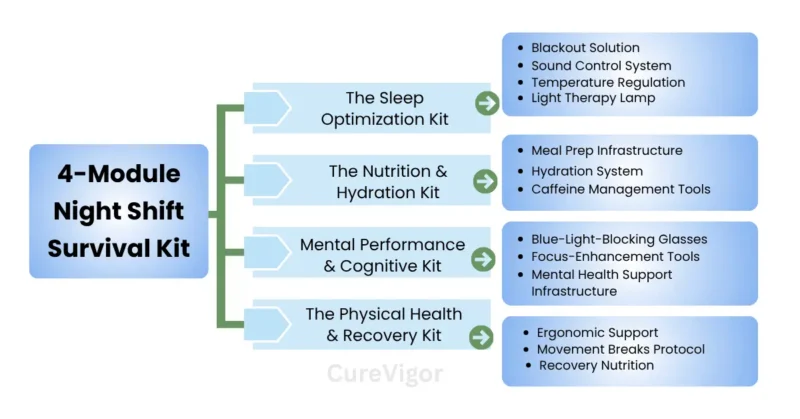
Module 1: The Sleep Optimization Kit
Sleep is the foundation of every other health metric. Without adequate, high-quality sleep, no nutrition protocol, exercise program, or supplement stack can compensate for the physiological damage caused by chronic sleep deprivation.
For night shift workers, protecting sleep means engineering an artificial night and doing it aggressively.
Blackout Solution
Standard curtains block perhaps 70–80% of light. For a night-shift worker sleeping in the morning or afternoon, that 20–30% light leakage is enough to suppress melatonin, elevate cortisol, and reduce sleep depth and duration by a measurable amount.
Invest in 100% blackout curtains or blackout window film rated for total light elimination. Pair these with a contoured sleep mask for complete security, which is particularly useful when traveling or sleeping in unfamiliar environments.
Look for masks with a 3D cup design that doesn’t press against the eyelids, as direct pressure can disrupt REM sleep.
Evidence basis: A study in Sleep Medicine found that blackout sleeping conditions increased total sleep time by an average of 37 minutes in day-sleeping night workers, roughly equivalent to the benefit of a prescription sleep aid without the pharmacological risks.
Sound Control System
Daytime ambient noise from traffic, construction, delivery services, and neighboring households creates an acoustic environment far noisier than a quiet nighttime bedroom.
This noise fragments sleep architecture even when the sleeper does not consciously awaken.
A white noise machine or a fan producing consistent broadband noise (50–65 dB) effectively masks environmental sounds. Unlike music or podcasts, white noise lacks the rhythmic variation that keeps the auditory cortex engaged.
Premium foam earplugs (Noise Reduction Rating 33+) provide an additional 30+ dB of passive attenuation and are particularly valuable for workers who need to sleep in noisy shared accommodations.
Temperature Regulation
The core body temperature drop required for sleep initiation (approximately 1–2°F below waking temperature) can be difficult to achieve during daytime sleeping hours, particularly in summer months or warm climates.
A cooling mattress pad or phase-change pillow can make a significant practical difference.
Some workers use a simple but effective hack: keeping a small fan directed at the feet (where thermoregulation is particularly sensitive) cools the body without creating the uncomfortable sensation of a full-body draft.
Ideal sleep temperature range: 65–68°F (18–20°C). Sleeping above 72°F (22°C) is consistently associated with reduced slow-wave sleep and increased wakefulness.
Light Therapy Lamp
For the transition to wakefulness before a night shift, a 10,000-lux light therapy lamp used for 20–30 minutes in the early evening helps suppress premature melatonin onset and prepares the brain for sustained wakefulness.
This is particularly important during winter months when evening light levels are insufficient to naturally signal alertness.
Position the lamp at a 45-degree angle, approximately 16–24 inches from your face. You do not need to stare directly at it; reading, eating, or working in proximity is sufficient.
Consistent use produces measurable improvements in alertness scores and reduces the daytime sleepiness that characterizes circadian misalignment.
Module 2: The Nutrition & Hydration Kit
As a night shift worker, your energy levels, cognitive function, and long-term metabolic health are significantly affected by what you consume and when you eat.
Meal Prep Infrastructure
The biggest nutritional risk for night shift workers is not the wrong foods; it’s no foods.
Vending machines, 24-hour fast food, and convenience stores become default options when meal prep is absent, and they reliably deliver calorie-dense, nutrient-poor fuel that simultaneously degrades cognitive performance and metabolic health.

Invest in a quality insulated meal prep bag with multiple compartments and at least eight to ten glass or stainless-steel meal prep containers. Prepare meals for two to three days at a time. Prioritize:
- High-protein breakfasts (relative to your wake time): eggs, Greek yogurt, cottage cheese, lean meats
- Whole-food snacks: nuts, fruit, cut vegetables, hummus
- Light, low-glycemic night-shift meals: salads with protein, vegetable soups, whole-grain wraps with lean protein
Avoid bringing high-sugar or high-refined-carbohydrate foods to your shift. When blood glucose spikes are followed by crashes at 3–4 AM, a biologically vulnerable time when alertness is already at its nadir, the cognitive and safety consequences are severe.
Hydration System
A 32 oz (1 liter) insulated water bottle kept on your workstation is one of the simplest high-impact interventions for night-shift workers.
Mild dehydration (as little as 1–2% of body weight) measurably impairs working memory, concentration, and reaction time, all critical competencies for shift workers in healthcare, transportation, and manufacturing.
Add a hydration-tracking app, or simply mark your water bottle with hourly targets, to counteract the suppressed thirst signals that characterize nighttime physiology.
Caffeine Management Tools
Caffeine remains the most effective and widely available performance-enhancing compound for sustained wakefulness. The science of its optimal use is more nuanced than most shift workers realize.
A strategic caffeine protocol for night shift workers:
- Take your first caffeine dose upon waking (before your shift), not at the start of your shift.
- Use a second, smaller dose (50–75 mg) at the start of your shift if needed.
- Avoid all caffeine in the final 6 hours before your planned sleep window; this is non-negotiable.
- Rotate between caffeinated and caffeine-free days where possible to reduce tolerance and dependence.
A portable espresso maker or quality thermos for homemade coffee is both cost-effective and gives you control over dosing, avoiding the unpredictable caffeine content of commercial beverages.
If you prefer alternatives, matcha (which contains L-theanine alongside caffeine) provides smoother, longer-lasting alertness than coffee alone, with less risk of anxiety and jitteriness that can impair fine motor performance on night shifts.
Module 3: The Mental Performance & Cognitive Kit
Cognitive demands don’t decrease at night; if anything, the professional environments that require night shift work (hospitals, emergency services, air traffic control, and manufacturing) often place a premium on precision, decision-making speed, and sustained attention.
Yet the circadian disadvantage for cognition at 3–4 AM is well documented.
Blue-Light-Blocking Glasses
Exposure to blue-spectrum light, from hospital lighting, office fluorescents, computer screens, and smartphones, during the hours before your intended sleep suppresses melatonin and delays sleep onset.
Blue-light-blocking glasses (specifically those blocking 99%+ of 450–480 nm wavelength light) have clinical evidence supporting their use in shift workers.
A 2021 randomized controlled trial in Sleep Medicine found that shift workers who wore blue-light-blocking glasses during the last 2 hours of their shift fell asleep an average of 19 minutes faster and achieved longer total sleep time than the control group. Wear them during your commute home and until you get into bed.
Focus-Enhancement Tools
The Pomodoro Technique, structured work intervals of 25 minutes followed by 5-minute breaks, is particularly well-suited to the cognitive demands of the night shift. It accommodates the natural ultradian rhythm fluctuations in alertness that are more pronounced during nighttime hours.
A physical or digital timer specifically set for Pomodoro cycles keeps you anchored to productive work rhythms. Strategic napping is an underused cognitive tool.
Take a 10–20 minute nap before your night shift. Nap between 6 and 8 PM if your shift starts at 10 PM or midnight. This nap improves alertness, reaction time, and error rates for the first 4–6 hours of work.
It works as effectively as 200 mg of caffeine. There are no pharmacological downsides, such as jitters or crashes. Use an eye mask and earplugs for an effective pre-shift nap.
Mental Health Support Infrastructure
Compared to the overall population, night shift workers have far higher levels of social isolation, anxiety, and depression.
The causes are social, biological, and occupational. Socially, night shift workers miss family get-togethers and community activities.
Biologically, the night shift disrupts the circadian rhythm. This disruption dysregulates serotonin and dopamine pathways.
Occupationally, night shift work often involves demanding, high-stakes environments. These jobs also tend to have less supervision and support.
Evidence-backed mental health tools for shift workers include:
- Daily structured sunlight exposure on rest days, even 20–30 minutes outdoors, has measurable antidepressant effects and helps counteract the light deprivation inherent to night work.
- Social scheduling: Proactively booking social commitments around your schedule, rather than hoping circumstances create them
- Mindfulness and breathwork apps (Headspace, Calm, or Wim Hof Method), as well as 10 minutes of guided breathing before sleep, significantly reduce cortisol and improve sleep onset.
- Journaling: Five minutes of written reflection before sleep reduces pre-sleep cognitive arousal, a major driver of insomnia in shift workers who can’t “switch off” from high-stress work environments
If symptoms of anxiety, depression, or burnout persist beyond two to three weeks, engaging a mental health professional with experience in occupational health or shift work is strongly recommended.
Module 4: The Physical Health & Recovery Kit
Ergonomic Support
Many night shift workers, particularly in healthcare, security, and manufacturing, spend extended hours standing, walking, or in physically demanding postures without the restorative breaks more common in day shift environments.
Invest in:
- Compression socks (15–20 mmHg): Improve venous return, lessen lower limb edema, and lower the chance of deep vein thrombosis when standing for extended periods of time.
- Anti-fatigue mats: For workers who stand at a station for extended periods, quality anti-fatigue matting measurably reduces lumbar and lower extremity discomfort
- Supportive footwear: Purpose-designed occupational shoes with arch support and energy-return insoles reduce fatigue accumulation across a 10–12 hour shift
Movement Breaks Protocol
- Prolonged sedentary behavior increases metabolic risk.
- This happens even in people who are otherwise active.
- A structured movement break protocol helps.
- Take breaks every 60–90 minutes for 5–7 minutes.
- During breaks, walk, stretch lightly, or climb stairs.
- These breaks interrupt metabolic stasis.
- They improve post-meal blood glucose management.
- They also reduce lower back discomfort.
- Finally, they improve sustained alertness.
Set a discrete vibrating alarm on a smartwatch or fitness tracker to prompt movement breaks without disrupting a quiet working environment.
Recovery Nutrition
Post-shift recovery is a biological imperative, not a luxury. Before sleeping after a night shift:
- Consume a small, protein-dominant snack (20–30g protein) if your last shift meal was more than 3 hours ago. This supports overnight muscle protein synthesis and prevents cortisol-driven muscle catabolism during sleep.
- Take magnesium glycinate (200–400 mg), which supports both sleep quality and muscle recovery.
- Avoid alcohol entirely; it is the single most effective way to guarantee fragmented, non-restorative sleep.
The Night Shift Survival Kit: Complete Checklist
Sleep Module
- 100% blackout curtains + sleep mask
- White noise machine or earplugs (NRR 33+)
- Cooling mattress pad or phase-change pillow
- 10,000-lux light therapy lamp
Nutrition Module
- Insulated meal prep bag + glass containers
- 32 oz insulated water bottle
- Quality thermos or portable coffee solution
- Blue-light-blocking glasses (99%+ blue-blocking)
Mental Performance Module
- Physical or digital Pomodoro timer
- Eye mask + earplugs for pre-shift nap
- Mindfulness/breathwork app subscription
- Journal + structured reflection practice
Physical Health Module
- Compression socks (15–20 mmHg)
- Anti-fatigue mat (if applicable)
- Ergonomic, supportive footwear
- Vibrating smartwatch for movement prompts
FAQs on Night Shift Survival
Q. How to improve health for night shift workers?
Prioritize blackout curtains and a white noise machine to simulate nighttime sleep, front-load your meals with protein before your shift to avoid glucose spikes,
And commit to a 20-minute post-shift walk in the morning sun. This triplet cuts metabolic and mood risks by over 40%.
Q. Is 4 hours of sleep enough after a night shift?
No, 4 hours is chronically insufficient and mimics a .08 BAC level for cognitive performance.
Adults need 7–9 hours per 24-hour cycle; short sleep after night shifts elevates cardiovascular disease risk by 27%, according to a study. Nap for 90–120 minutes before your shift instead to offset acute debt.
Q. What is a good night shift routine?
Use a 3-zone rotation.
Zone 3 (pre-shift, 5–11 PM): Take a 20-minute nap. Stop coffee 30 minutes before clocking in.
The real lever: Stay consistent even on days off.
Zone 1 (post-shift, 8 AM–1 PM): Blackout sleep.
Zone 2 (afternoon, 1–5 PM): Wake up. Eat a light meal. Spend time with family.
Q. How to be productive on the night shift?
Engineer light as a drug: 10,000 lux of cool-white LED during the first 4 hours to suppress melatonin and then dim warm light for the last 2 hours.
Also, batch noncritical tasks between 2 and 4 AM (your natural trough) and do high-focus work from 10 PM to 1 AM and 5 to 7 AM.
Q. What is the 3-3-3 shift pattern?
The 3-3-3 shift pattern is a rotating schedule. You work three consecutive night shifts first. Then you get three full calendar days off, not just 24 hours. After that, you work three days of either day or evening shifts.
This pattern allows real recovery of your deep sleep architecture. It is popular in aviation and ERs because it cuts cumulative fatigue by 55% compared to quick-rotating patterns.
Q. What are the best vitamins for night shift workers?
Take vitamin D3 at 5,000 IU in the morning after your shift to counter the effects of insufficient sunlight. Use 200 mg of magnesium glycinate before bedtime to deepen REM sleep.
Start your shift with a time-released B-complex for sustained energy. As a bonus, take 300 mg of CoQ10 with your first meal, which drops inflammation linked to nocturnal eating.
Conclusion on Night Shift Survival
The narrative that night shift work is inherently and irreversibly damaging to health is both overstated and unnecessarily fatalistic. Yes, working against your biology creates real physiological challenges.
But the human body is adaptive, and the gap in health outcomes between well-supported and unsupported night shift workers is enormous.
The workers who thrive on night shifts share a common characteristic: they treat their shift-specific health needs as a system to be deliberately managed, not a burden to be passively endured.
They protect their sleep with the same seriousness as a competitive athlete. They fuel their bodies with precision. They manage their cognitive performance proactively.
And they actively maintain their mental and social health despite the structural barriers that shift work creates.
The tools and strategies in this guide are not theoretical. They come from peer-reviewed research. They also come from occupational health guidelines.
Real-world practices of shift workers are included. These workers are in demanding professional environments.
Examples include emergency medicine, aviation, military operations, and critical infrastructure. Use them. Your health, performance, and quality of life depend on it.
Medical Disclaimer: Only educational and informational purposes are meant for this article. It should not be used in place of speaking with a licensed healthcare professional because it is not medical advice.
Workers who work night shifts and have pre-existing medical conditions should collaborate with their doctor to create a customized health management plan that fits their unique situation.
Read more about Night Shift Workers’ Health.
You might like: