
Create a screen-free home with 5 easy rules. Reduce digital distractions, improve focus, and design calm spaces for better concentration and family time.
Start with a relatable family situation: everyone is physically together, but each person is looking at a different screen.
Then explain that a screen-free home does not mean banning technology. Instead, it means intentionally designing the home so screens do not automatically fill every meal, quiet moment, bedtime, or family interaction.

Quick Summary Box
- Create clear screen-free spaces.
- Establish predictable screen-free times.
- Make family media rules realistic.
- Give children attractive alternatives.
- Model the habits you expect from them.
Understanding the Impact of Screens at Home
Use this section to replace the old generic “benefits” section and set up the discussion that follows. From here, focus on how screens affect home routines and family habits.
Discuss:
- How screens can become part of almost every household routine
- Why constant notifications and entertainment can make it harder to transition to focused activities
- How screens can compete with sleep, physical activity, play, reading, homework, and family interaction
- Why the goal should be balance rather than fear of technology
Current CDC research found that U.S. teens reporting 4+ hours of daily non-school screen time were more likely to report irregular sleep, insufficient rest, infrequent physical activity, and several mental-health-related outcomes.
What Is a Screen-Free Home?
Define the concept clearly.
A screen-free home does not necessarily mean:
No television, smartphones, computers, tablets, or internet.
Instead, explain that it means setting intentional boundaries around when, where, and why you use screens. Use your room to discuss:
- Screen-free zones
- Screen-free times
- Family media rules
- Device storage
- Digital boundaries
- Offline activities
Why Create a More Screen-Free Home?
The answer begins with family connection, focus, movement, and better bedtime routines.
More Opportunities for Family Interaction
Explain how meals, walks, games, conversations, and shared activities create natural opportunities for connection.
More Space for Focus and Learning
Discuss how removing unnecessary screens during homework, reading, creative activities, or conversations can reduce competing distractions.
More Time for Physical Activity
Instead of saying screens automatically cause inactivity, explain that reducing recreational screen use can free time for movement and outdoor activities. The CDC specifically recommends replacing screen time with activities involving family and friends or more movement.
Better Bedtime Routines
This deserves proper depth because it is one of the strongest practical reasons for a screen-free bedroom or bedtime routine. That is why the next point focuses on what the CDC recommends for sleep habits.
The CDC recommends consistent sleep routines and notes that removing technology from bedrooms or establishing a technology cutoff can support healthier sleep habits.
Screen-free living: 5 simple rules
Use this section as the article’s central framework. Each rule below builds on the last and makes the household plan easier to follow.
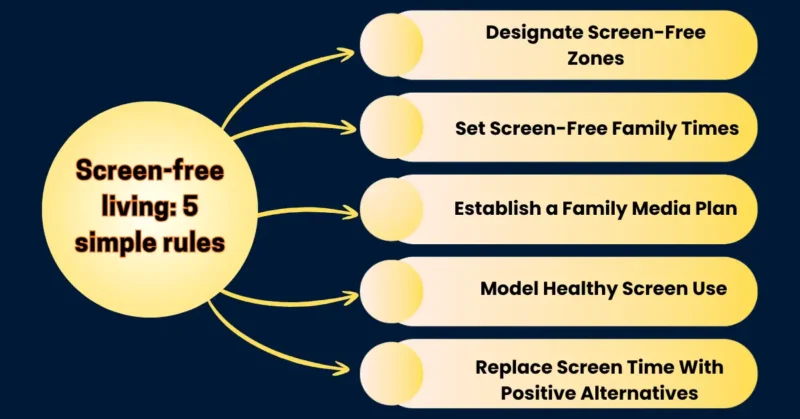
Rule 1: Designate Screen-Free Zones
Explain why physical space matters.
Make the Dining Table Screen-Free
No phones or tablets during family meals unless there is a genuine practical reason.
Keep Bedrooms Free From Recreational Screens
Talk about charging phones outside bedrooms and keeping televisions, gaming devices, and tablets elsewhere when practical.
Create a Screen-Free Homework Space
A child doing homework on a laptop may still need a screen, so clarify the difference between necessary educational technology and recreational distractions.
Create a Screen-Free Family Space
Design a living room, reading corner, or family area around conversation, books, games, music, and shared activities. Specifically list the dinner table, homework time, and before-bed periods as examples of screen-free zones.
Rule 2: Set Screen-Free Family Times
Instead of trying to control every minute of the day, establish predictable boundaries. This makes the examples below easier to apply.
Examples:
- During meals
- During family conversations
- Before bedtime
- During homework
- During family outings
- During certain weekend activities
Create a Family Media Curfew
Explain how a consistent evening cutoff can make bedtime less chaotic.
Start Small
A family does not have to introduce ten rules at once.
Start with one or two predictable screen-free periods and build from there.
Rule 3: Establish a Family Media Plan
This deserves its own substantial section because it is more useful than simply telling parents to “limit screen time.” The plan below shows how to make those limits specific.
Explain:
Decide Where Screens Are Allowed
Decide when screens are allowed.
Decide what content is appropriate.
Create a one-screen-at-a-time rule.
AAP recommends turning off devices you are not using to reduce distractions.
Notifications can repeatedly pull attention away from whatever someone is doing.
Revisit the Rules
Children’s needs change with age, school demands, social needs, and family routines. AAP recommends revisiting and revising a family media plan as children mature.
Rule 4: Model Healthy Screen Use
This is one of the most important additions.
Children notice what adults do.
If parents say:
“Put your phone away.”
While checking their own phone throughout dinner, the rule becomes much harder to enforce.
Discuss:
- Put your phone away during conversations.
- Avoid scrolling while children are talking to you.
- Keep phones away during family meals.
- Don’t automatically reach for a device during quiet moments.
- Let children see you enjoying offline activities.
AAP’s current guidance also emphasizes that parents can help make technology work for, rather than against, children’s well-being through thoughtful planning and choices.
Rule 5: Replace Screen Time With Positive Alternatives
This section should be much more than a short list.
The biggest problem with removing screens is often:
“What will my child do instead?”
Create an environment where alternatives are easy to access.
For Younger Children
- Building blocks
- Coloring
- Picture books
- Pretend play
- Puzzles
- Simple household tasks
For School-Age Children
- Board games
- Crafts
- Reading
- Cooking
- Gardening
- Sports
- Music
- Lego or building projects
For Teenagers
- Exercise
- Cooking
- Hobbies
- Reading
- Music
- Outdoor activities
- Family outings
- Creative projects
- In-person social time
The CDC recommends encouraging children and teens to replace screen use with enjoyable activities with friends and family or with more physical activity.
Now go deeper into the physical environment, which matches the title’s intent. Start with the spaces families use most often.
The Dining Area
Keep devices away from the table.
The Bedroom
Create a calm sleep environment.
The Homework Area
Remove unnecessary entertainment devices.
The Living Room
Make books, games, puzzles, and other activities visible and easy to reach.
The Outdoor Space
If you have a yard, balcony, garden, or nearby outdoor area, make it part of the family’s routine.
The idea is simple:
Make the healthy choice easier to see and use.

Establishing Screen-Free Family Times
Give readers a practical routine they can actually copy.
Morning
When possible, avoid starting the day with recreational scrolling.
After School
Give children a transition period for snacks, conversation, movement, or homework before recreational screen use.
Dinner
Keep meals device-free.
Evening
Move toward quieter activities such as reading, talking, preparing for the next day, or family games.
Before Bed
Create a predictable technology-free period.
This section can explain that screen-free routines work better when they are predictable rather than constantly negotiated.
Children’s Guide to Screen-Free Rules
This is another section the old article could use.
Give Warnings Before Screen Time Ends
A sudden “Turn it off now!” can create unnecessary conflict.
Explain the reason.
Children are more likely to understand rules when they know whether the purpose is dinner, homework, sleep, family time, or another activity.
Give Choices
Instead of:
“Stop using your tablet.”
Try:
“Would you like to read or play a board game after you put the tablet away?”
Stay Consistent
Rules that change daily are hard for children to understand.
Expect Some Resistance
Resistance does not automatically mean the rule is wrong. A new routine can take time.
Do Your Children Need Screens at School

Important distinction.
A screen-free home should not interfere with legitimate educational, communication, accessibility, or safety needs.
Explain the difference between:
Necessary screen use
and
Recreational screen use.
A child may need a laptop for homework, for example. That doesn’t mean gaming, social media, video streaming, and unnecessary notifications need to stay active at the same time. Kids Can Reduce Their Own Screen Use
This makes the article more family-focused.
Discuss:
- Phone-free meals
- No scrolling during conversations
- Charging phones outside the bedroom
- Turning off nonessential notifications
- Setting personal screen-free periods
- Choosing offline hobbies
- Putting devices away instead of simply turning them face down
The goal is not parental perfection.
It is modeling the behavior.

A Simple 7-Day Screen-Free Home Challenge
This can add considerable practical value without fluff.
Day 1: Choose one screen-free zone.
Day 2: Make one family meal screen-free.
Day 3: Turn off unnecessary notifications.
Day 4: Create a charging station outside bedrooms.
Day 5: Plan one screen-free family activity.
Day 6: Try a longer screen-free evening.
Day 7: Review what worked and create your family’s permanent rules.
This gives the reader something actionable rather than ending with generic advice.
How to Make Your Family’s Screen Boundaries Work
Keep this balanced and avoid diagnosing. End by reminding readers that small changes can make screen-free routines easier to maintain and that the final takeaway is to start small and stay consistent.
Possible signs include:
- Devices regularly interrupt meals.
- Possible signs include:
- Devices regularly interrupt meals.
- Children struggle to transition away from screens.
- If these patterns sound familiar, use the rules above to create clearer family boundaries and a more screen-free home.
- If these patterns sound familiar, start with one small boundary and build from there.
- Family conversations are repeatedly interrupted.
- Screens regularly push bedtime later.
- Children rarely choose offline activities.
- Parents also feel unable to put devices away.
- Homework is constantly interrupted by notifications.
These are reasons to reconsider household routines, not proof that a child has a screen-use disorder.
If your kids resist these new household zones or complain about boredom, check out our step-by-step parenting strategies on The Best Ways to Limit Screen Time for Your Kids.
FAQs About Creating a Screen-Free Home
Q. What is a screen-free home?
A screen-free home is a household that creates intentional times and places where recreational screens are not used, such as meals, bedrooms, homework periods, or family activities.
Q. How do I make my house screen-free?
Start with a few realistic boundaries, such as screen-free meals, bedrooms, and a consistent evening routine. Then introduce additional rules if they work for your family.
Q. Should children have TVs or phones in their bedrooms?
Keeping recreational screens out of children’s bedrooms can make it easier to protect sleep routines and reduce late-night screen use. CDC and AAP both support screen-free bedrooms as part of healthier family media habits.
Q. How can I get my child to stop using screens?
Use predictable rules, give warnings, explain the reason for the boundary, and offer an appealing alternative activity. Parents should also follow the household rules themselves.
Q. What can children do instead of screen time?
Children can read, draw, build, play games, help with cooking, spend time outdoors, exercise, listen to music, or participate in family activities. The best alternatives depend on the child’s age and interests.
Q. Does a screen-free home mean children cannot use technology?
No. The goal isn’t always to eliminate technology. A balanced home can allow technology for education, communication, creativity, and entertainment while protecting important screen-free spaces and routines.
Final Thoughts
Creating a screen-free home is less about taking technology away and more about deciding where it belongs and where it doesn’t.
You don’t need to throw away every device or create strict rules nobody can follow. Think about the places and moments that matter most: the dinner table, bedrooms, homework time, family conversations, and bedtime.
Then replace some screen habits with things your family actually enjoys.
When the physical environment supports the rules, parents model those rules, and children have meaningful alternatives, putting the screen away becomes less of a daily battle and more of a normal family habit.
A screen-free home is not about rejecting technology. It is about making enough room for people, rest, focus, movement, creativity, and connection.
Read more articles about Health & Wellness.
You might like to read: