

“Pay attention!”
Most parents have said these words more times than they can count.
Your child starts homework, gets distracted by a toy, leaves the table, asks for a snack, notices something outside the window, and somehow ends up doing everything except the task in front of them.
It can be frustrating. But a short attention span does not automatically mean your child is lazy, difficult, or incapable of learning.
Attention is a skill that develops throughout childhood. Children gradually learn how to stay with a task, ignore distractions, follow instructions, control impulses, and return to something after their attention wanders.
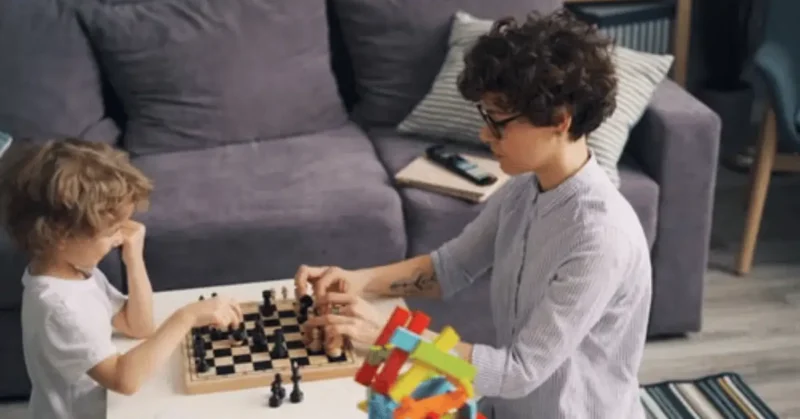
The good news? These skills can be practiced.
You don’t need complicated brain-training programs or unrealistic routines. Everyday play, reading, movement, sleep, family routines, and the way you approach difficult tasks can all create opportunities for your child to build better focus.
Quick Summary on Boosting Attention Span in Children
- Attention develops gradually and differs from child to child.
- Sustained play gives children a natural way to practice staying with an activity.
- Breaking large tasks into smaller steps can make concentration easier.
- Physical activity and adequate sleep support healthy attention and learning.
- Screens don’t have to disappear, but they shouldn’t crowd out sleep, play, movement, homework, and family time.
- Children learn follow-through through practice, encouragement, and realistic expectations.
- Persistent attention difficulties across different settings may deserve professional evaluation.
Why Attention Matters for Learning
Attention is a foundation of learning.
Before children can fully absorb a lesson, remember instructions, solve a problem, or finish a task, they need to direct their attention toward it.
But attention isn’t simply an “on” or “off” switch.
A child may concentrate intensely while building a Lego structure but struggle to listen during a long explanation. Another child may happily read for 30 minutes but become distracted after five minutes of handwriting practice.
That difference matters.
Instead of expecting your child to focus equally well on everything, look at whether they are gradually learning to start, continue, finish, and return to tasks.
10 Proven Ways for Boosting Attention Span of Your Child
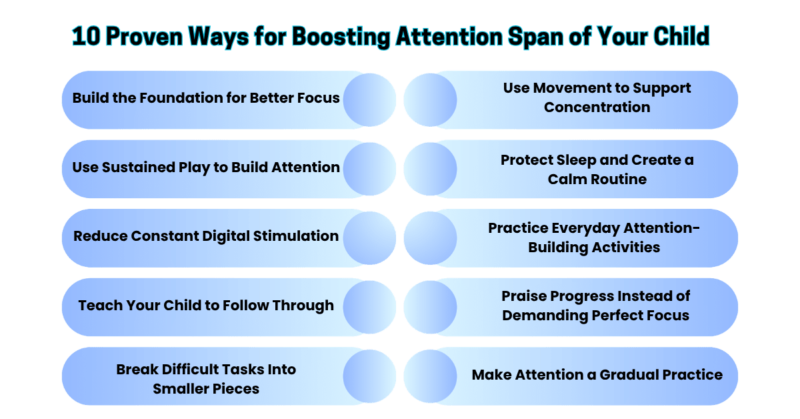
Improving a child’s attention span is less about making them sit still for a long time and more about helping them learn how to focus.
Try these practical strategies.
1. Build the Foundation for Better Focus
Before you try to increase your child’s concentration, check the basics.
Is your child sleeping enough? Are they getting opportunities to move? Are they eating regular meals? Do they have time to play? Is homework happening beside a television or a constantly buzzing phone?
Attention becomes harder when a child’s basic needs are being overlooked.
Start with a simple daily rhythm that includes:
- Adequate sleep
- Regular physical activity
- Time for outdoor or active play
- Balanced meals and snacks
- Quiet periods for reading or schoolwork
- Time to relax and connect with family
The CDC’s current guidance for children and teens emphasizes healthy routines that include sleep, physical activity, healthy eating, and balanced screen use. These habits support overall development and well-being.
You don’t need a perfect schedule. You need a reasonably consistent one.

2. Use Sustained Play to Build Attention
Children naturally practice attention when they become deeply involved in something they enjoy.
Think about a child building a tower, completing a puzzle, drawing a picture, playing pretend, or creating something from blocks. They may stay with that activity far longer than they would sit through a lecture.
Don’t rush to interrupt.
Give your child opportunities to play with an activity long enough to experience small challenges and solve them.
You can also gently extend the activity.
For example:
“You’ve built the house. What could we add to it?”
Or:
“You finished the puzzle. Would you like to find another one?”
The goal isn’t to force longer play. It is to give children regular opportunities to practice staying engaged.
3. Reduce Constant Digital Stimulation
You may have heard that parents should completely avoid “quick dopamine” activities to repair a child’s attention span.
That is an oversimplification.
The more useful question is:
Is digital media crowding out activities that help my child develop?
The American Academy of Paediatrics recommends thinking about what media may be replacing, including sleep, physical activity, reading, play, and family interaction. It also recommends practical habits such as screen-free times and places and turning off unnecessary notifications.
Try simple changes:
- Keep devices away during homework.
- Turn off unnecessary notifications.
- Avoid using multiple screens at once.
- Create screen-free meals.
- Keep devices outside the bedroom when practical.
- Make time for offline play every day.
You don’t have to make screens the enemy. The goal is balance.
4. Teach Your Child to Follow Through
Starting something is easy. Finishing it is a skill.
If your child frequently jumps from one activity to another, begin practicing follow-through with small tasks.
For example:
“Let’s finish putting these five books away.”
“Let’s complete this part of the puzzle before we start something else.”
“Let’s put all the art supplies back before choosing another activity.”
Keep the expectation reasonable.
If a child is tired or the task is far too difficult, insisting on completion may simply create frustration.
The goal is to teach:
Start → stay with it → finish → move on.
Over time, this becomes a habit.
5. Break Difficult Tasks Into Smaller Pieces
A large assignment can feel overwhelming to a child.
Instead of saying:
“Finish your homework.”
Try:
“Let’s start with these three questions.”
Then:
“Great. Now let’s do the next part.”
This technique is especially helpful when the task is boring, unfamiliar, or challenging.
You can also use a simple checklist:
- Read the question
- Write the answer
- Check the answer
- Move to the next question
Breaking work into smaller pieces gives children a clear target instead of one large mountain.
6. Use Movement to Support Concentration
Children are not designed to sit still all day.
Movement can be a useful part of a healthy attention routine. Walking, cycling, running, dancing, sports, playground games, and active outdoor play all give children opportunities to move.
The CDC notes that physical activity can benefit children’s attention and memory, and current guidance recommends regular daily activity for school-age children and adolescents.
You can also add short movement breaks during longer study periods.
Try:
“Let’s finish this section, then get up and stretch.”
A movement break doesn’t have to become another distraction. Keep it short and predictable.
7. Protect Sleep and Create a Calm Routine
Sometimes what looks like poor attention is simply an exhausted child.
Sleep supports learning, memory, attention, and behavior. The American Academy of Pediatrics notes that insufficient sleep is associated with attention problems and behavior concerns.
Create a bedtime routine that helps your child’s brain slow down.
For example:
Bath → pajamas → quiet reading → lights out
Try to keep bedtime reasonably consistent.
Screens can also interfere with a calming bedtime routine. Consider keeping phones, tablets, and gaming devices out of the bedroom and creating a screen-free period before sleep.
If your child regularly has trouble sleeping or seems unusually tired during the day, talk to their healthcare provider.
8. Practice Everyday Attention-Building Activities
You don’t need expensive educational products to help children practice attention.
Try activities such as:
- Puzzles
- Memory games
- Matching games
- Board games
- Drawing
- Coloring
- Building blocks
- Crafts
- Reading
- Cooking together
- Simple household tasks
- “Simon Says”
- Spot-the-difference activities
- Storytelling
Choose activities that require your child to listen, remember, observe, follow steps, or stay with a task.
And remember: fun matters.
A child who enjoys an activity is more likely to practice it willingly.
9. Praise Progress Instead of Demanding Perfect Focus
Children notice when adults are disappointed in them.
If every distraction leads to “Why can’t you pay attention?” they may start to think something is wrong with them.
Instead, notice the behavior you want to encourage.
Try saying:
“I noticed you stayed with that puzzle even when it was hard.”
“You remembered all three steps.”
“You got distracted, but you came back to your work.”
That last one is especially important.
Attention isn’t about never getting distracted. Everyone gets distracted.
A valuable skill is learning how to notice it and return.
10. Make Attention a Gradual Practice
Don’t expect a child to suddenly concentrate for an hour because you introduced a new routine.
Think of attention like a skill that develops through repeated practice.
Start with activities your child can reasonably manage. When that becomes comfortable, gently increase the challenge.
For example, if your child can comfortably read for 10 minutes, you might gradually work toward a slightly longer reading session.
The exact amount of time will differ from child to child.
No universal formula says a child’s attention span should equal a particular number of minutes based only on age.
What matters more is progress, function, and consistency.
How Parents Can Make Focus Easier
Sometimes the easiest way to improve attention is to change the environment rather than repeatedly telling your child to concentrate.
For homework or reading:
- Keep the workspace simple.
- Remove unnecessary toys.
- Put phones away.
- Turn off the television.
- Have needed supplies nearby.
- Give clear instructions.
- Work on one task at a time.
The AAP also recommends family media plans that fit the child’s age, personality, routines, and needs rather than relying on one rule for every family.
You can apply the same idea to attention.
Ask:
“What is making focus harder for my child?”
Then change one thing.
Maybe the room is noisy. Maybe homework begins when your child is hungry. Maybe the task is too long. Maybe the phone is constantly buzzing.
Small environmental changes can sometimes make a surprisingly big difference.
3 Types of Attention Span
Attention can be described in several ways. Three useful concepts for parents are selective attention, divided attention, and sustained attention.

1. Selective Attention
Selective attention means focusing on something important while ignoring distractions.
For example, a child may listen to the teacher while other students are talking.
2. Divided Attention
Divided attention involves managing more than one source of information or task.
This can be challenging for children. Asking a child to complete homework while watching videos and responding to messages creates competing demands.
This is one reason a simpler study environment can help.
3. Sustained Attention
Sustained attention means staying focused on an activity for a period of time.
Reading a chapter, completing a puzzle, listening to a story, or working through a set of math problems can require sustained attention.
Children develop this ability gradually.
What If My Child Keeps Getting Distracted?
Try not to treat every distraction as a battle.
Children naturally lose focus.
Instead, calmly redirect:
“Let’s come back to this question.”
Or:
“You were looking at your toy. Let’s finish this part first.”
Avoid turning every homework session into an argument.
If the task is genuinely too difficult, ask the teacher for help rather than assuming the child simply isn’t trying.
It can also help to watch for patterns.
Does your child struggle only with homework?
Or do they also have difficulty following instructions, completing activities, staying organized, or focusing at school and during play?
That distinction can be useful.
When Should You Talk to a Professional?
Occasional distraction is normal.
However, persistent attention difficulties may deserve professional advice when they interfere with learning, relationships, home life, or other daily activities.
Attention problems can have many possible causes. ADHD is one possibility, but sleep problems, learning difficulties, anxiety, developmental differences, and other factors can also affect concentration.
The CDC recommends professional evaluation when there are ongoing concerns about attention or behavior rather than trying to diagnose a child based on a checklist or online quiz.
If your child consistently struggles across different settings, speak with their pediatrician or another qualified healthcare professional. Their teacher can also provide useful information about how the child functions at school.
Getting help does not mean something is “wrong” with your child.
It means you are trying to understand what they need.
A Simple Daily Attention Routine
You don’t need to change everything at once.
Try this simple approach:
Morning:
Keep the morning predictable and allow enough time so your child isn’t constantly rushing.
After school:
Offer food, relaxation, and some movement before demanding focused schoolwork.
Homework:
Choose one task, remove distractions, and break the work into smaller sections.
Evening:
Make time for play, reading, family interaction, and a calm bedtime routine.
Every day:
Give your child opportunities to move, play, read, create, and practice finishing small tasks.
Consistency matters more than perfection.
FAQs on Boosting Attention Span in Children
Q. How can I increase my child’s attention span?
Focus on healthy routines rather than one quick solution. Make sure your child gets enough sleep, regular physical activity, time for play, and fewer unnecessary distractions. Break difficult tasks into smaller steps and give your child regular opportunities to practice staying with an activity.
Q. What games help children improve focus?
Puzzles, memory games, matching games, board games, building activities, crafts, drawing, and games such as “Simon Says” can help children practice listening, remembering instructions, waiting, and staying engaged. Choose activities that match your child’s age and interests.
Q. Does screen time cause a short attention span?
It is too simplistic to say that screen time alone causes attention problems. What matters is how media is used and what it may replace.
Excessive or poorly managed media use can crowd out sleep, physical activity, reading, play, and family interaction. Creating screen-free periods and reducing unnecessary notifications can help protect focused time.
Q. How long should a child be able to focus?
No single attention-span number applies to every child. Focus varies with age, development, interest, sleep, emotions, and task difficulty. Instead of comparing your child with a fixed formula, look for gradual improvement in their ability to start, continue, and finish age-appropriate activities.
Q. Why does my child focus on games but not homework?
Interest matters. Children can often stay engaged longer when an activity is rewarding, challenging, or enjoyable. Homework may feel repetitive or difficult by comparison.
Try breaking assignments into smaller pieces, removing distractions, giving short breaks, and connecting learning to your child’s interests when possible.
Q. When should I worry about my child’s attention span?
Talk with a healthcare professional if attention difficulties are persistent and interfere with school, home life, friendships, or daily activities.
If problems appear across multiple settings, an evaluation can help identify whether factors such as sleep, learning difficulties, anxiety, ADHD, or other developmental concerns may be contributing.
Final Thoughts: It’s a Process of Boosting Attention Span in Children
A child does not develop strong attention overnight.
There will be good days and distracted days. Some activities will hold their attention for a long time, while others will feel almost impossible.
That is normal.
Instead of constantly asking your child to “pay attention,” give them opportunities to practice attention.
Let them finish a puzzle. Read together. Play outside. Build something. Complete a small chore. Put the tablet away during homework. Protect bedtime. Praise them when they return to a task after getting distracted.
These ordinary moments can become valuable practice.
The goal isn’t to create a child who never loses focus.
The goal is to help your child gradually learn how to focus, follow through, manage distractions, and return to the task when attention wanders.
That’s a skill they can use for learning, relationships, work, and everyday life long after childhood.
Give your child time to grow.
The goal is not perfect concentration. It is helping children gradually learn how to start a task, stay with it, handle distractions, take healthy breaks, and return when their attention wanders.
Those are skills they can carry with them far beyond childhood.
Read more articles on health and life balance.
Medical note: This article is for general educational information and does not diagnose or treat attention disorders. If your child’s attention difficulties persist or interfere with daily life, speak with a qualified healthcare professional.
You might like to read: