Overcome self-doubt and build strong confidence with easy, proven strategies that help you grow self-trust, face fear, and feel more secure in yourself.
How to Overcome Self-Doubt & Build Unshakable Confidence
Self-doubt can make life feel harder than it needs to be. It can stop you from speaking up, trying new things, or trusting your own choices.
Even when you have talent and ability, self-doubt can make you feel small inside.
The truth is, confidence is not something only a few people are born with. It is something that grows over time.
With the right mindset and habits, you can reduce self-doubt and build real confidence that stays strong in difficult moments.

This article will help you understand why self-doubt happens, how it affects your life, and what you can do to overcome it. The goal is not fake confidence. The goal is steady, real, and lasting self-belief.
What is Self-Doubt?
Self-doubt is the habit of questioning yourself too much. It is that inner voice that says, “What if I fail?” or “Maybe I am not good enough.”
It can show up in work, relationships, study, business, or even simple daily decisions.
A little doubt is normal. It can help you stay careful and thoughtful. But when self-doubt becomes too strong, it can stop growth. It can make you afraid to act, speak, and trust yourself.
Self-doubt is not the same as humility. Humility means you are open to learning. Self-doubt means you hold yourself back, even when you are capable.
What Causes Self-Doubt?
Self-doubt often starts with past experiences. Criticism, failure, rejection, or being compared to others can leave a deep mark.
After some painful moments, the mind begins to expect more pain and tries to protect you by making you hesitate.
It can also grow from negative self-talk. If you keep telling yourself that you are weak, slow, behind, or not smart enough, those thoughts begin to feel true. Over time, they shape how you see yourself.
Comparison is another major cause. When you compare your life to the polished image of others, you often feel less successful or less worthy.
This is very common in the age of social media, where people usually show only their best moments.

Perfectionism also feeds self-doubt. If you believe you must do everything perfectly, then every small mistake feels like proof that you are failing. This creates fear, and fear weakens confidence.
How Self-Doubt Affects Your Life
Self-doubt does not stay inside your mind. It changes your actions, too. It can make you delay important work, avoid big chances, or stay silent when you should speak.
Many people with self-doubt wait too long before starting. They want to feel fully ready first. But that perfect moment often never comes, so they stay stuck while life keeps moving.
Self-doubt can also damage relationships. It may make you overthink what others say, ask for too much reassurance, or feel insecure even when someone cares about you. Over time, this becomes emotionally draining.
It also affects growth. When you avoid challenges, you miss the chance to learn and improve. That missed chance then becomes more “proof” for your self-doubt, and the cycle continues.
Self-Doubt, Self-Esteem, and Confidence
These three ideas are connected, but they are not identical. Self-doubt is when you question your ability or judgment in certain situations.
Confidence is your trust in your ability to act and handle things. Self-esteem is how you value yourself overall.
A person may feel confident in one area and doubtful in another. For example, someone may feel strong in business but weak in relationships.
Another person may look confident on the outside but still have low self-esteem on the inside.
Understanding this difference is important. It helps you solve the real problem instead of using the wrong solution.
Sometimes you do not lack ability. You simply lack trust in your own ability.
Signs That Self-Doubt Is Controlling You
Self-doubt often shows up in quiet ways. You may overthink simple decisions and keep asking yourself if you made the wrong choice. You may avoid trying because you fear embarrassment or failure.
You may also seek too much approval from others. Instead of trusting your own view, you depend on praise, reassurance, or outside validation to feel okay. This makes confidence weak and unstable.
Another sign is downplaying your strengths. Even when you do something well, you may tell yourself it was luck, timing, or help from others. Deep inside, you struggle to accept that you did a good job.
Some people with self-doubt also quit too early. They assume failure is coming, so they stop before giving themselves a fair chance. This pattern slowly hurts both confidence and progress.
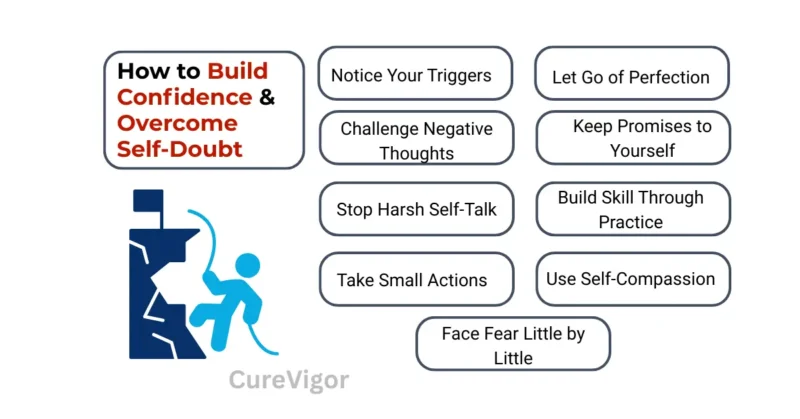
How to Build Confidence and Overcome Self-Doubt
Many people try to build confidence from outside sources. They feel good only when they get praise, attention, or success. But outside approval changes quickly, so that kind of confidence does not last.
Real confidence is different. It comes from self-trust, repeated effort, and personal growth. It stays stronger because it is built inside, not borrowed from other people’s opinions.
This is why confidence is not about always feeling bold. It is about trusting that you can handle life, learn from mistakes, and keep moving forward even when things do not go perfectly.
Notice Your Triggers
The first step in overcoming self-doubt is to notice when it appears. Self-doubt usually has triggers.
It may get stronger before speaking in public, applying for a job, posting online, starting a business, or having a hard conversation.
Pay attention to the moments when your mind becomes negative. Ask yourself what happened just before the doubt appeared. This helps you understand the pattern rather than feel confused by it.
When you see your triggers clearly, self-doubt becomes easier to manage. You stop seeing it as your whole identity and start seeing it as a reaction that can be changed.
Challenge Negative Thoughts
Not every thought in your mind is true. One of the best ways to reduce self-doubt is to question the negative story in your head. When your mind says, “I cannot do this,” pause and ask if that thought is really a fact.
Often, self-doubt speaks in extreme language. It says things like “I always fail” or “I am never good enough.” These thoughts feel powerful, but they are usually unfair and exaggerated.
Try replacing those thoughts with more balanced ones. Instead of saying, “I will fail,” say, “This is hard, but I can learn.” Instead of saying, “I am not good enough,” say, “I am improving with practice.”
Balanced thinking works better than fake positive talk. Your mind responds more strongly to thoughts that feel honest and believable.
Stop Harsh Self-Talk
Many people think harsh self-criticism will make them better. In reality, it often makes them weaker. When you constantly attack yourself, you create fear, shame, and emotional stress.
The way you speak to yourself matters. If your inner voice is always cruel, then every challenge feels heavier. But if your inner voice becomes calmer and kinder, confidence has room to grow.
This does not mean making excuses. It means correcting yourself without destroying yourself. You can learn from mistakes and still treat yourself with respect.
Take Small Actions
One of the biggest mistakes people make is waiting to feel confident before they act. In most cases, confidence comes after action, not before it. You build it by doing, not by waiting.
Start small. Take one action that feels slightly uncomfortable but still possible. Send the message. Ask the question. Share the idea. Practice the skill for ten minutes. One small move is enough to begin.
Each small action teaches your brain that fear is not always a stop sign. It gives you proof that you can move forward even when you feel unsure. That proof becomes the base of real confidence.
Let Go of Perfection
Perfection is one of the biggest enemies of confidence. When you expect everything to be flawless, you put too much pressure on yourself. Then even small mistakes feel huge.
Progress is a better goal than perfection. Strong people are not strong because they never fail. They are strong because they keep learning, adjusting, and improving.
When you stop chasing perfect results, you become more willing to try. That willingness is where growth begins. Confidence grows faster when you give yourself permission to be human.
Keep Promises to Yourself
Confidence becomes stronger when you trust yourself. One simple way to build that trust is to keep small promises to yourself every day.
This could be finishing one task, waking up on time, or following through on a simple goal.
When you break promises to yourself often, your mind notices. It starts to believe that you are unreliable. But when you follow through, even in small ways, your self-trust begins to grow.
This kind of confidence is quiet but powerful. It does not come from showing off. It comes from knowing, deep inside, that you can depend on yourself.
Build Skill Through Practice
Sometimes self-doubt feels strong because you still need more practice. That is not failure. It is just part of growth. Confidence often grows as ability improves.
If you want confidence in speaking, then practice speaking. If you want confidence in your work, then improve your skills.
If you want confidence in relationships, then practice better communication and emotional control.
Skill and confidence grow together. The more capable you become, the easier it is for your mind to trust you. Real confidence is not built on pretending. It is built on steady improvement.
Use Self-Compassion
Self-compassion means treating yourself with kindness during hard moments. It means not turning every mistake into a personal attack. It means remembering that struggle is part of being human.
Many people think self-compassion makes a person soft. In truth, it makes a person more emotionally stable. When you are kind to yourself, it becomes easier to recover, learn, and keep going.
You do not need to praise yourself in fake ways. Just be fair. Speak to yourself with patience, especially when life feels heavy or when things do not go your way.
Face Fear Little by Little
Avoiding fear may feel safe for a moment, but it usually makes fear stronger over time. The more you avoid difficult situations, the more your mind believes those situations are dangerous.
A better way is to face fear in small steps. If speaking in front of a group feels too hard, start by speaking to one person. If sharing your work feels scary, show it to someone you trust first.
This gradual approach helps your brain feel safer with time. It teaches you that discomfort is not the same as danger. With repeated exposure, the fear lessens and confidence grows.
Protect Your Mind from Negative Inputs
Your environment affects your confidence more than you may realize. If you are always around criticism, negativity, or comparison, self-doubt will grow faster.
This also includes what you watch and consume online. Content that constantly makes you feel behind, unattractive, or unsuccessful can quietly damage your self-image. Protecting your attention is part of protecting your confidence.
Choose better inputs. Spend more time with people, content, and routines that help you feel clear, calm, and focused. A healthy mind grows better in a healthy environment.
Daily Habits That Build Unshakable Confidence
Confidence is usually built through daily habits, not one big moment. Small actions repeated often create long-term change. That is why daily routines matter so much.

Simple habits can help a lot. Take time to reflect. Move your body. Practice one skill. Reduce negative self-talk.
Give yourself one clear task to complete each day. These steady actions slowly reshape how you feel about yourself.
The goal is not to feel amazing every day. The goal is to stay connected to yourself and keep moving, even on difficult days. That steady effort creates lasting inner strength.
How to Rebuild Confidence After Failure
Failure can damage confidence, especially if you take it personally. But failure is not a final judgment on your worth. It is just one result, one lesson, or one hard moment.
When you fail, allow yourself to feel disappointed without turning that pain into an identity. You are not a failure just because something failed. That difference is very important.
Look at the situation with honesty. Ask what went wrong, what you learned, and what you can do better next time. When you use failure as feedback, it becomes a teacher instead of a prison.
How to Stop Caring About What People Think
A lot of self-doubt comes from worrying too much about what others think. You may fear being judged, rejected, laughed at, or misunderstood. That fear can make you hide your real self.

The truth is, you cannot control every opinion. No matter what you do, some people will approve and some will not. Building confidence means giving less power to outside opinions and more power to your own values.
Ask yourself a better question. Instead of asking, “What will they think?” ask, “What kind of person do I want to be?” That question leads you back to your own truth.
Confidence Looks Different in Different Areas
Confidence is not one single thing. You may feel confident in one part of life and doubtful in another. This is normal and human.
Someone may feel strong in public but weak in close relationships. Another person may feel calm at home but doubtful at work.
This does not mean they have no confidence at all. It simply means confidence needs to be built in specific areas.
Be clear about where your self-doubt shows up most. The more specific you are, the easier it becomes to improve. A clear problem is easier to solve than a vague one.
When Self-Doubt Feels Too Heavy
Sometimes, self-doubt is deeper than a simple confidence issue. If it comes with strong anxiety, sadness, hopelessness, panic, or a strong desire to withdraw from life, it may be linked to a deeper emotional struggle.
In those cases, extra support may be very helpful. Talking to a qualified mental health professional can help you understand the roots of your self-doubt and build healthier thought patterns.
Getting help is not a weakness. It is a wise step when the burden feels too heavy to carry alone.
What Unshakable Confidence Really Means
Unshakable confidence does not mean you never feel fear. It does not mean you are always loud, bold, or certain. It means you stay steady even when fear shows up.
It means one mistake does not destroy your self-worth. It means one rejection does not make you feel worthless. It means you know that hard moments are part of life, but they do not define who you are.
This kind of confidence is calm and grounded. It is not built on showing off. It is built on self-respect, self-trust, and the ability to keep going.
FAQs
Q. How to build confidence and overcome self-doubt?
Confidence grows when you take small actions even before you feel fully ready. Each small success gives your mind proof that you can handle challenges.
Self-doubt becomes weaker when you question negative thoughts instead of accepting them as facts. Practice, patience, and self-trust help confidence grow over time.
Q. How to have unshakable confidence in yourself?
Unshakable confidence comes from trusting your values, skills, and ability to recover after mistakes. It means not depending fully on praise or approval from others.
When you accept that failure is part of learning, your confidence becomes stronger and more stable. Real confidence stays calm even in difficult moments.
Q. What are the 5 C’s of self-esteem?
The 5 C’s of self-esteem are often described as competence, confidence, character, connection, and caring. Competence means believing you can do things well.
Confidence is trusting your ability to face challenges. Character reflects values, connection means healthy relationships, and caring means kindness toward yourself and others.
Q. What are the 4 P’s of confidence?
The 4 P’s of confidence are preparation, practice, patience, and positive thinking. Preparation helps reduce fear because you know what you are doing. Practice builds skill and makes tasks feel easier.
Patience reminds you that confidence takes time, while positive thinking supports stronger self-belief.
Q. What are 7 ways to improve your self-esteem?
Self-esteem improves when you stop harsh self-talk, set small goals, celebrate progress, learn new skills, stay around supportive people, care for your health, and avoid unhealthy comparisons.
These daily habits slowly change how you see yourself. Growth happens when you treat yourself with fairness and consistency.
Q. How to be unshakeable in every situation?
Being unshakeable means staying calm under pressure. Focus on what you can control instead of reacting to everything around you.
Accept that not every situation will feel comfortable, but you can still respond wisely. Inner stability grows when your decisions follow your values rather than fear.
Q. What are the 6 pillars of self-esteem?
The 6 pillars of self-esteem are self-awareness, self-acceptance, self-responsibility, self-assertiveness, purposeful living, and personal integrity.
These pillars help a person build a healthy inner foundation. When these areas become stronger, confidence becomes more natural and long-lasting.
Q. What are the 3 C’s of self-esteem?
The 3 C’s of self-esteem are commonly confidence, competence, and connection. Confidence is belief in yourself, competence is your ability to do things well, and connection means feeling valued in relationships.
Together, these three support emotional strength and healthy self-worth.
Q. How can I be 100% confident in myself?
No one feels 100% confident all the time, because confidence naturally changes with situations.
The goal is not perfect confidence but strong self-trust even when fear appears. Accept your limits, keep learning, and remind yourself that confidence grows through action, not perfection.
Conclusion
Overcoming self-doubt takes time, but it is possible. You do not need to become a completely different person. You only need to build a new relationship with yourself, one step at a time.
Notice your triggers. Question negative thoughts. Take small actions. Let go of perfection. Keep promises to yourself.
Practice kindness instead of cruelty. These simple steps, repeated daily, can change the way you think and live.
Confidence is not a gift given to a lucky few. It is something you build through action, honesty, and growth. Self-doubt may still visit you sometimes, but it does not have to control your life.
Ready to leave self-doubt behind? Start building stronger confidence today by taking one small step, trusting your growth, and believing in your ability to rise.
Read more Health Balance articles.
You might like: