
Learn how to stay mindful when life gets overwhelming. Discover 7 practical techniques, from box breathing to the STOP method, to break the cycle of stress, stop emotional reactivity, and regain your calm in any situation.
Stress can feel like a smoke detector going off at full volume, even when the problem is just burnt toast. Your body reacts fast.
Your thoughts spiral. Your emotions rise. Before you know it, you’re no longer responding, you’re reacting.
This is where mindfulness comes in.
Mindfulness doesn’t remove stress. It helps you see it clearly, respond wisely, and stay grounded when things feel overwhelming.
It gives you a small but powerful pause between what happens and how you respond.
If you often feel stuck in your head, tense in your body, or overwhelmed by everyday pressure, you’re not alone.
This guide will walk you through what mindfulness looks like in real life and how to use it when you need it most.
Quick Summary Box
How to Stay Mindful in Stressful Situations – At a Glance
- Stress pulls you out of the present; mindfulness brings you back.
- Early signs include overthinking, tension, and emotional reactivity.
- Simple techniques like breathing, grounding, and pausing can reset your mind.
- You don’t need long practices—small moments of awareness are enough.
- Mindfulness helps you respond with clarity rather than react automatically.
- The goal isn’t to remove stress, but to change your relationship with it.
What Does It Mean to Stay Mindful Under Stress?
Staying mindful during stress means staying aware of what is happening, both inside and around you, without immediately reacting.
Instead of getting swept away by thoughts or emotions, you notice them. You observe what’s going on with a steady, calm attention.
It sounds simple, but under stress, your brain shifts into survival mode. It tries to protect you by reacting quickly.
That’s helpful in danger, but not in daily life situations like work pressure, arguments, or uncertainty.
Mindfulness helps you step out of autopilot.
When you’re mindful:
- You notice your thoughts without believing all of them.
- You feel emotions without being controlled by them.
- You respond instead of react.
Think of mindfulness as a mental “check-in.” It asks:
What’s actually happening right now?
That simple awareness creates space. And in that space, you can choose your next step with clarity.
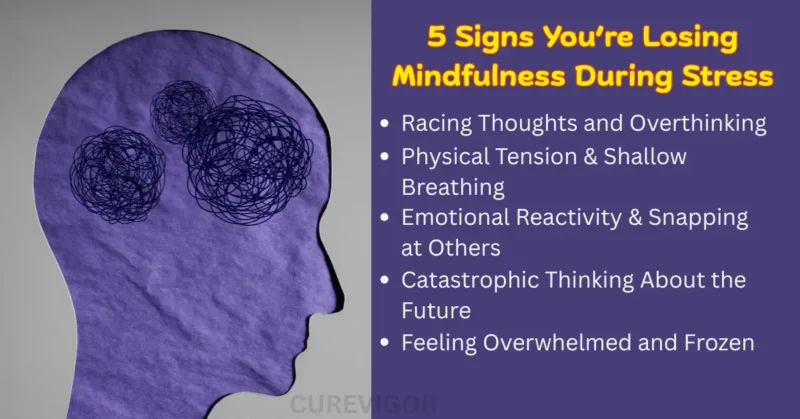
5 Signs You’re Losing Mindfulness During Stress
Stress has a quiet way of pulling you out of the present moment. It doesn’t usually announce itself clearly.
Instead, it builds in small shifts, in your thoughts, your body, and your reactions, until you suddenly feel overwhelmed or disconnected.
Learning to notice these early signals can make a real difference. It gives you a chance to gently come back to yourself before stress takes over.
Racing Thoughts and Overthinking
One of the earliest signs is a change in the speed and tone of your thoughts.
Your mind may start moving faster than usual, jumping from one idea to another without pause. You might replay a conversation again and again, wondering what you should have said differently.
Or your thoughts may drift into the future, creating scenarios that haven’t happened and may never happen.
At first, it can feel like you’re trying to solve a problem. But instead of clarity, you get more noise.
This is where mindfulness quietly slips away. Your attention is no longer grounded in what is actually happening right now. Instead, it’s scattered across imagined outcomes and unfinished thoughts.
A helpful way to notice this shift is to ask yourself: Am I thinking, or am I stuck in a loop?
That simple question can gently bring awareness back.
Physical Tension and Shallow Breathing
Stress doesn’t only live in your mind; it shows up in your body, often before you even realize it.
You might notice a subtle tightening in your shoulders while working, or a clenched jaw during a difficult conversation.
Sometimes your hands feel tense, or your chest feels slightly heavy. These are quiet signals that your body has moved into a protective state.
Your breath changes, too. It becomes shorter, quicker, and shallower. This happens because your body is preparing for action, even if no real danger is present.
What makes this tricky is how easy it is to ignore these signals. Many people remain in this tense state for hours without realising it.
Mindfulness begins the moment you pause and feel your body again. Even noticing one tight area or one shallow breath is enough to reconnect.
Emotional Reactivity and Snapping at Others
Another sign of lost mindfulness is how quickly emotions take over your responses.
You may find yourself reacting before you’ve had a chance to think. A small comment feels bigger than it is. A minor frustration leads to a sharp reply.
Later, you might wonder, Why did I respond like that?
This happens because stress narrows your awareness. Instead of seeing the full picture, your mind focuses only on the trigger.
In that moment, there’s no space, just reaction.
Mindfulness creates that missing space. It doesn’t remove emotion, but it allows you to notice it before acting on it.
Without that pause, emotions tend to lead the way, often in ways that don’t reflect how you truly want to respond.
If you notice yourself reacting quickly or feeling unusually defensive, it may be a sign that your awareness has drifted.
Catastrophic Thinking About the Future
Stress often pulls your attention out of the present and into imagined futures.
These thoughts can feel very real. Your mind may start asking “what if” questions that spiral quickly. What if this goes wrong? What if I can’t handle it? What if everything falls apart?
Even when nothing has actually happened, your body reacts as if it has.
This is one of the more exhausting aspects of stress. You’re not only dealing with the current situation, but you’re also carrying the weight of imagined outcomes.
Mindfulness gently interrupts this pattern. It reminds you to return to what is actually happening right now.
A small shift can help here: instead of asking what if, ask what is true in this moment?
Often, the present is more manageable than the story your mind is creating.
Feeling Overwhelmed and Frozen
Sometimes stress doesn’t make you react outwardly. Instead, it shuts things down.
You might feel stuck, unable to decide what to do next. Tasks that normally feel simple suddenly seem too big. Even starting can feel difficult.
This “freeze” response is your brain’s way of protecting you from overload. When too much is happening at once, it slows things down by stopping action altogether.
It can feel frustrating, especially when you know what needs to be done but can’t seem to move forward.
Mindfulness helps by gently narrowing your focus. Instead of trying to handle everything, it brings your attention to one small, manageable step.
Not the whole plan. Not the entire problem. Just the next step.
And often, that’s enough to begin again.
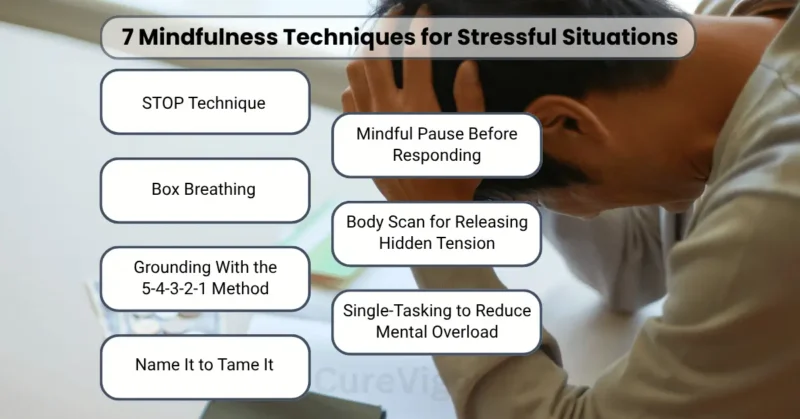
7 Mindfulness Techniques for Stressful Situations
When stress hits, it rarely arrives at a convenient time. You’re in the middle of a conversation, working through a deadline, or trying to make a decision.
That’s why mindfulness needs to be simple and practical, something you can use in real moments, not just quiet ones.
These techniques are not about doing them perfectly. They are about gently interrupting stress and returning to awareness, even if only for a few seconds.
STOP Technique: A Gentle Reset in the Middle of Stress
The STOP technique is like pressing a pause button when everything feels like it’s speeding up.
In stressful moments, your mind tends to rush ahead, and your body follows. This technique slows that process down just enough for you to regain clarity.
Callout Box: STOP Method
- Stop
- Take a breath
- Observe
- Proceed
What makes this technique powerful is not the steps themselves, but the intention behind them. When you stop, even briefly, you interrupt the automatic reaction.
The breath that follows isn’t just air; it’s a signal to your body that it can soften.
As you observe, you may notice things you missed a moment ago, tightness in your chest, a rush of thoughts, or a strong emotional pull.
And then, when you proceed, you’re no longer reacting blindly. You’re choosing your next step with awareness.
This can be used almost anywhere, before replying to a message, during a tense conversation, or even when you feel overwhelmed by a task.
Box Breathing to Calm Your Nervous System
Your breath is one of the quickest ways to influence how you feel.
When stress takes over, breathing becomes shallow and uneven. Box breathing gently restores rhythm and steadiness, which helps calm your nervous system.
Here’s the structure:
| Action | Duration |
| Inhale | 4 seconds |
| Hold | 4 seconds |
| Exhale | 4 seconds |
| Hold | 4 seconds |
As you follow this pattern, something subtle begins to shift. Your heart rate slows, your body loosens, and your thoughts become less urgent.
What’s helpful about this technique is how quiet it is. No one around you needs to know you’re doing it. You can use it while sitting at your desk, waiting in line, or even listening to someone speak.
After just a few rounds, you may notice that the intensity of stress has softened—not gone, but more manageable.
Grounding With the 5-4-3-2-1 Method
When your mind is caught in anxious thoughts, grounding brings you back to reality.
This method uses your senses to anchor you in the present moment, where things are usually more stable than your thoughts suggest.
Callout Box: 5-4-3-2-1 Method
- 5 things you can see
- 4 things you can feel
- 3 things you can hear
- 2 things you can smell
- 1 thing you can taste
As you move through each sense, your attention slowly shifts from internal noise to your surroundings.
You might notice the texture of your clothing, the hum of a fan, or the light coming through a window. These small details may seem simple, but they carry you out of your head and back into the moment.
This technique is especially helpful when stress feels intense or overwhelming. It reminds you that right now, in this moment, you are safe enough to pause.
Name It to Tame It: Creating Space From Emotions
Emotions can feel overwhelming when they remain unnamed. They move through you quickly, shaping your reactions before you fully understand them.
Putting feelings into words changes that.
When you quietly say to yourself, “I feel overwhelmed” or “I feel anxious,” something shifts. The emotion is no longer a wave pulling you under—it becomes something you can see.
There is also a biological reason for this. When you label an emotion, brain activity begins to move away from the emotional centre (the amygdala) and toward the thinking centre (the prefrontal cortex). This shift helps you feel more grounded and less reactive.
You don’t need perfect words. Even a simple label is enough. What matters is the act of noticing.
Over time, this practice builds a quiet kind of emotional awareness—one that allows feelings to exist without taking over.
Mindful Pause Before Responding
Many stressful moments are made harder by how quickly we respond.
A rushed reply, a defensive tone, or a sharp comment often comes from not having enough space between feeling and action.
A mindful pause creates that space.
It can be as simple as taking one slow breath before speaking. In that brief moment, you give yourself time to notice what’s happening inside you. You may feel tension in your body or a strong urge to react.
Instead of pushing that away, you acknowledge it.
Then, you ask yourself a quiet question: What response would feel right here, not just right now, but afterwards too?
This small pause often changes the direction of the interaction. It allows you to respond in a way that aligns more closely with your values, not just your immediate emotion.
Body Scan for Releasing Hidden Tension
Stress often settles into the body without drawing attention to itself.
You might carry it on your shoulders, your jaw, or even your stomach. Over time, this tension builds quietly, adding to your sense of unease.
A body scan brings gentle awareness to these areas.
You begin by noticing one part of your body at a time. There’s no need to change anything at first, just observe. You might realize your shoulders are slightly raised or that your jaw is tight.
As you notice, you allow those areas to soften, even just a little.
This doesn’t require a long session. Even 30 seconds can help. The goal isn’t to remove all tension, but to reconnect with your body and release what you can.
Many people find that once they start paying attention, they discover tension they didn’t even know they were holding.
Single-Tasking to Reduce Mental Overload
In stressful moments, the instinct is often to do more, faster.
You might try to handle multiple tasks at once, thinking it will help you catch up. But in reality, this creates more pressure.
What we often call multitasking is actually constant switching between tasks. Each switch requires mental effort, which increases fatigue and stress.
Studies suggest this can significantly raise stress hormones, making you feel even more overwhelmed.
Single-tasking offers a quieter approach.
Instead of spreading your attention thin, you place it fully on one task. You give yourself permission to focus, without rushing ahead to the next thing.
As you do this, something shifts. The task feels more manageable. Your thoughts slow down. And the sense of overwhelm begins to ease.
It may not seem like much, but focusing on one thing at a time can create a surprising sense of calm.
A Small Reminder That Matters
Mindfulness doesn’t require long periods of silence or perfect focus.
Sometimes, it’s just a brief moment of noticing your breath. A short pause before speaking. A quick check-in with your body.
Even ten seconds can make a difference.
These small moments don’t eliminate stress, but they change how you meet it.
How to Practice Mindfulness During High-Stress Events
Stressful situations are where mindfulness matters most, but also where it feels hardest to access.
In these moments, the goal isn’t to stay perfectly calm. It’s about staying present enough to respond with awareness, even when things feel intense.
Mindfulness at Work During Deadlines
Work stress often builds gradually, only to suddenly feel overwhelming.
Deadlines, messages, and expectations can create a sense of constant urgency. It can feel like there’s no time to pause, but that’s exactly when small pauses matter most.
Before opening a new task or message, take a single slow breath. It may seem insignificant, but it creates a small reset.
As you work, notice when your mind begins to rush ahead. You might start thinking about everything you still need to do. When that happens, gently bring your attention back to the task at hand.
During meetings or conversations, try to stay fully present. Instead of preparing your response while the other person is speaking, simply listen. This not only reduces stress but also improves clarity and connection.
When pressure rises, slowing down, even slightly, often helps you move more effectively, not less.
Mindfulness During Family or Relationship Conflict
Conflict can quickly pull you out of awareness.
Emotions feel stronger, and the urge to defend or explain yourself becomes immediate. In these moments, mindfulness isn’t about staying perfectly calm; it’s about staying connected to what’s happening inside you.
As the conversation unfolds, notice your reactions. You may feel tension in your chest or a strong urge to interrupt. Instead of acting on it right away, acknowledge it silently.
Listening becomes especially important here. Not listening to reply, but listening to understand. This doesn’t mean you agree; it simply means you’re present.
If things feel too intense, it’s okay to pause. Even a short break can help both people return with more clarity.
Mindfulness creates space in conversations where things might otherwise escalate.
Mindfulness in Financial or Health Stress
Stress related to finances or health can feel ongoing and uncertain.
Unlike short-term stress, this type often lingers in the background, affecting your thoughts throughout the day. It may result in ongoing anxiety about the future.
Mindfulness helps by gently bringing your attention back to the present moment.
You may notice your mind drifting toward worst-case scenarios. When that happens, instead of trying to stop the thought completely, you acknowledge it and return to what is in front of you.
What can you do today? What is within your control right now?
This shift doesn’t solve everything, but it reduces the weight of uncertainty.
Avoiding these stresses completely often makes them feel heavier. Facing them with awareness, even in small ways, can make them feel more manageable.
Practical Techniques to Enhance Mindfulness Daily
To learn to stay mindful, start by incorporating simple breathing techniques into your routine.
For example, take a few minutes each day to focus on your breath.
Inhale slowly through your nose, hold it for a moment, and then exhale gently through your mouth.
This practice centres your mind and helps you remain present.
Another way is to engage your senses while performing daily tasks.
During mealtime, pay close attention to the flavours, textures, and aromas of your food.
This practice not only enhances your awareness but also transforms ordinary moments into meaningful experiences, fostering a deeper connection with the present.
Summary for Skimmers
If you’re short on time, here’s the heart of it:
Staying mindful during stress means noticing what’s happening in your mind and body without getting carried away by it. When stress rises, your thoughts speed up, your body tightens, and your reactions become automatic.
Simple practices, like slowing your breath, pausing before responding, or focusing on your senses, help you return to the present moment.
You don’t need perfect focus or long sessions. Even a few seconds of awareness can shift how you feel.
Over time, these small moments build a calmer, clearer way of handling stress. You may still feel pressure, but you won’t feel as lost inside it.
Common Inquiries About How to Stay Mindful
Q. How to focus in stressful situations?
Focusing during stress starts with calming your body before trying to control your thoughts. When your body feels tense, your mind struggles to stay steady. A slow, steady breath can help bring your attention back.
Instead of trying to handle everything at once, gently narrow your focus to one small task. Give it your full attention, even if it feels simple. This reduces mental overload and makes it easier to move forward.
It also helps to notice when your mind drifts. Rather than getting frustrated, guide it back, again and again. Focus is not about holding attention perfectly, but about returning to it with patience.
Q. What is the 3-3-3 rule in mindfulness?
When under stress or worry, the 3-3-3 rule is a straightforward grounding method that helps you refocus on the present.
You begin by noticing three things you can see around you. Then, you shift to three things you can hear. Finally, you move three parts of your body, such as your fingers, shoulders, or feet.
This method works by engaging your senses and gently pulling your mind away from anxious thoughts.
It’s especially helpful when your thoughts feel overwhelming, as it gives your attention something real and immediate to focus on.
Q. What is the 42% rule for burnout?
The 42% rule often refers to research suggesting that nearly 42% of workers report experiencing burnout at some point. While the exact number can vary across studies, the idea highlights how common burnout has become.
This isn’t just about feeling tired. Burnout includes emotional exhaustion, reduced motivation, and a sense of detachment from work or daily life.
Understanding this number can help normalize the experience. If you’re feeling drained or disconnected, you’re not alone. It also shows the importance of early awareness, rest, and mindful breaks before stress becomes overwhelming.
Q. What are the 5 C’s of mindfulness?
The 5 C’s of mindfulness describe qualities that support a calm and aware mind: curiosity, compassion, calmness, clarity, and courage.
Curiosity helps you observe your thoughts without judgment. Compassion allows you to treat yourself kindly, especially during stress.
Calmness develops as you slow down and breathe. Clarity comes from seeing situations as they are, not as your fears imagine them.
Courage is what helps you stay present, even when emotions feel uncomfortable. Together, these qualities create a balanced and supportive way of responding to stress.
Q. What are the 5 C’s of burnout?
The 5 C’s of burnout often describe common experiences people face when prolonged stress sets in: cynicism, confusion, chronic fatigue, reduced confidence, and detachment.
Cynicism may manifest as negative thinking or a lack of motivation. Confusion can make it hard to focus or make decisions. Chronic fatigue leaves you feeling tired even after rest.
While detachment can lead to a sense of emotional separation from relationships or a job, decreased confidence can cause self-doubt. Recognizing these signs early can help you take steps toward recovery and support.
Q. What are the 3 R’s of burnout?
The 3 R’s of burnout are recognition, reversal, and resilience.
Recognition means noticing the signs of burnout early, such as exhaustion or loss of interest. This awareness is the first and most important step.
Reversal focuses on making changes, like setting boundaries, resting, and reducing stress where possible. It’s about gently shifting your daily patterns.
Resilience is built over time through habits that support your well-being, such as mindfulness, rest, and balanced routines. It helps you handle future stress with greater strength and stability.
Learning How to Stay Mindful When It Matters Most
Stress is part of life. It shows up in quiet worries, busy days, and unexpected challenges. You don’t need to remove stress to feel better; you need a steadier way to meet it.
That’s where how to stay mindful becomes meaningful.
Mindfulness isn’t about being calm all the time. It’s about noticing when you’re not. It’s about catching the moment your thoughts begin to race, your body tightens, or your emotions take over, and gently returning to awareness without judgment.
There will be times when you forget. That’s human. What matters is the return.
Each time you pause, take a breath, or notice what’s happening inside you, you are building a new pattern.
One that is slower, steadier, and more supportive. Over time, this changes how you respond to stress, not by removing it, but by softening its impact.
Think of mindfulness as a relationship, not a skill you master once. Some days it feels easy. Other days, it takes effort. Both are part of the process.
And even in your busiest or hardest moments, there is always a small opening, a breath, a pause, a single moment of awareness. That’s where change begins.
Stress is inevitable, but staying stuck in it doesn’t have to be. Which of these 7 techniques will you try the next time things get hectic?
Choose one, try it for 60 seconds, and see how your perspective shifts. Leave a comment below sharing your favorite way to find your centre.
Or save this post for the next time you need a mindful reset!
Read more Health and Wellness informational blogs.
You might like: