
Tired of dragging through your day? Try these 5 circadian rhythm hacks to feel more awake, sharper, and more energized naturally.
Even after eight hours in bed, you wake up weary. By 2 p.m., you’re reaching for your third coffee, and by 9 p.m., you’re somehow wide awake scrolling your phone.
If that sounds like your daily loop, your circadian rhythm is probably out of sync, and no amount of caffeine will fix it. The real solution is working with your body’s internal clock, not against it.
I spent years in this exact loop. I’d blame stress, blame work, and blame age. The truth was simpler and more annoying: I was sending my body the wrong signals at the wrong times, all day long.
Once I learned how to reset those signals, my energy stabilized in a way no supplement or productivity hack ever delivered.
These five circadian rhythm hacks for better wakefulness are the ones that genuinely moved the needle for me, and they’re backed by sleep science strong enough to bet your mornings on.
What Your Circadian Rhythm Actually Is (And Why It Controls Your Energy)
The roughly 24-hour internal clock that runs in the background of every cell in your body is known as your circadian rhythm.
It decides when you feel alert, when you feel sleepy, when your body releases hormones, when your digestion fires up, and when your body temperature rises and falls.
It’s controlled by a tiny region in your brain called the suprachiasmatic nucleus, and its main input is light.
When your circadian rhythm runs smoothly, mornings feel energizing, afternoons feel productive, and evenings naturally wind down toward sleep.
When it’s misaligned, from late nights, screen overload, irregular meals, or shift work, you get the opposite: groggy mornings, afternoon crashes, and 11 p.m. bursts of “wait, why am I suddenly wide awake?”
Fixing the rhythm fixes the energy. Everything else is just patching symptoms.
Here Are The 5 Circadian Rhythm Hacks for Better Wakefulness
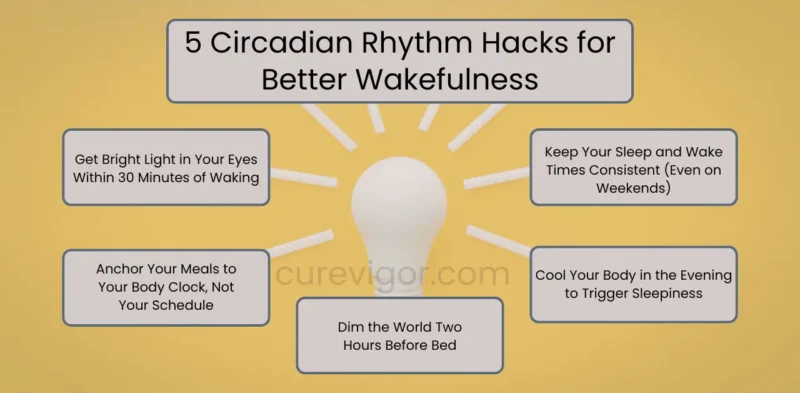
Hack 1: Get Bright Light in Your Eyes Within 30 Minutes of Waking
If you only try one thing from this article, make it this one. Morning light is the single most powerful signal you can give your brain to set the rest of your day on track.
Here’s what’s happening: when bright light hits your eyes shortly after waking, it tells your brain to shut off melatonin production and start the alertness cascade.
Cortisol rises sharply, body temperature climbs, and your wake-up “anchor” gets locked in for the day. That same anchor is what makes you naturally sleepy roughly 14–16 hours later, which means good mornings literally create good nights.
What you want is direct outdoor light, even on cloudy days. A 10-minute walk outside without sunglasses delivers far more lux than any indoor lamp; even a sunny window through glass cuts the intensity dramatically.
On dark winter mornings or if you genuinely can’t get outside, a 10,000-lux light therapy lamp placed at arm’s length while you eat breakfast or check email works as a solid backup.
I started doing this with a five-minute walk to the end of my street, coffee in hand. Within about a week, I was waking up naturally before my alarm. It still surprises me how quickly such a small habit rewired my energy.
Hack 2: Anchor Your Meals to Your Body Clock, Not Your Schedule
Most people think of the circadian rhythm as a brain thing. It’s actually a whole-body thing, and your digestive system has one of the strongest secondary clocks in your body.
When you eat, it sends a signal to your rhythm almost as powerful as when you see light.
The hack is to eat your meals on a consistent schedule, with most of your calories earlier in the day. Your metabolism, insulin sensitivity, and digestive enzymes are all at peak performance before sunset.
Eating a heavy meal at 10 p.m. forces your body to process food when it’s biologically trying to wind down, which fragments your sleep and leaves you groggy the next morning.
A practical version looks like this: eat breakfast within an hour or two of waking (even something small), have your largest meal at lunch or early dinner, and try to finish eating at least 2–3 hours before bed.
You don’t need to be religious about it; just stop the late-night grazing that secretly sabotages your wakefulness the next day.
When you do this consistently, hunger starts showing up on a predictable schedule, energy stabilizes between meals, and that 3 p.m. crash quietly disappears.
Hack 3: Dim the World Two Hours Before Bed
This one is going to feel inconvenient, and it’s still worth doing. Bright light, especially the blue wavelengths from phones, laptops, TVs, and overhead LED lighting, signals to your brain that it’s still daytime.
Your melatonin production gets delayed, your sleep onset gets pushed later, and your morning wakefulness pays the price.
The fix isn’t about banning screens. It’s about reducing total light exposure in the last two hours before bed. Switch off the overhead lights and use lamps.
Drop your phone and laptop brightness to the lowest comfortable level. Turn on night mode or use blue-light-filtering glasses if you’re working late.
Most modern phones have a “wind down” mode that does this automatically; set it for two hours before your target bedtime.
If you want to take it further, candles or warm-toned salt lamps in the evening give your brain a powerful “the sun is setting” signal.
It sounds dramatic, but the difference in how easily you fall asleep and how clear-headed you wake up is genuinely noticeable within a few nights.
You don’t have to live like a monk. You just have to stop blasting your eyes with sunrise-level light at 10 p.m. and expect your body to know what time it is.
Hack 4: Keep Your Sleep and Wake Times Consistent (Even on Weekends)
This is the hack everyone hates and the one that works the fastest. Your circadian rhythm thrives on predictability.
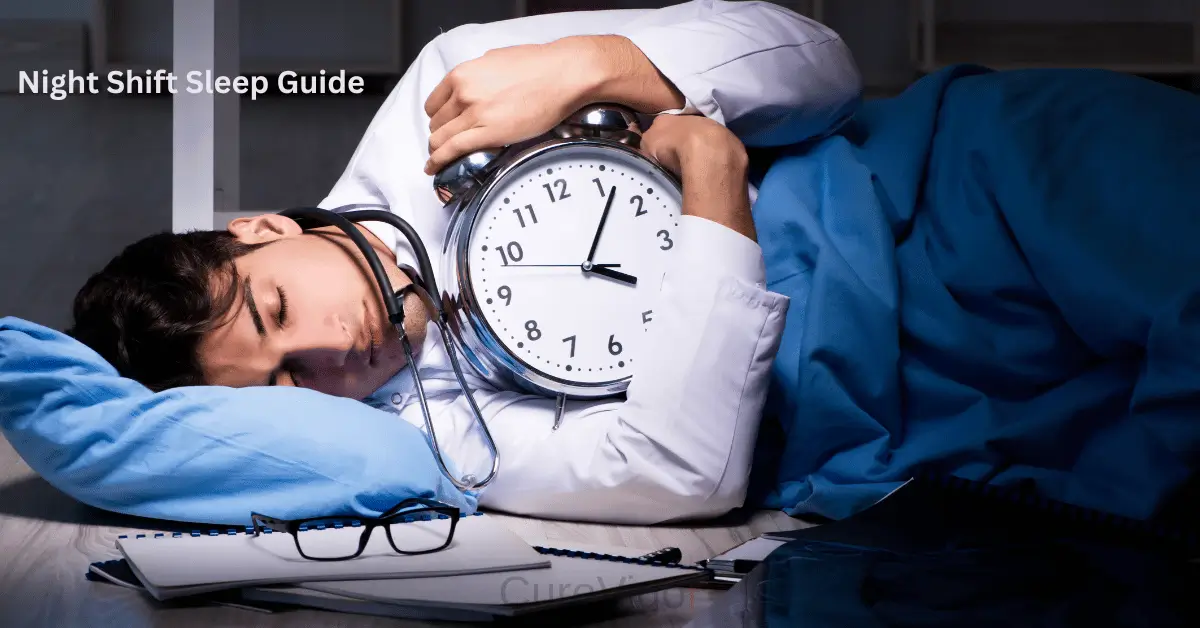
When you wake up at 6:30 a.m. on weekdays and 10 a.m. on weekends, you’re essentially flying your body across two time zones every Friday night and dragging it back every Monday morning.
The fancy term for this is “social jet lag,” and research links it to worse sleep, more fatigue, weight gain, and lower mood.
The hack is simple: pick a wake-up time you can hit seven days a week and stick to it within a 30–60-minute window. Bedtime can flex a little more than wake time; your wake-up is the stronger anchor.
If you had a late night, get up at your normal time and take a short nap in the early afternoon instead of sleeping in. That preserves your rhythm while still letting you recover.
I resisted this one for years because weekends felt like the only time I could “catch up” on sleep.
The catch was that I never actually felt caught up; I just felt jet-lagged every Monday and Tuesday. Once I set my wake time, Mondays stopped being Mondays. That alone was worth the trade.
Hack 5: Cool Your Body in the Evening to Trigger Sleepiness
Your core body temperature follows a clear circadian pattern, rising during the day to support alertness and dropping in the evening to trigger sleepiness.
You can use this on purpose to fall asleep faster and sleep more deeply, which directly improves how awake you feel the next day.
The simplest version is to keep your bedroom cool. Most sleep researchers point to 60–67°F as the ideal range. Cooler than you’d expect, right?
A warm room counters your body’s natural temperature drop, leading to lighter, more fragmented sleep.
Even better: take a warm shower or bath about 90 minutes before bed. It sounds backward, but the warm water brings blood to your skin, and when you step out, your core temperature drops faster and more dramatically than it would on its own.
That sharp drop is one of the strongest sleep signals your body can receive. Studies show people fall asleep about 10 minutes faster on average with this trick — and the quality of that sleep is noticeably deeper.
If a bath isn’t your thing, even washing your face with warm water and slipping into a cool bedroom does a softer version of the same thing.
The point is to work with the temperature curve your body is already trying to follow.
How Long Until You Feel a Difference?
Most people notice meaningful changes within 7–14 days of consistently applying these hacks.
Morning grogginess usually fades first, usually within the first week. Afternoon crashes ease up next. Falling asleep faster and waking before your alarm tend to show up around the two-week mark.
The catch is consistency. Doing this for three days and then drifting back to your old patterns won’t deliver lasting results.
Your circadian rhythm responds to repeated signals, not one-off attempts. Like brushing your teeth, it is small, every day, non-negotiable, and pays off quickly.
What Sabotages These Hacks (Even When You’re Trying)
A few common habits quietly undo all of the above. Late-afternoon caffeine is the biggest one; that 4 p.m. coffee is still in your system at midnight, blocking the adenosine that should be making you sleepy.
Alcohol in the evening fragments your sleep architecture even when it knocks you out fast. Late, heavy workouts spike your core temperature when it should be falling. And doom-scrolling in bed exposes you to exactly the kind of light your brain reads as “morning.”
You don’t need to be perfect. You do need to know what’s working against you so you can make the trade-off consciously instead of by accident.
Recap
Your circadian rhythm is the master switch behind your energy, focus, and mood, and most of us spend our days unknowingly working against it.
The five hacks we covered work because they speak your body’s native language: bright morning light to anchor your wake-up, consistent meal timing to align your metabolism, dim evenings to protect melatonin production, steady sleep and wake times to eliminate social jet lag, and a cool bedroom routine to trigger deeper sleep.
None of them require expensive gadgets or major lifestyle overhauls. They just require consistency.
Apply even two or three of these for a couple of weeks, and you’ll feel the difference in how you wake up, how you power through your afternoons, and how easily you fall asleep at night.
FAQs: Circadian Rhythm and Wakefulness
Q. How long does it actually take to reset a messed-up circadian rhythm?
For most healthy adults, 1–2 weeks of consistent morning light, meal timing, and sleep schedule will produce a noticeable reset.
It can take three to four weeks of consistent practice to fully stabilize larger shifts, such as recovering from long-term late nights or shift work.
Q. Can I fix my circadian rhythm if I work night shifts?
You can absolutely improve it, even if you can’t fully “normalize” it. The key is to keep your sleep and wake times consistent on your days off.
Instead of flipping back to a day schedule, use blackout curtains during daytime sleep, and treat your wake-up time as your “morning” no matter when it falls on the clock.
Q. Is napping bad for my circadian rhythm?
Not at all, when done right. A 20-minute nap before 3 p.m. can boost alertness without disrupting your nighttime sleep.
Long naps or late-afternoon naps can mess things up by reducing your sleep pressure for the night.
Q. Does melatonin actually help reset my rhythm?
Low doses (0.3–0.5 mg) taken 4–6 hours before your target bedtime can help shift your rhythm earlier, but it’s a precision tool, not a sleep aid.
Most over-the-counter doses (3–10 mg) are far higher than research supports and can actually worsen morning grogginess. Talk to your doctor before adding it.
Q. Why am I wide awake at 11 p.m. but exhausted at 8 a.m.?
That’s a classic delayed circadian rhythm: your internal clock has drifted later than your schedule would like.
The fix is morning light exposure immediately upon waking, a consistent earlier wake time, and aggressive evening light dimming. Within 1–2 weeks, your sleepy signals start arriving earlier.
Q. Do circadian rhythm hacks work for people over 50?
Yes, and arguably more powerfully. As you age, your circadian rhythm naturally becomes more fragile and easier to disrupt, which is why older adults often struggle with sleep.
The same hacks, morning light, consistent timing, and cool bedrooms tend to deliver fast, noticeable improvements at any age.
Take Back Your Energy, One Small Signal at a Time
Better wakefulness isn’t about grinding harder, drinking more coffee, or finding the perfect supplement.
It’s a matter of giving your body the signals it has been waiting for: bright morning light, steady meal times, dim evenings, consistent sleep windows, and a cool bedroom.
These five circadian rhythm hacks for better wakefulness aren’t dramatic or expensive. They’re just consistent. And consistency is exactly what your internal clock is built to respond to.
Pick one to start with this week. I’d suggest the morning light walk because it delivers the fastest, most obvious payoff. Add a second hack the following week. Stack a third the week after.
Within a month, you’ll feel like a different version of yourself, the version that wakes up before the alarm, powers through the afternoon without crashing, and falls asleep without negotiating with your phone for an hour first.
Your body has been trying to run on a 24-hour clock this whole time. Stop fighting it. Start working with it. The energy you’ve been chasing has been waiting on the other side of better signals all along.
Don’t try to overhaul everything at once; that’s the fastest way to give up by next Tuesday.
Pick one hack from this list and commit to it for the next seven days. I’d start with the morning light walk because it’s the easiest win and you’ll feel the payoff almost immediately.
Then come back, add another hack, and keep stacking. Your future self, the one waking up clear-headed without three alarms, will thank you.
If you found this guide helpful, share it with someone who’s always running on empty, and check out our related posts on shift work health, energy crashes, and sleep optimization to keep building your wakefulness toolkit.
Read more about night shift health.
You might like: