The best caffeine timing strategy for night shift workers is to take most of your caffeine in the first 3–4 hours of your shift, keep your daily total under about 400 mg, and stop all caffeine at least 8 hours before your planned daytime sleep (6 hours is the absolute minimum).
On 10–12 hour shifts, split that caffeine into two smaller doses instead of one large one. After your cut-off, use light, movement, water, and protein, not more coffee, to get through the 3–5 a.m. slump.
Timing matters more than amount because caffeine has a half-life of roughly five hours. A coffee at 4 a.m. is still about half active when you lie down at 9 a.m. The sleep you lose makes the next shift harder, which pushes you toward more caffeine, which costs more sleep. Good timing breaks that cycle.
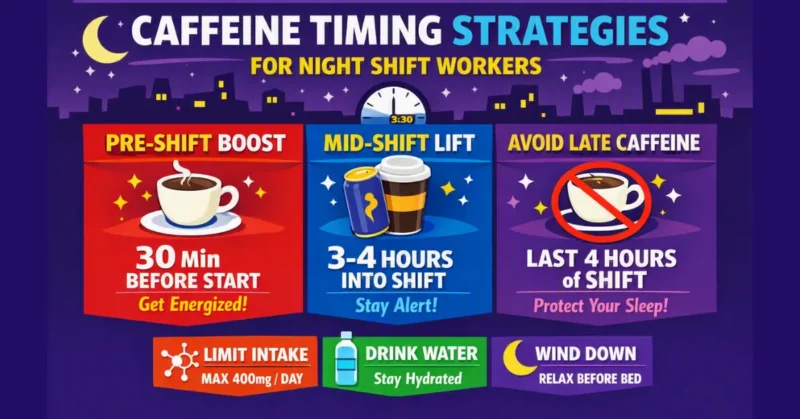
This guide explains how caffeine works with, or against, your body clock, gives you four timing strategies to match your shift, provides ready-made schedules, and shows what to do when you have hit your limit.
The science of caffeine (and why it’s not the same as energy)
Caffeine does not create real biological energy; instead, it blocks a brain chemical called adenosine that causes tiredness, creating a temporary illusion of alertness.
You can learn more about this process through the LMNT Science Guide.
How Caffeine Works in the Brain
- The Sleepy Molecule: Adenosine is a natural chemical in your body. It builds up in your brain as you stay awake and active.
- Receptor Lock: Adenosine binds to specific brain cell receptors to slow activity and make you feel sleepy.
- The Imposter: Caffeine has a molecular shape that is very similar to adenosine. It slips into those same receptors first.
- The Blockade: Because caffeine occupies the space, real adenosine cannot attach. Your brain fails to receive the fatigue message.
Why It Is Not Real Energy
- Zero Calories: Caffeine provides no actual fuel, nutrients, or cellular energy (like ATP) for your body.
- Masked Fatigue: It merely hides your tiredness while sleep debt keeps piling up in the background. Read more on this distinction at The Results Method.
- Downstream Stimulation: With adenosine blocked, other chemicals like dopamine and norepinephrine rise, boosting focus and mood.
The Timeline and the Crash
- Absorption: Caffeine enters your bloodstream within 15 minutes.
- Peak Effect: It reaches maximum alertness levels between 30 and 60 minutes.
- The Wear-Off: Your liver clears the chemical after 3 to 5 hours.
- The Rebound: All the accumulated adenosine rushes back to open receptors at once, causing an energy crash.
Night Shift Caffeine Timing Matters More Than Amount

How Caffeine Affects Circadian Rhythm and Sleep Quality
Your body’s inherent 24-hour clock is called your circadian rhythm. It determines when you feel alert and when you feel sleepy, and light mainly sets it.
Night work asks you to stay alert when this clock is pushing hardest for sleep, especially between about 3 and 5 a.m., when body temperature and alertness reach their lowest point.
Adenosine is blocked by caffeine. The longer you stay up, the more adenosine accumulates in your brain, causing “sleep pressure.” You no longer feel pressure because caffeine takes up the receptors that adenosine would typically employ. But adenosine keeps building in the background. When the caffeine wears off, all of the built-up pressure arrives at once. That is the caffeine crash.

Caffeine also does something less obvious: it moves your body clock. A dose equivalent to a double espresso consumed three hours before bedtime delayed the internal clock by about forty minutes, according to a study published in Science Translational Medicine (2015).
For a night worker trying to sleep in the morning, late caffeine doesn’t just keep you awake; it nudges your clock further from where you need it.
Finally, caffeine lowers sleep quality even when you do fall asleep. It reduces deep (slow-wave) sleep and increases awakenings. Daytime sleep is already lighter and shorter than night sleep for most shift workers. Late caffeine makes a fragile sleep more fragile.
Caffeine Half-Life: Why Late Coffee Ruins Daytime Sleep
The half-life of caffeine is the time your body needs to clear half of it. For most healthy adults, it is around 5 hours, though it ranges from roughly 2 to 10 hours depending on genetics, pregnancy, some medicines (including oral contraceptives, which slow clearance), and smoking (which speeds it up).
Here is what that means if you plan to sleep at 9 a.m. and drink one 100 mg cup of coffee:
| 11 p.m. | 10 | ~25 mg |
| 1 a.m. | 8 | ~33 mg |
| 3 a.m. | 6 | ~44 mg |
| 5 a.m. | 4 | ~57 mg |
Assumes a 5-hour half-life. Slow metabolizers retain more.
A cup of coffee at 5 a.m. leaves more caffeine in your system at bedtime than a full cup of green tea. Research confirms this matters.
In a controlled study in the Journal of Clinical Sleep Medicine (2013), 400 mg of caffeine taken even 6 hours before bed cut measured sleep by more than an hour, and participants mostly did not notice the loss.
According to a 2023 systematic analysis published in Sleep Medicine Reviews, people should drink a typical cup of coffee eight to nine hours before bedtime to avoid reduced overall sleep duration.
That is where the 8-hour cut-off comes from.
Staying Alert vs. Causing Burnout
Picture two workers who each drink 300 mg of caffeine per shift. The first drinks it in the first three hours and sleeps seven hours afterward. The second spreads it out until 6 a.m., sleeps five broken hours, wakes groggy, and needs more caffeine tomorrow. Same amount, opposite results.

Caffeine borrows alertness; sleep pays back the debt. Used early and in moderation, caffeine is a legitimate tool—NIOSH, the U.S. occupational health agency, lists carefully timed caffeine among its fatigue countermeasures for nurses on night shifts.
Used as a replacement for sleep, it feeds a cycle of shortening sleep, rising cortisol, irritability, and the kind of chronic exhaustion that shift workers often describe as burnout.
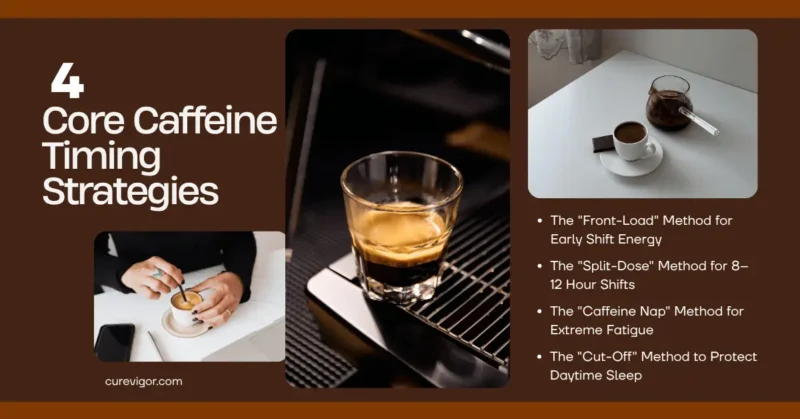
The 4 Core Caffeine Timing Strategies for Night Shift Workers
Pick the strategy that fits your shift length and your sensitivity. Most people settle on one or two.
Strategy 1: The “Front-Load” Method for Early Shift Energy
Best for: 8-hour shifts, people who are sensitive to caffeine, and anyone who struggles to fall asleep after work.
How to do it:
- Drink your main coffee (about 100 mg) with your pre-shift meal, 30–60 minutes before you start. Caffeine starts working within about 15–30 minutes and peaks around an hour later.
- If needed, take a second, smaller dose (50–100 mg) within the first 3–4 hours of the shift, but check it against your cut-off. For most 8-hour night shifts, that puts the second dose around 1–2 a.m.
- Stop completely after that.
Why it protects sleep quality: By the time you go to bed 9–10 hours later, your caffeine has passed through roughly two half-lives, leaving about a quarter of the dose. For most people, that is low enough to sleep normally.
Strategy 2: The “Split-Dose” Method for 8–12 Hour Shifts
Best for: 10–12 hour shifts, where a single early dose will not carry you to the middle of the night.
How to do it:
- Take 50–100 mg at the start of the shift.
- Take a second 50–100 mg around the middle of the shift, as long as it is still at least 8 hours before your planned sleep.
- Keep every single dose under 200 mg. The European Food Safety Authority considers single doses up to 200 mg and daily totals up to 400 mg safe for most healthy adults.
Why smaller doses beat one big one: A large dose produces a sharp peak. Caffeine temporarily raises cortisol, adrenaline, heart rate, and blood pressure, and big single doses are what cause jitters, a racing heart, and stomach upset.
Two smaller doses produce lower peaks, steadier alertness, and a gentler landing. Black or green tea works well as the second dose because it contains less caffeine and is absorbed more slowly.
Strategy 3: The “Caffeine Nap” Method for Extreme Fatigue
Best for: The first night after a schedule change, or any shift you begin already short on sleep.
How to do it:
- Drink 100–200 mg of caffeine quickly, one strong coffee or two espresso shots. Do not sip it over half an hour.
- Lie down immediately for a 15–20 minute nap. Set an alarm.
- Wake as the caffeine peaks. The nap clears some adenosine; the caffeine blocks the rest.
Researchers at Loughborough University’s sleep laboratory showed in the 1990s that caffeine combined with a short nap reduced sleepiness and driving errors in tired drivers more than either alone.
When to use it without hurting alertness later:
- Before the shift starts (ideal), or on a break in the first half of the shift.
- Never after your caffeine cut-off.
- Keep the nap under 20–30 minutes. Longer naps drop you into deep sleep, and waking from deep sleep causes grogginess (“sleep inertia”) that can last 30 minutes or more.
- Safety exception: If you are dangerously sleepy before driving home, a short nap, with a small dose of caffeine if necessary, is safer than pushing through, even if it costs some daytime sleep.
Strategy 4: The “Cut-Off” Method to Protect Daytime Sleep
This rule applies no matter which strategy you use.
The rule: Write down the time you plan to be asleep. Subtract 8 hours. That is your last caffeine of any kind. If your schedule makes 8 hours impossible, treat 6 hours as the hard floor and keep the last dose small.
Watch for hidden caffeine:
| Brewed coffee, 240 ml (8 oz) | 95 mg |
| Espresso, 1 shot | 63 mg |
| Instant coffee, 240 ml | 60 mg |
| Black tea, 240 ml | 47 mg |
| Green tea, 240 ml | 28 mg |
| Energy drink, 240 ml (8 oz) | 80 mg—a 470 ml (16 oz) can is ~160 mg; some brands reach 300 mg |
| Cola, 355 ml (12 oz) | 34 mg |
| Dark chocolate, 28 g (1 oz) | ~20 mg |
| Decaf coffee, 240 ml | 2–5 mg |
Pre-workout powders and some pain relievers also contain caffeine. Check labels.
Best options after your cut-off: water, a protein-and-fiber snack, a 3–5 minute walk or stair climb, bright light, a cold drink, and a short nap on a break if your workplace allows it. The alternatives section below covers each.
Sample Caffeine Schedules Based on Shift Type
These schedules assume you fall asleep within about 90 minutes of getting home. Adjust the times to your real bedtime—the anchor is always “8 hours before sleep,” not the clock.
| 11 p.m.–7 a.m. — front-load (sleep 8:30–9 a.m.) | 10:30 p.m.: one coffee (~95 mg) with pre-shift meal | 12:30–1 a.m.: tea or half cup (~30–50 mg) | 1 a.m. (2:30 a.m.) | Protein snack, 5-minute walk, bright light, water |
| 10 p.m.–6 a.m. — split-dose (sleep 7:30–8 a.m.) | 9:30 p.m.: ~60–95 mg | 11:30 p.m.–midnight: ~50 mg | Midnight (1:30 a.m.) | Same, plus a 15-minute nap on break if permitted |
| 7 p.m.–7 a.m. — 12-hour split-dose (sleep 8:30–9 a.m.) | 6:30 p.m.: ~95 mg | 11 p.m.–midnight: ~95 mg | 1 a.m. (2:30 a.m.) | Move every 60–90 minutes; snack at 3 a.m.; sunglasses for the drive home |
Rotating Shifts: Resetting Caffeine Timing With Your Circadian Rhythm
Rotating schedules are the hardest because your body clock never settles. Three rules keep caffeine from making it worse:
- Anchor caffeine to your next sleep, not to the clock. Each day, ask “When will I sleep next?” and count back 8 hours. That number moves as your shifts move.
- Front-load on the first night of a block. The first night shift is usually the worst because you have been awake since morning. A caffeine nap before the shift and a front-loaded dose help you through it. Keep the cut-off strict so you can sleep the next morning.
- Go light on caffeine when rotating back to days. Caffeine delays your clock. When you need your clock to move earlier, keep caffeine to the morning, get outdoor light early, and skip afternoon coffee for the first two or three days.
Habits and Foods That Boost Caffeine Timing
Caffeine and protein for blood sugar balance
Coffee on an empty stomach, or coffee with a sugary pastry, sets up a spike and crash. Caffeine on its own can make your blood sugar response to food a little sharper, and sugar adds a second spike on top. Two hours later, you feel worse than before you started.
Pairing your first coffee with protein and fiber—eggs, Greek yogurt, nuts, cheese, and a hummus wrap—slows glucose absorption, steadies energy, and protects your stomach.
This is one more reason to take your first dose with your pre-shift meal rather than alone at the start of the shift. The Night Shift Meal Plan has a full week of pre-shift meals and snacks that fit this timing.
Hydration to Prevent Headaches
A mid-shift headache usually has one of three causes: dehydration, low blood sugar, or caffeine withdrawal. Water fixes the first. Moderate coffee does not dehydrate regular drinkers, but on a night shift, coffee often replaces water, and tired people forget to drink.
- Keep a 1-liter bottle at your station and finish it during the shift.
- Match each caffeinated drink with a glass of water.
- Electrolyte drinks are only necessary if you sweat heavily, in physical jobs, or in hot environments. For everyone else, ordinary food supplies enough sodium and potassium. If you do use one, choose a low-sugar version.
Caffeine + Light Exposure = Natural Alertness
Light is the strongest signal your body clock receives. Bright light during the first half of your shift raises alertness on its own and helps your body adapt to night work. Taking your caffeine in a brightly lit area at the start of the shift combines the two most effective everyday alertness tools you have.
The second half of this habit matters just as much: wear sunglasses on the way home and keep your bedroom dark. Morning sunlight tells your clock it is daytime, which fights the sleep you are about to try to get.
A Night Worker’s Caffeine Timing Errors
1. Drinking coffee all shift. A cup every two hours feels harmless, but the last one at 5 or 6 a.m. steals an hour of sleep. You wake tired, drink more, and the cycle tightens. Fix: front-load and set a cut-off.
2. Using energy drinks and sugar for quick energy. A 470 ml (16 oz) energy drink can contain 160–300 mg of caffeine plus 50 g of sugar. You get a sharp spike, a sugar crash within 1–2 hours, and a caffeine load that is still active at bedtime.
Fix: If you want caffeine, choose coffee or tea and keep the dose in check.
3. Chasing fatigue with more caffeine instead of fixing sleep. If you need 400 mg to feel normal, caffeine is no longer giving you energy; it is covering withdrawal and sleep debt. Fix: protect daytime sleep first (dark, cool, quiet room; consistent schedule; no alcohol before bed), then reduce caffeine to the lowest dose that works.
4. Ignoring your own sensitivity. Slow caffeine metabolizers, people with anxiety, reflux, or high blood pressure, and anyone taking medicines that slow caffeine clearance may need earlier cut-offs and smaller doses. Fix: if you routinely lie awake after work, move your cut-off earlier by an hour and see what changes.
5. Taking a large dose on an empty stomach. This maximizes jitters, stomach upset, and the crash. Fix: pair caffeine with protein.
Alternatives to Caffeine
For most schedules, the 3–5 a.m. low arrives after your cut-off. This is where non-caffeine tools do the real work.
What Electrolytes, Cold Water, and L-Theanine Actually Do
- Tea contains the amino acid L-theanine. A few small studies suggest that combining it with caffeine improves attention and reduces jitteriness. It works well with early-morning caffeine, since green tea gives you both. On its own, it is calming, not energizing, so it is not an after-cut-off stimulant.
- Cold water, drinking it or splashing it on your face, gives a brief, modest alertness boost. It buys minutes, not an hour. Use it right before a task that needs focus.
- Electrolytes matter only if you are sweating. Otherwise, water and a salty protein snack do the same job.
Light and Movement Breaks for Energy Management
A brisk 3–5 minute walk or stair climb every 60–90 minutes reduces sleepiness at 4 a.m. more reliably than another coffee would, and it has no effect on your later sleep. Add:
- Stand for phone calls and paperwork.
- Switch to an active or social task during the low point.
- Move to the brightest area available.
- If your workplace allows it, a 15–20 minute nap on a break is the single most effective non-caffeine tool for fatigue.
Easy Snacks That Reduce Fatigue Without Increasing Caffeine
Keep snacks small (200–300 kcal) and built on protein plus fiber. A heavy meal at 3 a.m. slows digestion and makes you sleepier.
- Greek yogurt with a handful of nuts
- A slice of fruit and a boiled egg
- Hummus with carrot or pepper sticks
- Cottage cheese with berries
- Whole-grain crackers with cheese
Caffeine, Sleep, and Long-Term Night Shift Health
How Poor Caffeine Timing Increases Cortisol and Burnout
In moderate amounts, caffeine isn’t linked to long-term harm in healthy adults. The harm comes from how mis-timed caffeine affects sleep.
Short, broken daytime sleep raises cortisol, the body’s main stress hormone, and keeps it elevated when it should be low. Chronic sleep loss also raises blood pressure, increases appetite and cravings, worsens mood, and reduces insulin sensitivity.
Shift work already carries a higher cardiovascular and metabolic risk; poor sleep multiplies it. Our guide on how to prevent a heart attack covers what shift workers can do about that risk.
Burnout is not caused by coffee. But the pattern of too little sleep, too much caffeine, and too little recovery is one of the most common engines behind the exhaustion, cynicism, and reduced performance that define it.
Signs You’re Caffeine-Dependent vs. Truly Fatigued
Likely caffeine dependence:
- Headache, irritability, or mental fog within 12–24 hours of skipping caffeine
- Needing more caffeine than a year ago for the same effect
- Coffee makes you feel “normal,” not “better.”
Likely true fatigue or sleep debt:
- You are sleepy even after caffeine
- Brief involuntary “microsleeps” during quiet tasks
- You fall asleep within minutes whenever you sit still
- You sleep three or more hours longer on days off
Both can be true at once. Dependence responds to a reset; sleep debt responds only to sleep.
Resetting Your Caffeine Tolerance
A reset lets lower doses work again. To minimize withdrawal symptoms, which usually start 12 to 24 hours after the last dose and might linger for several days, take it gradually.
- Start on a stretch of days off or lighter shifts.
- Cut your daily total by about 25% every 3–4 days, swap one coffee for tea, or use half a coffee.
- Hold at 100 mg or less for a week (one cup, front-loaded).
- Return to your chosen strategy at the lowest dose that works.
- Repeat every few months if you notice your dose creeping up.
Who Should Be Careful With Caffeine
Before consuming caffeine strategically, see a physician or pharmacist if you are pregnant or nursing (the recommended daily maximum is 200 mg), have high blood pressure, a heart rhythm issue, anxiety, reflux, or sleeplessness, or take medications that interact with caffeine.
See a doctor or sleep specialist if severe sleepiness or insomnia continues for weeks despite good timing. That pattern can be shift work sleep disorder, a recognized circadian rhythm disorder, and caffeine alone won’t fix it.
FAQ: Caffeine Timing Strategies for Night Shift Workers
Q. What is the best time to drink coffee on the night shift?
With your pre-shift meal, 30–60 minutes before you start, and, if needed, a second smaller dose within the first 3–4 hours. Caffeine peaks about an hour after you drink it, so this covers the first half of the shift while leaving 8 or more hours before daytime sleep.
Q. How many hours before bed should I stop caffeine?
Eight hours is the target; six is the minimum. A 2013 study found that 400 mg taken 6 hours before bed still cut sleep by over an hour, and a 2023 review estimated that a standard cup of coffee should be finished 8–9 hours before bedtime. If you sleep at 9 a.m., stop by 1 a.m.
Q. Can caffeine help with shift work sleep disorder?
It can reduce sleepiness during the shift, and sleep medicine guidelines list it as an option for that purpose. It does not treat the disorder itself, which is a mismatch between your body clock and your schedule.
If you have had persistent insomnia or excessive sleepiness tied to your shift pattern for weeks, see a sleep specialist. Treatment may include timed light exposure, planned naps, sleep scheduling, and in some cases prescription wake-promoting medication.
Q. Is it better to have one big coffee or multiple small ones?
Multiple small doses, as long as all of them fall before your cut-off. Smaller doses produce lower peaks in cortisol and heart rate, fewer jitters, steadier alertness, and a smaller crash. Keep single doses under 200 mg and the daily total under 400 mg.
Q. Should I drink coffee as soon as I wake up for a night shift?
It is fine. The popular advice to “wait 90 minutes after waking” is based on the normal morning cortisol peak, but little direct evidence shows it matters, and shift workers’ cortisol rhythms are already shifted.
What matters more is eating with your coffee and counting that dose toward your daily total and your cut-off.
Q. Is decaf okay after my cut-off?
Yes, for most people. Decaf contains roughly 2–5 mg per cup, and the warm drink and the routine can help you through a low point. If you are very sensitive, switch to herbal tea.
Start Tonight: Your Caffeine Timing Plan
Do three things before your next shift:
- Write down your planned bedtime and subtract 8 hours. That is your cut-off. Put it in your phone.
- Move your first coffee to your pre-shift meal. Pair it with protein.
- Pack one protein snack and a 1-liter bottle of water for the 3–5 a.m. low, and plan a 5-minute walk instead of a late coffee.
Try it for one week and note how quickly you fall asleep and how you feel at the start of the next shift. Most people notice a difference within a few days. To support the same rhythm with your meals, use the Night Shift Meal Plan alongside this schedule.
General health disclaimer: This article provides general education, not personalized medical advice. Caffeine affects people differently. If you are pregnant, have a heart, blood pressure, anxiety, or sleep condition, or take regular medication, consult a qualified healthcare professional before changing your caffeine habits.
Read more about night shift workers’ health.