
Explore the core practices, 7 principles, and historical legacy of Spiritualism.
Thank you for reading this post, don't forget to subscribe!Learn how mediumship, meditation, and evidence-based spiritual habits can foster personal growth, healing, and a deeper connection to the eternal spirit in our modern world.
The 19th century saw the rise of spiritualism, a religious movement based on the idea that the human soul lives on and can communicate with the living.
This philosophy provides insights into the nature of existence and life after death and has tremendously impacted various cultural and theological landscapes.
What are the Core Beliefs of Spiritualism
Spiritualism is a belief system that emphasizes personal growth, moral accountability, and direct connection to the spirit realm.
Its core principles provide a framework for understanding life, death, and the interconnectedness of all beings.
Below, we delve into spiritualism’s foundational beliefs, providing context, examples, and differentiations to deepen your understanding.
The Seven Principles of Spiritualism
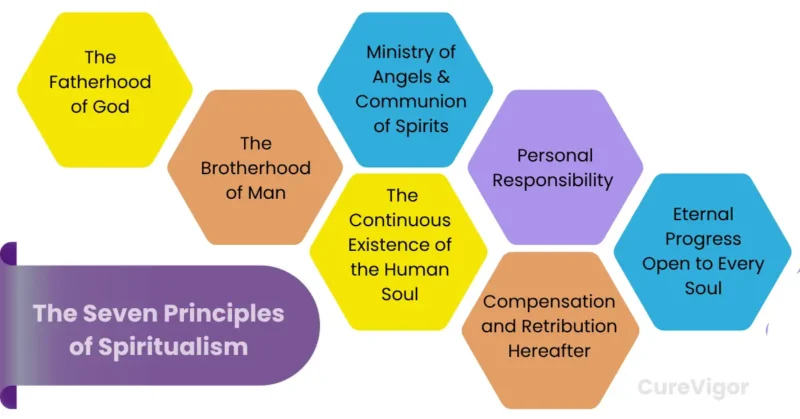
The Seven Principles are at the heart of spiritualism, which serves as guiding tenets for believers. Each principle offers profound insights into the spiritual journey:
1. The Fatherhood of God
Spiritualists acknowledge a universal creative force, often called “infinite intelligence.” This principle unites all beings under a single divine source, fostering a sense of unity and belonging.
Many spiritualists express their connection to this force through meditation or prayer, recognizing divine energy in daily life.
2. The Brotherhood of Man
This principle emphasizes humanity’s interconnectedness and promotes compassion, empathy, and mutual respect. Spiritualists believe that helping others is not just an act of kindness but a spiritual duty.
Community-driven initiatives, such as those highlighted in 25 Ways to Boost Your Spiritual Health, align closely with this belief.
3. The Ministry of Angels and Communion of Spirits
Communication with spirits is central to spiritualism. Mediums bridge the physical and spiritual realms, facilitating guidance, comfort, and healing messages.
Historical accounts, like those of the Fox Sisters, demonstrate how this practice shaped the movement’s foundations.
4. The Continuous Existence of the Human Soul
Spiritualists view the soul as eternal, transcending physical death. This belief provides solace to those grieving and reinforces moral accountability.
The concept aligns with themes from What is Spiritual Health: All You Want to Know, emphasizing the soul’s ongoing evolution.
5. Personal Responsibility
Unlike some religious doctrines that emphasize external salvation, spiritualism teaches that individuals are accountable for their actions. Life choices directly shape one’s spiritual journey.
This principle encourages active self-improvement and aligns with ideas explored in Self-Love in Spirituality.
6. Compensation and Retribution Hereafter
Spiritualists believe in a cause-and-effect relationship between actions and their spiritual consequences.
This principle resembles karma, in which good deeds bring rewards and bad deeds bring challenges.
Anecdotes from mediumship sessions often highlight spirits reflecting on their earthly behaviors and their impact on the afterlife.
7. Eternal Progress Open to Every Soul
Every soul has the potential for growth and enlightenment, regardless of past mistakes.
Spiritual Awakening: Transforming Religious Beliefs demonstrates this optimistic view, empowering believers to embrace change and pursue personal evolution.
How These Principles Shape Spiritualist Practice
The Seven Principles are not rigid dogmas but are intended as guiding truths.
They serve as a moral compass, encouraging adherents to live with integrity, compassion, and spiritual awareness.
By integrating these principles into daily life, spiritualists aim to:
- Build meaningful relationships rooted in love and mutual respect.
- Support their communities through acts of kindness and service.
- Seek spiritual growth through meditation, reflection, and study.
- Foster harmony between the physical and spiritual worlds.
These principles define spiritualism’s essence and provide timeless wisdom that resonates beyond the movement.
History and Evolution of Spiritualism

- Origins of Spiritualism
- Global Spread and Key Figures
- Impact of Scientific Research
Origins of Spiritualism
The history of spiritualism is rich and fascinating, tracing its roots to ancient practices and culminating in the modern-day spiritualist movement.
Among the pivotal events that shaped spiritualism was the emergence of the Fox Sisters in Hydesville, New York, in 1848.
Kate and Maggie Fox, through their apparent ability to communicate with spirits via raps and knocks, sparked widespread curiosity and laid the foundation for spiritualism as we know it today.
Their séances captured the imagination of a population eager to connect with the beyond, especially in an era marked by high mortality rates and limited scientific understanding.
Long before the Fox Sisters, however, spirit communication was already a part of human history.
The Bible records the story of the Witch of Endor, who is said to have conjured the spirit of the prophet Samuel at King Saul’s request.
This narrative highlights humanity’s timeless fascination with the possibility of contacting the deceased.
Practices akin to spiritualism can also be found in ancient Greek, Roman, and Egyptian cultures, where oracles and priests claimed to serve as intermediaries between the living and the spirit world.
The spiritualist movement gained momentum in the 19th century, transitioning from scattered, informal practices into a more organized and widespread phenomenon.
Séances and spirit circles became common in Victorian drawing rooms, appealing to a society grappling with questions about life, death, and the afterlife.
These gatherings provided solace and a sense of wonder, transforming spiritualism into a significant cultural and religious movement.
Global Spread and Key Figures
As spiritualism grew, it spread beyond the United States, gaining prominence in England and France.
In England, the movement flourished during the mid-19th century, attracting people from various walks of life, including notable intellectuals and members of the aristocracy.
Public demonstrations of mediumship and the establishment of spiritualist societies helped to legitimize and formalize the practice.
France played a unique role in the evolution of spiritualism, particularly through Allan Kardec.
Kardec, a prominent educator and writer, compiled and codified spiritualist ideas into a structured philosophy called Spiritism.
His seminal work, The Spirits’ Book (1857), presented a comprehensive framework for understanding the spiritual world, including concepts of reincarnation and moral progression.
Spiritism gained immense popularity in Brazil, thriving as a religious movement that influenced millions.
In the United States, spiritualism maintained its momentum through the work of various mediums and leaders who organized gatherings, camps, and conventions.
Figures such as Andrew Jackson Davis, often called the “Poughkeepsie Seer,” contributed to spiritualism’s philosophical underpinnings.
Davis combined Mesmerism, Transcendentalism, and natural science to develop a cohesive spiritualist worldview.
Impact of Scientific Research
The rise of spiritualism coincided with a burgeoning interest in scientific inquiry, prompting efforts to investigate mediums’ claims and the phenomena they reported.
In the late 19th and early 20th centuries, several prominent scientists focused on spiritualism, seeking to verify its legitimacy.
William Crookes, a renowned British chemist and physicist, conducted extensive experiments with mediums, including Florence Cook.
He documented instances of materialization, levitation, and other seemingly supernatural phenomena, lending spiritualism an air of credibility.
However, many within the scientific community met his findings with skepticism, questioning the rigor of his methods and the reliability of his conclusions.

The skepticism surrounding spiritualism intensified with the efforts of professional magicians like Harry Houdini.
Determined to expose fraudulent mediums, Houdini attended séances and demonstrations, using his expertise in illusion to debunk their claims.
His revelations and those of others in the debunking movement greatly affected Spiritualism’s reputation, particularly in the United States.
Despite these challenges, spiritualism adapted and persisted. In the mid-20th century, spiritualism experienced a revival as part of the New Age movement, which embraced a broader spectrum of spiritual practices and beliefs.
This resurgence marked a renewed interest in channeling, healing, and other forms of spirit communication.
Spiritualism’s history and evolution demonstrate its resilience and enduring appeal. From its ancient roots to its formalization in the 19th century and subsequent global spread, spiritualism has captivated humanity’s imagination.
While it has faced criticism and challenges, it offers a unique perspective on the mysteries of life, death, and the beyond.
By understanding its origins, key figures, and the impact of scientific inquiry, we gain deeper insight into a movement that bridges the gap between the seen and unseen worlds.
Beliefs About Afterlife and Moral Accountability
Spiritualists perceive the afterlife as a vibrant continuation of existence, not a distant, static realm.
The transition from the physical to the spiritual world is seamless, with spirits retaining their individuality and memories.
This belief challenges traditional notions of heaven and hell, focusing instead on moral development.
The Role of Life Reviews
Spiritualists often describe “life reviews” during mediumship sessions, where spirits reflect on their earthly experiences. These reviews emphasize accountability and inspire the living to act with integrity.
This perspective complements the themes in The Connection Between Spirituality and Social Support for Wellness, highlighting how our actions ripple through relationships and communities.
Role of Spirit Guides and Their Significance
Spirit guides are pivotal in spiritualism. They offer wisdom and support to individuals navigating their spiritual path.
These entities, often described as enlightened beings, assist in personal growth and decision-making.
Mediums frequently connect with spirit guides during readings, sharing their insights to empower clients.
How Spirit Guides Communicate
Communication from spirit guides can manifest in various ways, including:
- Intuitive nudges or gut feelings.
- Symbolic dreams or visions.
- Synchronistic events that confirm decisions or directions.
Spiritualists view these interactions as reminders of their connection to a higher purpose, as explored in Where to Find Your Spiritual Home.
How Spiritualism is Different from Other Religions
Spiritualism is distinct from many traditional religions due to its experiential nature. While most religions emphasize faith in scriptures or divine revelations, spiritualism prioritizes direct, personal experiences with the spirit realm.
Below are key differentiators:
- Direct Evidence of the Afterlife: Spiritualism relies on mediumship and psychic phenomena to validate the afterlife, offering tangible experiences rather than abstract doctrines.
- Absence of Dogma: Unlike structured religions, spiritualism encourages individual exploration and interpretation of spiritual truths.
This freedom aligns with the ideas in 25 Simple Spiritual Practices for Beginners, which emphasize personal discovery. - Focus on Healing: Spiritualism integrates spiritual healing practices, often facilitated by mediums or energy workers. This emphasis on healing is a core aspect of its community gatherings and services.
- Progressive Beliefs: Many traditional religions emphasize static beliefs, while spiritualism advocates continuous learning and growth in life and beyond.
This progressive outlook resonates with the themes in Spiritual Intentions 2025: Purposeful Balanced Life.
Spiritualism’s core beliefs provide a transformative lens through which individuals can explore their spirituality, connect with the divine, and seek personal growth.
By emphasizing moral accountability, eternal progress, and direct communication with the spirit realm, spiritualism offers a unique and empowering approach to understanding life and the afterlife.
Its inclusive and experiential nature inspires believers worldwide, bridging the gap between ancient traditions and modern spiritual needs.
Mediumship: The Heart of Spiritualism
Mediumship lies at the core of spiritualism, serving as the vital bridge between the physical world and the spiritual realm.
It is both a profound practice and a sacred gift, deeply embedded in spiritualist traditions. This section delves into the essence of mediumship, its various forms, notable historical figures, and its modern adaptations.
What is a Mediumship?
Mediumship is the ability to communicate with the spirits of the deceased or other non-physical entities.
It is regarded as a divine skill that allows mediums to serve as conduits for messages, wisdom, and guidance from the spirit world.
Spiritualists view this practice as offering comfort to the grieving, insights for the curious, and proof of life beyond death.
Types of Mediumship
1. Mental Mediumship
Mental mediums receive messages through the mind, often using techniques such as:
- Clairvoyance: Seeing visions of spirits or symbolic imagery.
- Clairaudience: Hearing voices or sounds from the spirit realm.
- Clairsentience: Sensing emotions or physical sensations conveyed by spirits.
Example: A medium might describe the appearance or personality of a spirit to validate its identity to a loved one.
2. Physical Mediumship
This form involves physical phenomena that can be experienced by others present, including:
- Spirit Rapping: Audible knocks or sounds believed to be caused by spirits.
- Materialization: The visible appearance of spirit forms.
- Levitation: Objects or even the medium itself are lifted.
Unlike mental mediumship, physical mediumship often requires a séance environment for such phenomena to manifest.
Phenomena of Mediumship
Mediumship is accompanied by remarkable phenomena that have fascinated believers and skeptics alike:
Clairvoyance and Trance State
Mediums enter a heightened consciousness, allowing spirits to communicate through visions or speech.
Trance states can range from light (conscious awareness) to profound (complete control by a spirit entity).
Spirit Rapping
Spirit rapping, popularized by the Fox Sisters in the 19th century, involves tapping or knocking to convey coded messages from spirits.
Evidential Mediumship
Many mediums aim to provide verifiable details, such as personal anecdotes or characteristics of the spirit, to offer proof of communication.
Explore Ways to Practice Mindfulness for practical guidance on deepening your connection to the present moment as part of spiritual practice.
Famous Mediums in History
Certain media have gained prominence throughout history for their remarkable abilities and contributions to spiritualism.
- The Fox Sisters
Kate and Maggie Fox are often credited with sparking the spiritualist movement. Their ability to communicate with spirits through rapping sounds captivated 19th-century audiences.
- Florence Cook
A famous physical medium, she was known for materializing Katie King’s spirit. Her séances intrigued believers and skeptics alike, including scientists such as William Crookes.
- Edgar Cayce
Cayce, often known as the “Sleeping Prophet,” gave trance-based psychic readings on anything from spiritual direction to health.
Their legacies inspire countless individuals who seek a deeper understanding of mediumship and its potential to connect humanity with the unseen.
For an engaging perspective on beliefs and self-discovery, take our Beliefs Quiz: Gain Clarity.
Modern Mediumship
Mediumships have evolved to remain relevant in the 21st century, adapting to the changing spiritual and technological landscape.
Adapting to the Digital Age
Modern mediums now offer readings through online platforms, using video calls or chat services to reach a global audience. This accessibility has made mediumship more popular than ever.
Integration with Mindfulness and Meditation
Many modern media emphasize the importance of mindfulness and meditation in strengthening the connection with the spiritual realm.
Practices like grounding and visualization have become staples of contemporary mediumship.
To learn about meditation’s potential risks and rewards, read Side Effects and Critical Cautions of Meditation.
Increased Focus on Healing
Mediumship today often emphasizes emotional and spiritual healing, comforting those grieving the loss of loved ones.
Mediums guide clients in finding closure and embracing the journey of life and death with hope.
Mediumship remains the heartbeat of spiritualism, offering a timeless connection to the spirit world.
From the Fox Sisters’ spirit rapping to the modern digital practices of today’s mediums, the essence of mediumship has endured and adapted.
It is a personal and collective experience that bridges the physical and spiritual, the past and the present.
Practices in Spiritualism
Spiritualism encompasses a rich tapestry of practices designed to bridge the gap between the physical and spiritual realms.
From traditional séances to modern-day spiritualist gatherings, these rituals offer opportunities for connection, healing, and enlightenment.
Below, we explore three core practices in spiritualism: séances and spirit communication, spiritual healing, and traditions and ceremonies.
Séances and Spirit Communication
Séances are one of the most iconic practices in spiritualism. They provide a structured environment for contacting spirits.
This ageless tradition has evolved significantly, blending historical rituals with modern adaptations.
Traditional vs. Modern Séance Practices
Traditional Séances:
In the 19th century, séances were often conducted in dimly lit rooms, with participants seated around a table.
The medium would enter a trance and facilitate communication with spirits through audible knocks, automatic writing, or direct speech.
Example: The Fox Sisters, who pioneered spirit rapping, held séances to answer attendees’ questions, often astonishing audiences with accurate responses.
Modern Séances:
Today’s séances have embraced technology. Modern media use video calls, chatrooms, and other digital platforms to connect with global audiences.
While the essence of spirit communication remains, contemporary mediums often focus more on emotional healing and less on spectacle.
Ethical Considerations in Spirit Contact
Ethics play a critical role in séances. Mediums are urged to approach spirit communication with respect and integrity, ensuring that their practices:
- Avoid exploitation of vulnerable individuals, especially those grieving.
- Focus on delivering messages of comfort and guidance rather than fear or sensationalism.
- Remain transparent about the methods used and the nature of spirit contact.
If you’re seeking clarity on how to embark on a spiritually transformative journey, explore Spiritual Awakening: Life-Changing Path for insights.
Spiritual Healing
Spiritual healing is a cornerstone of spiritualist practice. It blends ancient traditions with contemporary approaches to restore balance and well-being.
Link to Mesmerism and Magnetic Healing
The roots of spiritual healing can be traced to Mesmerism, developed by Franz Anton Mesmer.
Mesmerism introduced the concept of magnetic healing, positing that energy fields could influence health.
- Spiritualists adapted Mesmerism to emphasize that healing stems from spirit influence rather than magnetic power.
- Healers act as conduits for spirit energy, channeling divine vibrations to the recipient.
Stories of Healing Through Spirit Communication
Numerous accounts attest to the transformative power of spiritual healing:
- Case Study: A grieving mother once reported that after attending a séance and receiving a message from her departed child, her chronic migraines disappeared—a testament to the emotional and physical healing that spirit communication can offer.
- Another Example: A man suffering from anxiety found solace after a medium conveyed reassuring words from his late father, enabling him to rebuild his confidence and inner peace.
For practical tips on fostering your spiritual well-being, check out 25 Ways to Boost Your Spiritual Health.
Rituals and Ceremonies
Rituals and ceremonies in spiritualism are deeply rooted in community and shared experiences, offering moments of reflection, learning, and connection.
Sunday Services
Many Spiritualist churches hold Sunday services, combining traditional elements like hymns and prayers with unique practices such as:
- Inspirational Addresses: Delivered by mediums or spiritual leaders, inspirational addresses focus on topics such as life after death, moral accountability, and the importance of personal growth.
- Message Services: Mediums offer brief, evidential messages from spirits to attendees, fostering a collective sense of wonder and hope.
Spiritualist Camps
Spiritualist camps emerged in the late 19th century as dedicated spaces for believers to gather. These camps often feature:
- Private readings with mediums.
- Workshops on mediumship development, healing, and spiritual growth.
- Communal séances and ceremonies.
Other Gatherings and Rituals
Spiritualists also partake in seasonal and personalized rituals, such as:
- Circle Meetings: Intimate gatherings for focused spirit communication and healing.
- Celebrations of Life: Events honoring departed loved ones, blending grief and gratitude into a meaningful ceremony.
For guidance on cultivating inner harmony, read How to Find Inner Peace.
The Role of Community in Spiritual Practices
The collective nature of spiritualist practices highlights the importance of social support in spiritual growth.
By participating in séances, healing sessions, and ceremonies, individuals find solace in shared beliefs and mutual encouragement.
Spirituality and social support foster wellness and resilience. Explore this connection further in The Connection Between Spirituality and Social Support for Wellness.
Spiritual practices—séances, spiritual healing, and rituals—are more than traditions; they are profound experiences that offer insights into the spiritual realm and pathways to personal growth.
Spiritualism continues to guide and inspire, whether through the timeless ritual of a séance, the transformative power of healing, or the communal spirit of ceremonies.
Spiritualism in the Modern Era
Spiritualism has continually evolved, adapting to cultural shifts and embracing technological advancements.
The modern era has brought about significant changes in practice, global influence, and integration with New Age movements.
Here, we explore how spiritualism continues to thrive and expand in today’s world.
Integration with New Age Practices
Spiritualism has found a natural partner in New Age spirituality, blending traditional beliefs with contemporary approaches to personal and collective enlightenment.
Channeling and Modern Spiritual Movements
Channeling, where individuals act as conduits for messages from spirits or higher beings, has become a cornerstone of modern spiritualism.
- Differences from Traditional Mediumship: While traditional mediums focus on connecting with deceased loved ones, modern channelers often claim to communicate with spiritual guides, ascended masters, or extraterrestrial beings.
- Examples of Popular Channeling Figures: Esther Hicks, known for channeling the collective consciousness “Abraham,” has gained global recognition for teachings on the law of attraction.
Spiritualism and New Age practices align on shared values, such as personal transformation, interconnectedness, and the pursuit of higher consciousness.
These philosophies encourage individuals to set Spiritual Intentions for a Purposeful and Balanced Life and create a meaningful existence.
Global Influence of Spiritualism
Spiritualism has transcended its Western origins, finding unique expressions and widespread acceptance worldwide.
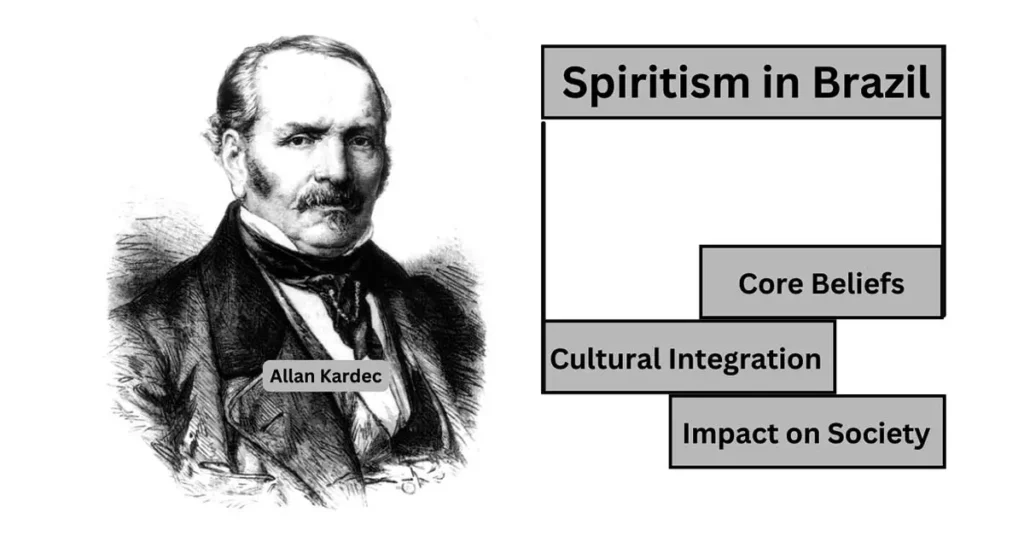
Spiritism in Brazil
Spiritism, an offshoot of Spiritualism developed by Allan Kardec in France during the 19th century, has found its largest following in Brazil.
- Core Beliefs: Spiritism emphasizes reincarnation, moral improvement, and the active role of spirits in human affairs.
- Cultural Integration: In Brazil, spiritism is not merely a religious movement but a cultural phenomenon. Spiritist centers offer free healing services, educational programs, and charitable work.
- Impact on Society: Spiritism’s teachings on personal accountability and spiritual evolution have influenced Brazilian literature, cinema, and healthcare, making it a cornerstone of the nation’s spiritual identity.
Other Regions
- United Kingdom and the U.S.: Spiritualism remains prominent in spiritualist churches and psychic fairs.
- Asia: Countries like India and Japan have embraced aspects of spiritualism, integrating them with local spiritual traditions such as ancestor worship and mindfulness practices.
Discovering Where to Find Your Spiritual Home can provide valuable insights for those seeking a spiritual anchor.
Digital Spiritualism
The Internet and social media have revolutionized spiritualism, enabling it to reach a global audience and adapt to the digital age.
Online Séances and Virtual Mediumship
The COVID-19 pandemic accelerated the transition to online spiritual practices:
- Virtual Séances: Platforms like Zoom and Skype are now used for group spirit communication, making séances accessible to anyone with an internet connection.
- Online Mediumship Services: Mediums offer consultations via video calls, breaking down geographical barriers and providing personalized experiences to clients worldwide.
Social Media’s Role in Shaping Spiritualism
Social media platforms have become hubs for spiritual content and community building.
- Instagram and TikTok: Mediums and spiritual practitioners engage followers by sharing bite-sized teachings, live readings, and inspirational quotes.
- YouTube Channels and Podcasts: Many spiritualists host educational content on YouTube, guiding viewers through meditation, spirit communication, and healing practices.
- Global Connectivity: Social media fosters a sense of belonging, enabling people from diverse backgrounds to connect and share their spiritual journeys.
The Rise of Digital Communities
The internet has also facilitated the creation of digital spiritualist communities, where individuals can seek support, ask questions, and participate in collective rituals.
These spaces emphasize inclusivity and cater to people who may not have access to traditional spiritual gatherings.
If you’re exploring ways to embrace spirituality, consider starting with Self-Love in Spirituality to nurture your inner growth.
Modern Challenges and Opportunities
While spiritualism in the modern era has seen remarkable growth, it also faces challenges, such as:
- Commercialization: The rise of “pay-to-practice” mediums and spiritual services has led to concerns about authenticity.
- Skepticism: Despite its growth, spiritualism continues to face scrutiny from scientific and religious communities.
- Preservation of Traditions: Balancing technological innovation with respect for historical practices remains an ongoing endeavor.
However, the modern era also presents unprecedented opportunities for spiritualism.
- Youth Engagement: Younger generations are increasingly drawn to spiritualist ideals, particularly those centered on mindfulness and sustainability.
- Collaborative Practices: Blending spiritualism with other spiritual movements creates a more prosperous and inclusive spiritual landscape.
Spiritualism in the modern era is a testament to its adaptability and enduring relevance.
By integrating with New Age practices, expanding its global influence, and embracing digital platforms, spiritualism inspires and guides people toward a more profound understanding and connection.
Whether through channeling, Spiritism in Brazil, or virtual séances, Spiritualism offers a path that bridges the physical and spiritual, the past and present, and the individual and the collective.
As we progress, this dynamic and transformative tradition remains a beacon for those seeking meaning and connection in an ever-changing world.

Common Misconceptions and Debates in Spiritualism
Despite its rich history and dedicated following, spiritualism is often criticized.
These misconceptions stem from its overlap with other spiritual practices, its association with supernatural phenomena, and ethical concerns.
This section clarifies these issues while addressing the criticisms spiritualism faces from skeptics and traditional religions.
Misconceptions About Necromancy, Witchcraft, and Fraud
Spiritualism Is Not Necromancy
One of the most common misconceptions is equating spiritualism with necromancy.
- Necromancy Defined: Necromancy refers to the dark art of summoning spirits for manipulation or occult purposes. It is often depicted in fiction as sinister or harmful.
- Spiritualism’s Distinction: In contrast, spiritualism is centered on respectful communication with the spirit world to seek guidance, healing, or closure. Mediums serve as conduits for positive connections, often during structured séances.
- The Role of Consent: Unlike necromancy, spiritualism emphasizes mutual consent between spirits and practitioners, ensuring ethical and meaningful interactions.
Mislabeling as Witchcraft
Spiritualism is frequently conflated with witchcraft due to its supernatural elements.
- Differences in Practice: Witchcraft often involves rituals, spells, and the manipulation of natural energies, while spiritualism focuses on communication with spirits and personal spiritual growth.
- Overlap and Divergence: While both practices may share themes like connecting with unseen forces, their goals, methodologies, and cultural roots are distinct.
Fraud in Spiritualism
Fraud has historically been a significant concern in spiritualism, fueling skepticism.
- Historical Cases: Instances of fake mediums using deceptive tactics like table tilting, spirit rapping, and hidden wires tarnished the movement’s reputation in the late 19th and early 20th centuries.
- Modern Safeguards: Today, ethical mediums and organizations prioritize transparency, discourage fraudulent practices, and promote genuine spiritual work.
Impact of Fraud: While fraudulent cases have harmed public trust, they have also prompted spiritualists to adopt stricter ethical guidelines and foster accountability.
Ethical Concerns in Spiritualism
Respecting the Spirit World
Spiritualists emphasize that spirit communication should be approached with care and reverence.
- Ethical Mediumship: Genuine mediums aim to provide healing and closure rather than exploiting spirits for entertainment or profit.
- Avoiding Exploitation: Charging exorbitant fees or making unverifiable claims is widely discouraged within the community.
Impact on Vulnerable Individuals
Critics argue that spiritualism may exploit the grief or vulnerability of those seeking to contact deceased loved ones.
- Counterpoint: Responsible practitioners focus on providing comfort and healing, ensuring that clients feel supported rather than manipulated.
- Educating Seekers: Raising awareness about ethical practices helps individuals make informed decisions when seeking spiritualist services.
Balance Between Belief and Evidence
The tension between faith and empirical evidence has long been debated within and outside the spiritualist movement.
- Scientific Scrutiny: While some phenomena have been studied under controlled conditions, spiritualism largely relies on subjective experiences that cannot be universally validated.
- Spiritual Perspective: Proponents argue that spiritualism is about personal growth and connection, transcending the need for scientific validation.
Criticism from Traditional Religions
Conflicts with Religious Doctrine
Many traditional religions view spiritualism as incompatible with their beliefs.
- Views on Spirit Communication: Major religions like Christianity and Islam often prohibit contacting the dead, citing scriptural warnings.
- Concerns About Idolatry: Spiritual practices, such as mediumship and séances, are sometimes perceived as idolatry or deviating from monotheistic worship.
Accusations of Deception
Some religious critics claim spirits contacted during séances may be deceptive entities rather than benevolent guides.
- Demonology Concerns: Within certain faiths, spirit communication is interpreted as interaction with malevolent forces posing as loved ones.
- Spiritualist Response: Spiritualists counter this by emphasizing the positive, healing outcomes of their practices and the discernment mediums used to identify genuine spirit connections.
Opportunities for Interfaith Dialogue
Despite these criticisms, there is growing interest in exploring common ground between spiritualism and traditional religions.
- Shared Values: Concepts like moral accountability, the afterlife, and spiritual growth resonate across diverse faiths.
- Bridging Gaps: Open dialogues foster mutual respect and understanding, dispel misconceptions, and reduce stigma.
Misconceptions and ethical debates are inevitable for a movement as unique and complex as spiritualism.
By addressing issues like fraud, clarifying distinctions between necromancy and witchcraft, and responding to criticism from traditional religions, spiritualism continues to evolve and establish its credibility.
FAQs About Spiritualism and Spirituality
Q. What are the practices of Spiritualism?
Spiritualism primarily focuses on the practice of mediumship to prove the continuity of life after death.
Practitioners engage in communal services that include healing through energy work, inspirational speaking, and “demonstrations of spirit” where mediums convey messages from the deceased.
Meditation and prayer are also central, used to quiet the mind and harmonize one’s personal vibration with the spirit world.
Q. What are the 5 spiritual practices?
While various traditions differ, five universally recognized practices include meditation for internal clarity and prayer for divine connection.
Mindfulness encourages staying present in the current moment, while journaling allows for deep self-reflection and emotional processing.
Finally, service to others or “Seva” acts as a practical application of compassion, grounding spiritual growth in community support.
Q. What are the 7 principles of Spiritualism?
Originating from the Spiritualists’ National Union, these principles include the Fatherhood of God and the Brotherhood of Man, emphasizing universal connection.
They also teach the Communion of Spirits, the Continuous Existence of the soul, and Personal Responsibility for one’s actions.
The final principles focus on Compensation and Retribution hereafter for deeds done on earth and a path of Eternal Progress open to every human soul.
Q. What are the 3 C’s of spirituality?
The three C’s are often defined as Connection, Compassion, and Contribution. Connection involves building a relationship with the self, others, and a higher power.
Compassion is the practice of empathy and non-judgment toward all living beings. Contribution refers to the intentional act of giving back to the world, ensuring that your spiritual internal state translates into a positive external impact.
Q. What are the three main types of Spiritualism?
Spiritualism can generally be categorized into Modern Spiritualism, which focuses on communication with spirits through mediums.
Christian Spiritualism, which blends these beliefs with the teachings of Jesus. Scientific Spiritualism, which seeks to prove the existence of the afterlife through empirical observation and psychic research.
Each branch emphasizes the survival of consciousness but differs in its theological or analytical approach.
Q. What are the 12 rules of spirituality?
Often linked to the “12 Laws of the Universe,” these rules include the Law of Divine Oneness, stating everything is connected, and the Law of Vibration, which suggests everything moves and carries energy.
Other rules include the Law of Cause and Effect (Karma) and the Law of Polarity, which teaches that everything has an opposite.
Mastering these rules helps individuals align their personal energy with the natural flow of existence.
Q. What are the 7 spiritual habits?
To maintain spiritual health, practitioners often adopt habits such as Daily Silence (meditation), Deep Reading of sacred or philosophical texts, and Gratitude journaling.
Other habits include Regular Fasting (from food or technology) to build discipline, Physical Movement to honor the body, Acts of Kindness, and Sabbath or dedicated rest to recharge the soul and reflect on life’s purpose.
Q. What are the 12 spiritual powers?
In the Unity movement, these are innate faculties within every human: Faith, Strength, Wisdom, Love, Power, Imagination, Understanding, Will, Order, Zeal, Renunciation, and Life.
By developing these twelve qualities, individuals can transform their character and overcome earthly challenges.
They are viewed as “tools of the soul” that, when balanced, lead to a state of spiritual enlightenment and mastery.
Q. What are the 5 pillars of spirituality?
The five pillars often include Belief in a higher purpose, Practice through ritual or meditation, and Community to foster shared growth.
The fourth pillar is Virtue, which involves living a life of integrity and ethics, and the fifth is Experience, moving beyond theory to personally feel a connection to the divine.
Together, these pillars provide a stable structure for a meaningful and disciplined spiritual life.
Final Thoughts: The Enduring Pulse of Spiritualism
The history of Spiritualism—from the Fox Sisters’ early séances to the modern digital era—is a testament to our timeless search for the eternal spirit.
By bridging the gap between the seen and unseen, these practices offer more than just answers about the afterlife; they provide a grounded sanctuary for those navigating the complexities of a material world.
Through mediumship, healing, and the Seven Principles, Spiritualism remains a living philosophy.
It encourages us to prioritize personal responsibility and eternal progress, values that are as vital today as they were a century ago.
Whether you connect through traditional services or vibrant online communities, the core message remains the same: we are all part of a continuous, connected existence.
You don’t need to be a devoted practitioner to benefit from this wisdom. Simple habits like daily meditation or practicing universal compassion can nurture your inner self and foster profound personal growth.
Spiritualism invites you to blend the metaphysical with the practical, creating a life that is both mindful and purposeful.
Ultimately, this journey is about the courage to explore the unknown and the curiosity to seek truths that resonate with your soul.
By embracing these insights, you open the door to a path of healing, transformation, and enlightenment.
The journey toward balance and deeper understanding starts with a single step. Are you ready to take it?
Read more Balanced Life articles.
You might like: