

The best self-care practices for shift workers focus on protecting sleep, managing food and caffeine, staying physically active, reducing stress, maintaining social connection, and setting realistic boundaries.
Because night and rotating shifts can disrupt sleep and circadian rhythms, plan self-care around your work schedule rather than treating it as an occasional activity.
Read time: About 10–12 minutes
Quick Summary
- Protect your main sleep period as seriously as you protect your work hours.
- Create a dark, cool, quiet sleep environment.
- Use caffeine strategically instead of relying on it throughout your shift.
- Prepare simple, balanced meals and snacks before work.
- Add short movement breaks rather than waiting for time for a full workout.
- Build a short decompression routine after work.
- Protect your relationships without sacrificing your recovery time.
- Watch for persistent fatigue, anxiety, low mood, or sleep problems that need professional support.
The article covers sleep and recovery, nutrition and energy, movement, circadian rhythm support, stress management, mental health, boundaries, social connection, daily routines, weekly planning, common mistakes, useful resources, and professional support.
Why Self-Care Practices for Shift Workers Are Non-Negotiable

Working unusual hours is not simply a matter of moving your bedtime a few hours later.
The circadian rhythm is an intrinsic timing system in your body. It helps coordinate sleep, alertness, hormones, body temperature, and other daily processes.
Night work and rotating schedules can conflict with this natural timing system, making it harder to sleep and recover.
Fatigue can also affect more than your energy. According to NIOSH, workplace fatigue can slow reaction time, reduce concentration, affect short-term memory, and impair judgment.
That is why self-care for a shift worker should not mean expensive spa treatments or finding an hour for yourself every day.
It means protecting the basic systems that help you function well.
Your self-care plan should make it easier to:
- Sleep enough and sleep well.
- Eat regularly and sensibly.
- Manage physical fatigue.
- Reduce accumulated stress.
- Maintain relationships.
- Recover between shifts.
- Recognize when your body or mind needs additional help.
The goal is not to make shift work effortless. The goal is to make your routine more sustainable.
How Shift Work Affects Sleep, Stress, and Energy
Night workers often have to sleep when their environment is bright and noisy and stay awake when their body naturally expects sleep.
NIOSH reports that night-shift workers have particularly high levels of sleep-related problems, while fatigue is associated with nonstandard schedules that disrupt or shorten sleep.
Rotating schedules can be especially challenging because your sleep-wake pattern may keep changing.
That is why simply saying, “I will catch up on my days off,” doesn’t always solve the problem.
Self-care needs to work with your actual schedule.
5 Essential Self-Care Pillars for Shift Workers
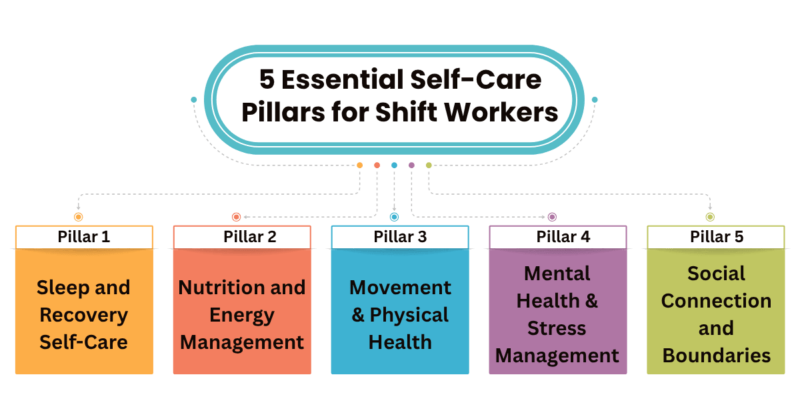
Pillar 1: Sleep and Recovery Self-Care
Sleep is the foundation of wellness for shift workers.
If your sleep is consistently poor, healthy eating, exercise, patience, concentration, and emotional resilience all become harder.
Create a Sleep Environment That Supports Recovery
For daytime sleep, make your bedroom as close to a nighttime environment as possible.
Try to make it:
- Dark: Use blackout curtains, blinds, or an eye mask.
- Quiet: Consider earplugs or white noise if outside sounds disturb you.
- Cool: A comfortable temperature can make it easier to remain asleep.
- Comfortable: Your mattress, pillow, and bedding should support restful sleep.
- Phone-free where possible: Notifications can interrupt your recovery period.
NIOSH specifically recommends sleeping in a dark, comfortable, quiet, and cool environment.
Protect Your Main Sleep Period
Treating daytime sleep as optional is one of the most common blunders shift workers make.
If you arrive home after a night shift, it can be tempting to clean the house, answer messages, run errands, or spend time with family.
But if sleep is your recovery tool, it deserves priority.
NIOSH advises night-shift workers to go to bed soon after arriving home and avoid using the early part of the day for chores when you need it for sleep.
Tell the people around you when your sleep hours are.
Your family may need to understand that “I’m home” does not mean “I’m available.”
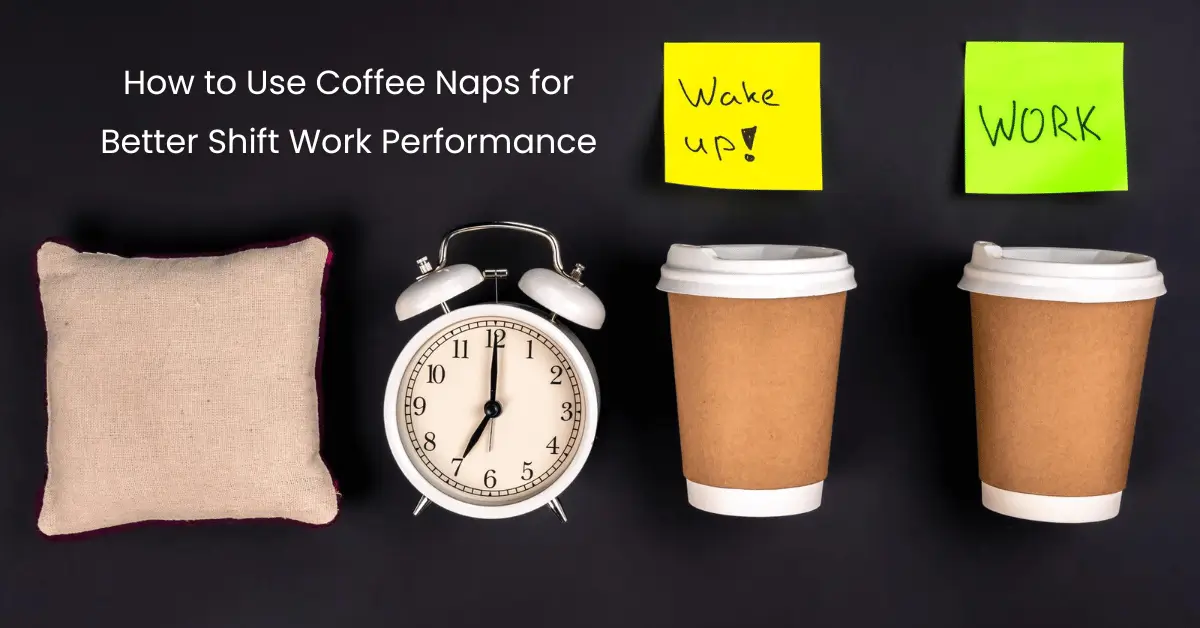
Use Naps Strategically
A nap can sometimes help you prepare for a night shift or reduce fatigue.
NIOSH guidance notes that short naps of around 15–30 minutes can help reduce fatigue during work, while a longer pre-shift nap may help prepare someone for a night shift.
However, naps should complement your main sleep, not replace adequate recovery.
Build a Post-Shift Wind-Down Routine
Give your brain a predictable signal that work has ended.
For example:
- Arrive home.
- Dim bright lights.
- Have a small meal or snack if genuinely hungry.
- Take a shower.
- Put your phone away.
- Spend 5–10 minutes doing something calming.
- Go to bed.
A simple routine is easier to repeat than an elaborate bedtime ritual.

Pillar 2: Nutrition and Energy Management
Nutrition for shift work can be difficult because working hours change when you eat, where you eat, and what food is available.
Research reviews have found that shift workers can have irregular meal patterns, eat at unconventional times, and see changes in diet quality.
The answer is not to follow an extreme diet.
Instead, make healthy food the easy option.
Plan Meals Before Your Shift
If you wait until you are exhausted and extremely hungry, vending machines, fast food, sugary snacks, or oversized portions can become much more tempting.
Prepare simple options such as
- Eggs with whole-grain toast.
- Yogurt with fruit and nuts.
- Chicken or beans with vegetables and rice.
- Oatmeal with fruit.
- A whole-grain sandwich with a protein filling.
- Fruit with yogurt or a small handful of nuts.
- Vegetable soup with a protein source.
You do not need a perfect meal every time.
You need reliable options that provide protein, fiber-rich carbohydrates, healthy fats, and plenty of fluids.
Pay Attention to Meal Timing Without Becoming Obsessive
Research on meal timing among night workers is growing, but there isn’t yet enough evidence to prescribe one perfect eating schedule for every shift worker. A 2026 systematic review found promising but limited evidence for strategies that regulate overnight eating, while emphasizing the need for larger and longer studies.
So instead of following rigid rules, focus on consistency and food quality.
If a heavy meal makes you uncomfortable before sleep, consider a lighter meal or snack and leave larger meals for a time when you digest them comfortably.
Hydrate Regularly
Keep water available during your shift.
Dehydration can make an already exhausting shift worse, and sometimes people confuse thirst for hunger.
If your job involves significant sweating or physical work, your fluid needs may be higher.
Use Caffeine Strategically
Coffee can help with alertness, but it shouldn’t be the foundation of your energy strategy.
Caffeine later in the shift can make it harder to sleep after you return home. NIOSH recommends reducing caffeine and other stimulants several hours before planned sleep, with individual sensitivity varying.
A better approach is to decide when to stop caffeine rather than drinking it whenever you feel tired.
Choose Real Food Over Constant Sugar
Sugar might give you a brief energy boost, but consuming sweets and energy drinks all day long can lead to bad habits.
Try pairing carbohydrates with protein or fiber instead.
For example:
Instead of: biscuits + energy drink
Try: fruit + yogurt + water
Instead of: candy bar
Try: whole-grain crackers + cheese or nuts
Instead of: sugary coffee several times a night
Try: one planned caffeinated drink followed by water or a lower-sugar option.
Pillar 3: Movement and Physical Health
You don’t need a long gym workout to benefit from movement.
When you are tired, think small and consistent.
Try micro-workouts.
A five- or ten-minute movement session can include:
- Bodyweight squats.
- Gentle lunges.
- Wall push-ups.
- Shoulder rolls.
- Calf raises.
- Walking.
- Gentle stretching.
If you have a physically demanding job, your self-care may need to focus more on mobility, recovery, and avoiding overtraining.
The goal is to support your body, not punish it for being tired.
Take Movement Breaks During Long Shifts
If your workplace allows it, stand up, walk briefly, stretch your shoulders, or change position during breaks.
For physically demanding jobs, recovery can matter even more.
Long work hours can reduce recovery time and contribute to physical fatigue and musculoskeletal problems.
Get Appropriate Daylight Exposure
Light is an important signal for the circadian system.
For workers trying to maintain a night-oriented schedule, light management needs to be individualized. NIOSH discusses the strategic use of bright light as one possible approach to circadian adaptation, while also noting that no single strategy works for every shift-work situation.
If you are trying to sleep after a night shift, reducing bright light before bed may be helpful. NIOSH guidance also recommends avoiding bright light shortly before planned sleep.
If you work rotating shifts, talk with a healthcare professional before using aggressive light-management strategies or light devices.
Pillar 4: Mental Health and Stress Management
Shift work can affect your emotional life as well as your sleep.
Research has found an association between shift work and poorer mental health, although the strength of the relationship varies by schedule and study design. Irregular or unpredictable work schedules appear particularly important.
That does not mean every shift worker will develop a mental health problem.
It does mean that mental health deserves a place in your self-care plan.
Create a Decompression Routine After Work
Your brain may stay in “work mode” even after you leave the workplace.
Try a short transition routine:
- Change into comfortable clothes.
- Take a warm shower.
- Practice slow breathing for a few minutes.
- Write down tomorrow’s tasks so they stop circling in your head.
- Listen to calming music.
- Avoid stressful conversations immediately before sleep when possible.
The routine does not need to be perfect.
Its purpose is to create a psychological boundary between work time and recovery time.
Try Simple Stress-Management Tools
You can experiment with:
Slow breathing: Take slower, comfortable breaths for several minutes.
Journaling: Write down what is bothering you instead of carrying every thought into bed.
Meditation: Use a short guided practice rather than expecting yourself to meditate for 30 minutes.
Progressive relaxation: Slowly relax different muscle groups.
Quiet time: Sometimes doing nothing is exactly what an exhausted nervous system needs.
Notice Warning Signs
Pay attention if you begin experiencing persistent:
- Irritability.
- Anxiety.
- Low mood.
- Loss of interest in activities.
- Emotional exhaustion.
- Difficulty concentrating.
- Sleep problems.
- Feelings of hopelessness.
- Dependence on drugs, alcohol, or other substances to cope.
Self-care is helpful, but it is not a substitute for professional mental healthcare when symptoms are persistent or severe.
Pillar 5: Social Connection and Boundaries
One of the less obvious problems with shift work is that your schedule may not match everyone else’s.
Your friends may be having dinner while you are sleeping.
Your family may want to spend Saturday morning together while you are recovering from a night shift.
Over time, this mismatch can create loneliness or frustration.
Set Boundaries Around Sleep
Explain your schedule clearly to the people who matter.
Instead of saying:
“Please don’t disturb me.”
Try:
“I need to sleep from 9 a.m. to 3 p.m. after my night shifts. Unless it is urgent, please message me after 3.”
Specific boundaries are easier for others to understand.
Protect Social Connection
You do not need to attend every gathering.
Instead, create smaller opportunities for connection:
- A short phone call.
- Breakfast together after waking.
- A walk with a friend.
- One planned family meal.
- A video call on a day off.
- A shared hobby.
Quality matters more than quantity.
Learn to Say No
One of the most important forms of burnout prevention is recognizing that your days off are not automatically available for everyone else’s requests.
If you worked three exhausting night shifts, you may genuinely need time to recover.
Saying “I can’t this time” does not make you selfish.
It may be exactly what allows you to return to work healthier and more focused.
Daily Self-Care Practices for Shift Workers
The 10-Minute Checklist
You do not need a two-hour wellness routine.
Start with ten intentional minutes.
Before Your Shift
- Drink water.
- Eat a balanced meal or prepare one for later.
- Check that you have your planned snacks.
- Decide when you will stop caffeine.
- Take two minutes to stretch or walk.
- Ask yourself: “What do I need tonight to get through this shift well?”
During Your Shift
- Drink water regularly.
- Take movement breaks when possible.
- Eat the food you prepared before you get extremely hungry.
- Take a few slow breaths during stressful moments.
- Check your fatigue level.
After Your Shift
- Avoid unnecessary errands when sleep is the priority.
- Reduce bright light before bed.
- Follow your wind-down routine.
- Keep your bedroom dark, quiet, cool, and comfortable.
- Protect your planned sleep period.
Weekly Self-Care Plan for Shift Workers
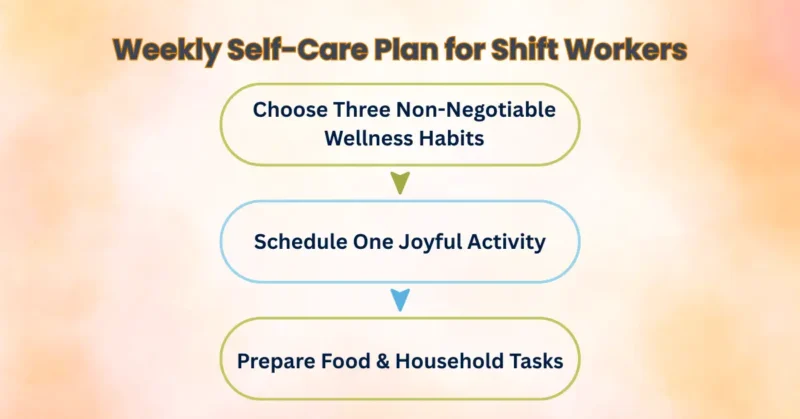
Daily habits are useful, but weekly planning can make shift work much easier.
Choose Three Non-Negotiable Wellness Habits
For example:
- Protect my main sleep period.
- Prepare healthy food before my shifts.
- Move my body for at least a few minutes every day I can.
Do not choose ten habits.
Three consistent habits are more useful than a long list you abandon after a week.
Prepare Food and Household Tasks
Use one block of time to prepare:
- Two or three easy meals.
- Healthy snacks.
- Work clothes.
- Water bottles.
- Laundry.
- Basic household tasks.
Preparation reduces the number of decisions you have to make when you are exhausted.
Schedule One Joyful Activity
Do something that has nothing to do with work.
It could be:
- Reading.
- Gardening.
- Watching a favorite show.
- Cooking.
- Spending time with family.
- Meeting a friend.
- Going outdoors.
- Pursuing a hobby.
Wellness for shift workers should include pleasure, not only productivity.
Common Self-Care Mistakes Shift Workers Make
Relying Only on Caffeine and Sugar
Caffeine can temporarily increase alertness, but it cannot replace sleep.
Sugar may be convenient, but constant sugary snacks are not a sustainable energy strategy.
Build your routine around sleep, food, hydration, movement, and recovery instead.
Treating Days Off Like a Reset Button
If you completely reverse your sleep schedule every few days, your body may struggle to adapt.
NIOSH notes that repeatedly switching between night-oriented and daytime schedules can strain the circadian system.
Your ideal routine depends on whether you work permanent nights, rotating shifts, or a mix of schedules.
Ignoring Social Isolation
Being exhausted can make you withdraw from people.
But complete isolation can make emotional stress harder to manage.
Aim for small, realistic moments of connection.
Trying to Be Perfect
Perhaps the biggest mistake is expecting yourself to follow a perfect wellness routine while working an imperfect schedule.
Some weeks will be messy.
You may eat convenience food.
You may miss a workout.
You may sleep badly.
Self-care is not about doing everything correctly.
It is about returning to supportive habits when you can.
Tools and Resources to Support Self-Care Practices for Shift Workers
Simple tools can make your routine easier.
Sleep Tools
Consider:
- Blackout curtains
- Eye masks
- Earplugs
- White-noise machines
- Comfortable bedding
- A sleep-tracking app if you find the information useful.
Remember that a sleep tracker is a tool, not a medical diagnosis.
Planning Tools
A calendar or habit-tracking app can help you see your:
- Work shifts.
- Sleep windows.
- Meal preparation.
- Exercise.
- Social plans.
- Recovery days.
Seeing everything together can prevent you from accidentally filling every day off with commitments.
Meal Containers
Having food ready before work removes one of the biggest barriers to healthy eating.
Keep your system simple. A few reusable containers, a water bottle, and a small cooler bag may be enough.
When to Seek Professional Help
Self-care is not meant to make you manage serious problems alone.
Talk with a healthcare professional if you regularly have difficulty sleeping despite giving yourself enough opportunity to sleep, feel excessively sleepy while working or driving, or experience persistent anxiety, depression, or other significant changes in mood.
Fatigue can affect attention, reaction time, memory, and judgment, so it’s especially important to take severe sleepiness seriously when your work or commute involves safety-sensitive tasks.
If you think you may have a sleep disorder or if your sleep issues are making it difficult for you to function, you should also consult a specialist.
If you are struggling emotionally, reaching out is not a failure of self-care.
Getting professional support is self-care.
FAQs About Self-Care for Night Shift and Rotating Schedules
Q. How often should shift workers practice self-care?
Ideally, build self-care into your everyday routine rather than saving it for your days off. Focus first on sleep, food, hydration, movement, stress management, and recovery. Even small habits can be useful when they are realistic enough to maintain.
Q. What is the number-one self-care practice for shift workers?
Protecting adequate sleep is the best place to start. Sleep supports concentration, mood, physical recovery, and safe functioning. NIOSH recommends getting enough sleep and creating a dark, quiet, cool, comfortable sleep environment.
Q. Can self-care really prevent burnout with rotating shifts?
Self-care can reduce some factors that contribute to exhaustion, but it cannot eliminate every risk associated with demanding schedules. Workload, shift length, schedule predictability, staffing, and recovery time also matter. NIOSH emphasizes that fatigue management requires both worker-level and workplace-level strategies.
Q. What should I eat during a night shift?
Choose practical, balanced foods that provide protein, fiber-rich carbohydrates, vegetables or fruit, and healthy fats. Avoid relying on sugary snacks and highly caffeinated drinks for energy.
Research suggests meal patterns and timing can change during shift work, but evidence isn’t strong enough to recommend one perfect eating schedule for everyone.
Q. Should I exercise after a night shift?
It depends on your energy, job demands, and sleep needs. Gentle stretching or light movement may be reasonable, but if exercise would significantly delay your main sleep period, sleep should usually take priority. Regular physical activity is useful, but your routine needs to support your recovery.
Q. How can I safeguard my mental well-being whilst working at night?
Start by getting enough sleep, eating regularly, moving about, taking time to unwind, and interacting with others. Establish boundaries for your recuperation time and make space for enjoyable activities.
Seek professional assistance if symptoms such as anxiety, depression, emotional tiredness, or other conditions continue or interfere with day-to-day activities.
Q. Is rotating shift work harder than permanent night work?
Not necessarily for every individual. Different schedules create different challenges. Rotating schedules can require repeated adjustments to sleep and daily routines.
At the same time, permanent night work can create ongoing conflicts between a night-oriented work schedule and daytime social or family life. Individual response varies.
The Bottom Line: Make Recovery Part of Your Shift
The best self-care practices for shift workers are not complicated.
They are the habits that protect your ability to recover:
Sleep enough. Eat regularly. Hydrate. Move. Manage stress. Protect your boundaries. Stay connected. Ask for help when you need it.
Most importantly, stop measuring self-care by how much free time you have.
A shift worker may not have an hour for meditation, a perfect meal plan, or a long workout. You can still take care of yourself.
Start with one change.
Tonight, prepare your food before work. Tomorrow, protect your sleep window. During your next shift, take a few movement and breathing breaks. On your next day off, make time for one thing you genuinely enjoy.
Small, repeatable choices can turn self-care from another responsibility into a practical recovery routine for shift work.
Your schedule may be unusual, but your need for rest, nourishment, movement, connection, and peace is not.
Start small, protect your recovery, and build a self-care routine that fits the life you actually live.
Read more articles on night shift workers’ health.