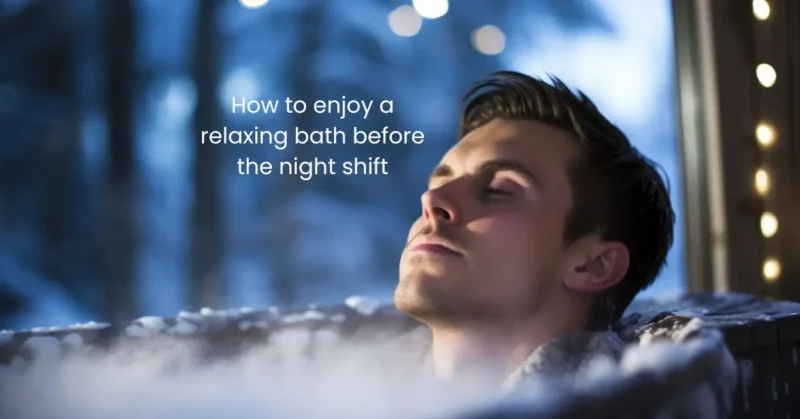
Learn how to enjoy a relaxing bath before the night shift to improve sleep quality and reduce stress. Expert tips for shift workers’ sleep hygiene.
You know the exhaustion, that heavy, bone-deep fatigue that hits after an eight-hour overnight rotation, when the rest of the world is waking up with coffee and sunlight while you’re trying to convince your brain that 8:00 AM is actually bedtime.
You lie there, curtains drawn, heart still racing from the commute, staring at the ceiling as anxiety about missed sleep mounts with every passing minute. Your body craves rest, but your circadian rhythm is screaming that it’s morning.
What if the solution isn’t another sleeping pill or meditation app, but something far simpler?
A deliberately engineered bath, precisely timed, scientifically temperatured, and biochemically optimized, can override your confused internal clock and trigger the physiological cascade necessary for deep, restorative day sleep.
Quick Summary Box: The Pre-Shift Bath Protocol
Key Takeaways:
- Timing is everything: Bathe exactly 90 minutes before sleep to exploit the post-bath cooling effect that triggers melatonin release.
- Temperature precision matters: Maintain water between 100 and 104°F (38 and 40°C)—too cool fails to vasodilate; too hot prevents the necessary core temperature drop
- Magnesium is mandatory: Add 2 cups of Epsom salts (magnesium sulfate) to support GABA production and muscle relaxation, which are unique to shift-work physical strain.
- Light hygiene post-bath: Zero screens for 30 minutes after exiting; your suprachiasmatic nucleus needs darkness to interpret the bath’s thermal signal as “night.”
- Duration discipline: 15–20 minutes maximum; longer immersion disrupts skin barrier function without additional sleep benefits
- Add-in hierarchy: Lavender (Lavandula angustifolia) and chamomile essential oils provide genuine anxiolytic effects by activating the olfactory-limbic pathway.
Why a Relaxing Bath Before Night Shift Works
The Physiology of Warm Water Bath Benefits on the Nervous System
When you submerge in warm water, you initiate a sophisticated thermoregulatory deception. Your body interprets the warmth as a signal to dilate peripheral blood vessels (vasodilation), shunting blood to your skin and extremities.
This superficial warming actually facilitates a subsequent drop in your core body temperature, the biological signature your brain requires to initiate sleep.
For night shift workers, this mechanism is revolutionary. Your suprachiasmatic nucleus (SCN), the master clock in your hypothalamus, typically uses light cues to determine sleep timing.
However, temperature is a secondary zeitgeber (time-giver). By forcing a rapid decline in core temperature through the bath-exit-cooling protocol, you effectively bypass the “it’s morning” light signals bombarding your retinas, tricking your pineal gland into releasing melatonin despite the hour.
Circadian Override: How Baths Trigger Melatonin in Inverted Schedules
During a normal circadian rhythm, your core temperature drops approximately 1–2 degrees Fahrenheit as bedtime approaches. This cooling activates parvocellular neurons in the preoptic area of the hypothalamus, which inhibit wake-promoting orexin neurons.
When you work nights, this natural cooling doesn’t align with your sleep needs; you need to sleep at 8:00 AM, when your body is programmed to warm up for the day.
The bath creates an artificial temperature valley. As you soak, your core temperature rises slightly (0.5–1.0°C). When you exit, evaporative cooling and conductive heat loss through your dilated peripheral vessels lower your core temperature faster and to a greater extent than would occur naturally.
This rapid decline signals the SCN that “night has fallen,” triggering melatonin secretion regardless of the sunlight trying to penetrate your blackout curtains.
Relaxing Bath Routine Before Bed vs. Before Night Shift
Standard evening bath advice fails shift workers because it ignores chronobiological context. A typical nighttime bath emphasizes relaxation, aromatherapy, and indefinite soaking.
Your pre-night-shift bath is pharmacologically precise; it targets specific physiological switches.
Unlike evening bathers who seek general relaxation, you need parasympathetic activation robust enough to counteract cortisol and adrenaline accumulated during overnight work.
The temperature must be slightly warmer (closer to 104°F) than typical recommendations (98–100°F) to overcome the sympathetic tone (fight-or-flight state) that night work induces.
Additionally, your post-bath environment requires stricter light hygiene than that of evening bathers, as your circadian system is already confused by the inverted schedule.
Best Time and Water Temperature for Your Relaxing Bath
Ideal Water Temperature for Relaxation and Vasodilation
Precision matters. The ideal temperature range for inducing vasodilation without cardiovascular stress is between 100°F and 104°F (38–40°C), according to research published in the Journal of Physiological Anthropology.
Below 98°F, you fail to raise skin temperature sufficiently to trigger the heat-dissipation response necessary for core cooling. Above 105°F, you risk tachycardia and delayed sleep onset due to excessive cardiovascular load.
Use a floating bath thermometer. Subjective perception of temperature is unreliable when you’re exhausted; what feels “warm” to a sleep-deprived shift worker may actually be lukewarm (ineffective) or scalding (harmful). The goal is therapeutic hyperthermia, not comfort soaking.
Timing Your Bath to Match Your Sleep Schedule
The 90-minute rule is non-negotiable. You must exit the bath exactly 90 minutes before you intend to be asleep.
This interval allows the initial surface warming to dissipate and the core temperature to reach its nadir precisely when you’re attempting to fall asleep.
If you bathe immediately before bed, you carry excess heat into the sheets, preventing the rapid cooling your brain interprets as a sleep signal.
If you bathe too early (3+ hours before), the temperature effect dissipates before you attempt sleep. Mark your target sleep time, count back 90 minutes, and start filling the tub.
Duration Protocol: How Long Should a Relaxing Bath Before Night Shift Last
Fifteen to twenty minutes. Not thirty. Not “until the water gets cold.” Extended immersion causes skin maceration (breakdown of the stratum corneum) and can actually elevate cortisol through prolonged heat stress.
Set a timer. The therapeutic window for temperature manipulation closes after 20 minutes; additional time provides no circadian benefit and increases the risk of dehydration.

Quick Bath Planner (Goal → Timing → Temperature → Duration → Add-ins)
| Goal | Timing | Temperature | Duration | Add-ins (optional) |
| Calm down before leaving for your night shift (pre-shift wind-down). | 30–60 minutes before you leave (gives time to dress, hydrate, and reset) | 37–39°C (98–102°F) warm, not hot | 10–15 minutes | 1 cup Epsom salt, 1 tbsp fragrance-free bath oil, lavender/chamomile (properly diluted) |
| Reduce muscle tension after a physically demanding day (without getting sleepy) | 45–90 minutes before leaving or earlier in the evening | 38–40°C (100–104°F) if you tolerate heat | 15–20 minutes | Epsom salt (1–2 cups), bath pillow, gentle stretch in-water |
| Set up better sleep after your night shift (post-shift sleep prep) | 60–120 minutes before planned sleep (after shift) + keep lights low afterward | 37–40°C (98–104°F) | 15–20 minutes | Epsom salt (1–2 cups), colloidal oatmeal (if skin is dry), calming scent (diluted) |
| Quick reset when you’re short on time | 20–40 minutes before leaving (or anytime you can fit it) | 37–38°C (98–100°F) | 5–10 minutes | Pre-measured Epsom salt packet, fragrance-free cleanser, warm towel/robe after |
| Skin comfort + relaxation (sensitive skin) | 30–90 minutes before leaving or 60–120 minutes before sleep | 37–38°C (98–100°F) | 10–15 minutes | Colloidal oatmeal, fragrance-free bath oil; avoid essential oils/bubbles |
| Reduce stress without overheating (heat sensitivity) | 30–60 minutes before leaving or earlier | 36.5–37.5°C (97–100°F) | 8–15 minutes | Minimal add-ins, cool water nearby, gentle aromatherapy only if tolerated (diluted) |
Note: Essential oils should be diluted (with a carrier oil or formulated bath product). If you feel lightheaded, shorten the bath and lower the temperature.
Step-by-Step Relaxing Bath Routine Before Bed for Shift Workers
Pre-Bath Preparation: Dim Lights and Digital Sunset Protocol
Thirty minutes before entering the bath, initiate your “digital sunset.” Blue light (460–480 nm) from phones and tablets suppresses melatonin production through intrinsically photosensitive retinal ganglion cells (ipRGCs). Even brief exposure can negate your bath’s thermal signaling.
Dim household lights to 50 lux or lower (equivalent to candlelight). Switch your phone to night mode or, ideally, leave it outside the bathroom.
Gather your supplies, Epsom salts, oils, a towel, and a robe beforehand so you’re not searching through bright closets mid-routine. The goal is a seamless transition from work to bath to bed without alerting your brain that it’s daytime.
Integration: Epsom Salt Bath and Aromatherapy Oils for Stress Relief
Fill the tub to hip level when seated (full submersion isn’t necessary and wastes water). Add 2 cups of magnesium sulfate (Epsom salts); this provides approximately 500 mg of absorbable magnesium via dermal penetration, supporting gamma-aminobutyric acid (GABA) receptor function and reducing neural excitability.
Add three drops of Roman chamomile and five drops of real lavender essential oil (Lavandula angustifolia). These oils contain substances such as apigenin and linalool, which bind to benzodiazepine receptors in the brain, producing anxiolysis without drowsiness.
The terpene profiles required for neurochemical action are absent from “fragrance oils” and synthetic substitutes; therefore, avoid using them.
Stir the water to disperse oils (they’ll float otherwise) and enter slowly to avoid shocking your system.
Post-Bath Steps to Keep Your Body Warm and Calm
Exit the bath without rinsing (the magnesium residue continues absorbing). Pat—don’t rub; keep your skin dry to avoid friction-induced sympathetic activation. Immediately don a pre-warmed robe or thermal wear.
Your goal now is to allow cooling to occur gradually; if you get cold too quickly, your body will shiver (thermogenesis), raising core temperature and defeating the purpose.
Move directly to your darkened bedroom. Do not check email. Do not raid the refrigerator. The 30-minute window post-bath is when your core temperature is dropping; protect this thermoregulatory signal at all costs.
Best Add-ins for a Night Shift Bath
Epsom Salt Bath for Muscle Relaxation and Magnesium Absorption
Night shift work, whether you’re lifting patients, standing at assembly lines, or patrolling, creates unique patterns of muscular tension.
Magnesium sulfate (MgSO₄) in bath water is absorbed transdermally at rates of 0.5-1.0 mmol/cm²/hour, replenishing intracellular magnesium stores depleted by stress.
Magnesium prevents excessive muscle contraction by acting as a natural calcium channel blocker.
For shift workers, this means your lower back, legs, and shoulders, typically tightened during overnight vigilance, can release tension chemically rather than just mechanically. Use pharmaceutical-grade Epsom salts, not scented bath crystals, which contain fillers.
Lavender and Chamomile Oils: Aromatherapy for Sleep Hygiene
Your olfactory bulb has direct neural projections to the amygdala and hippocampus, limbic structures regulating emotion and memory.
Lavender’s linalool content reduces cortisol levels by approximately 30% in controlled studies. Chamomile’s apigenin flavonoid binds to GABA-A receptors, creating mild sedation.
Instead of applying these oils directly to the skin, which could irritate it, mix them with a carrier (the bath water itself serves as a carrier).
The steam will volatilize the terpenes. Creating an olfactory environment that signals “safety and rest” to your threat-detection systems is crucial when you’re trying to sleep while the world is active.
Magnesium Soak vs. Magnesium Flakes: Reducing 3rd Shift Tension
While Epsom salts (magnesium sulfate) are standard, magnesium chloride flakes offer superior bioavailability. Chloride ions create a more acidic bath environment (lower pH), which enhances magnesium penetration through the stratum corneum.
If you experience chronic night-shift muscle cramps or restless legs syndrome (common in circadian rhythm disorders), switch to magnesium chloride.
Use 1–2 cups per bath. The chloride form also supports detoxification pathways stressed by overnight work schedules.
Common Mistakes That Ruin Your Relaxing Bath Before Night Shift
Thermal Errors: Water Too Hot or Too Cold for Relaxation
Too hot (>105°F): Causes vasodilation so extreme that blood pressure drops, triggering compensatory adrenaline release (the opposite of relaxation). You exit wired and sweaty, unable to cool properly.
Too cold (<98°F): Fails to raise skin temperature sufficiently. Without the heat gradient between skin and core, you don’t get the post-bath cooling effect. You might feel refreshed, but you won’t trigger sleep physiology.
Chronobiological Disruption: Bathing Too Close to Wake Time
If you finish your bath at 6:00 AM but need to wake at 2:00 PM for your next shift, you’ve compressed your sleep opportunity. The bath’s cooling effect lasts approximately 4–6 hours; bathing too early in your sleep window means you wake during the rebound in temperature, as your body warms up again. This creates mid-sleep awakenings and sleep fragmentation.
Light Pollution: Using Screens and Bright Lights Post-Immersion
This is the most common failure mode. You exit the bath relaxed, then check your phone “just for a minute.” That minute of blue light suppresses melatonin for 90 minutes, erasing the thermal preparation you just completed.
The bath prepares your body; darkness seals the deal. Violate this sequence, and you’ve wasted 20 minutes of precious pre-sleep time.
Quick 10-Minute Relaxing Bath Routine Before Bed When You’re Short on Time
The Express Protocol: Fast Wind Down for Busy Night Shift Workers
Sometimes overtime happens, or you hit traffic. When you have only 10 minutes:
- Fill to ankle depth (saves time/heating) but make it hotter (105°F)—partial immersion requires a higher temperature for a systemic effect.
- Add 1 cup Epsom salts and 3 drops lavender only—simplify the oil blend.
- Submerge fully clothed in a bathing suit or light cotton—sounds strange, but wet fabric against skin maintains heat contact while you sit on the tub edge if lying down fully isn’t possible.
- Paradoxical breathing: Inhale for 4 counts, hold for 7, exhale for 8—while soaking. This activates the mammalian dive reflex and parasympathetic tone simultaneously.
- Exit at exactly 10 minutes, dry quickly, and have immediate darkness.
3 Add-ins That Work Without Prep
Keep these pre-measured in your bathroom:
- Pre-portioned Epsom salt cups (small Tupperware containers with 1-cup measures)
- Lavender rollerball (pre-diluted in jojoba oil, applied to temples rather than bath if time is critical)
- Warm towel (heated in a microwaveable pack while bathing)
Bath vs. Shower: What’s Better for Night Shift Self-Care
Warm Water Bath Benefits vs. Contrast Shower Therapy
Showers provide hydrostatic pressure variation that can be stimulating (the “Scottish shower” effect). While contrast showers (alternating hot/cold) are excellent for morning wakefulness, they activate the sympathetic nervous system through thermal shock, exactly what you don’t want before daytime sleep.
Immersion bathing provides a uniform temperature distribution and hydrostatic pressure on the chest (approximately 40 mmHg at shoulder depth), thereby increasing stroke volume and triggering the “diving reflex,” a parasympathetic response that lowers heart rate. You cannot achieve this in a shower.
Decision Matrix: When to Choose Each for Pre-Shift Wind Down
Choose a bath when:
- You have 20+ minutes.
- Sleep onset is your primary goal.
- Muscle soreness is present.
- You need to lower core temperature.
Choose a shower when:
- You have less than ten minutes.
- You need to remove workplace contaminants (hospital pathogens, industrial grease) quickly.
- You need to warm up (winter commutes) rather than cool down.
- You’re preparing for a shift (wakefulness) rather than post-shift sleep.
FAQs
Q: Should I take a bath before or after a night shift?
If you need to calm anxiety and loosen muscles before work, a pre-shift bath can help as a “transition ritual.” If your main goal is sleep quality, a bath before your post-shift sleep window is often more effective, especially when paired with a dark room and reduced light exposure afterward.
Q: What’s the best water temperature for a relaxing bath before a night shift?
Most people relax best around 37–40°C (98–104°F). Hotter water can raise heart rate and cause overheating, while cooler water may feel refreshing rather than calming. If you don’t have a thermometer, aim for “warm and comfortable” rather than steamy.
Q: How long should I soak to relieve stress without feeling groggy?
A 10–20 minute bath is a practical target. Shorter soaks can still reduce tension, while longer baths increase the chance of dehydration and post-bath sluggishness. End the bath if you feel dizzy, overly flushed, or sleepy enough that commuting feels unsafe.
Q: Do Epsom salts or magnesium soaks actually work?
Epsom salts are commonly used for muscle soreness and relaxation, and many people find them subjectively helpful. Evidence on magnesium absorption through skin is mixed, but the warm water + quiet time combination is reliably calming. If you have sensitive skin, start with a smaller amount and rinse afterward.
Q: Which essential oils are best for a night shift bath, and how do I use them safely?
Lavender and chamomile are popular for a stress-relief bath, but essential oils should be diluted (mixed with a carrier oil or used in a properly formulated bath product) to reduce irritation.
Avoid adding undiluted drops directly to water, and skip fragrances that feel energizing or trigger headaches. If you have asthma, allergies, or pets, use extra caution or go fragrance-free.
Q: What if I only have 10 minutes for a bath or shower?
If time is tight, a warm shower is usually more practical and still relaxing. If you can, do a 5-minute rinse followed by a 5-minute shallow soak to get some of the “soak” benefit. The key is what you do after: dry off, stay warm, dim the lights, and avoid screens.
Conclusion
Overnight work doesn’t have to mean chronic sleep deprivation. By treating your pre-sleep bath as a physiological intervention rather than a luxury, you reclaim control over your circadian rhythm.
Remember the critical triad: 100–104°F water temperature, 90-minute pre-sleep timing, and absolute light hygiene post-immersion.
Your bath is not just cleaning your body; it’s recalibrating your internal clock, clearing adenosine from neural receptors, and signaling safety to your threat-detection systems.
In the battle between your work schedule and your biology, the properly engineered bath is your most powerful natural weapon.
Read more about night shift workers’ health.
You might like: