

Recover faster after consecutive night shifts with a science-backed 3-day plan. Learn how to reset your sleep, reduce inflammation, and rebuild lasting energy without the crash.
You’ve just finished your final shift. You hand over your report, walk out into the jarring morning sunlight, and feel a bone-deep exhaustion that words can barely capture.
You’ve pushed your body through consecutive nights of work against its natural rhythm, and now you’re expected to flip back to a “normal” life, family, errands, and daytime responsibilities. The crash is not just inevitable; it’s already here.

Most shift workers simply grit their teeth and push through their recovery days, treating them like any other time off. This is a mistake. Recovery after consecutive night shifts is not passive rest; it’s an active, strategic process.
You cannot expect your body to simply bounce back from the profound physiological disruption you’ve just put it through. You need a deliberate, science-backed protocol.
This guide provides exactly that: a clear, compassionate, and effective 3-day plan to help you reset your circadian rhythm, reduce inflammation, repay your sleep debt, and rebuild your energy so you can feel fully human again, not just barely functional.
The Core of Night Shift Recovery
What is the fastest way to recover after consecutive night shifts?
A structured 3-day protocol prioritizing sleep, light management, and anti-inflammatory nutrition is the fastest path to recovery.
On day one, prioritize a strategic morning mimicking sleep with controlled light exposure. On day two, use bright morning light, gentle movement, and hydration to aggressively reset your circadian rhythm.
On day three, rebuild your energy with balanced meals and social connection. Do not attempt to flip your schedule instantly; instead, use a controlled transition that honors your body’s need for gradual recalibration and deep rest.
Why You Need a Deliberate Recovery Protocol
You may have treated your post-night-shift days as just “catching up on sleep,” but what happens beneath the surface is far more complex.
Your body has been operating in a state of physiological rebellion, and you need to understand why a structured recovery is non-negotiable.
Why You Need to Recover After Consecutive Night Shifts
Consecutive night shifts disrupt nearly every system in your body. Your internal clock becomes misaligned, melatonin production is suppressed, and cortisol patterns turn chaotic.
Working late into the night raises the risk of cardiovascular issues, alters glucose metabolism, and induces inflammation, according to research from the National Institute for Occupational Safety and Health (NIOSH).
What happens to your body during consecutive night shifts
Every consecutive night shift adds pressure to two systems at once: your circadian rhythm (the internal clock that expects light during the day and darkness at night) and your sleep homeostat (the pressure that builds the longer you’re awake).
When shifts stack up, your circadian rhythm never fully adjusts, and your sleep periods get shorter and more fragmented, a combination researchers describe as circadian misalignment.
Each additional night compounds sleep debt. Your body accumulates adenosine, inflammatory markers rise, and the hypothalamic-pituitary-adrenal axis (often linked to adrenal fatigue from shift work) stays in overdrive. Digestion slows, immune function drops, and emotional regulation suffers.
Note: The information below reflects general findings from sleep and occupational health research. It is not a diagnosis or personalized treatment plan. If fatigue, mood changes, or sleep problems are severe or persistent, speak with a doctor.
Sleep debt recovery, inflammation, and adrenal fatigue in shift work
Sleep debt is not repaid hour-for-hour. You need both quantity and quality of sleep, plus daytime strategies that reduce systemic inflammation. Without proper recovery, chronic low-grade inflammation can contribute to metabolic problems and persistent fatigue.
Signs you haven’t fully recovered: fatigue, brain fog, mood swings
- Persistent fatigue that doesn’t lift after a “normal” amount of sleep
- Brain fog — slower recall, trouble concentrating, forgetfulness
- Mood swings or irritability that feel out of character
- Increased hunger for sugar and caffeine as the body chases quick energy
- Muscle stiffness or unusual soreness after otherwise normal activity
- Waking up still exhausted, even after 7–8 hours of daytime sleep
Signs You Haven’t Recovered After Consecutive Night Shifts:
- Even after eight or more hours of sleep, persistent weariness
- Difficulty concentrating or remembering details
- Irritability or sudden mood swings
- Digestive issues or unusual hunger patterns
- Headaches or heightened sensitivity to light and noise
If you recognize three or more of these, follow the structured recovery steps below.
How to Recover After Consecutive Night Shifts
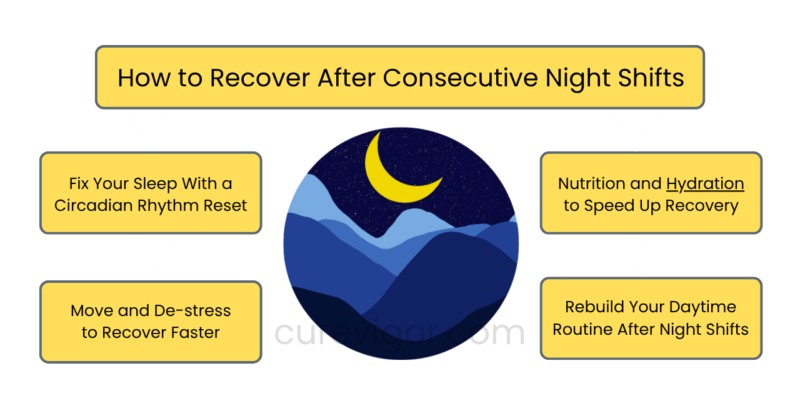
Step 1: Fix Your Sleep With a Circadian Rhythm Reset
Quality post-night-shift sleep forms the foundation of your recovery. Most shift workers need 7–9 hours of daytime sleep after consecutive nights, even though your body naturally wants less.
Post-night shift sleep: how many hours do you actually need
Aim for at least 8 hours on the first recovery day. Your body is repaying significant sleep debt, so protect every minute.
Reset sleep after night shifts with light exposure therapy.
Light is your most powerful tool. Upon waking, seek bright light (10,000 lux light box or direct sunlight) for 20–30 minutes to suppress melatonin and signal daytime. In the evening, use dim lighting and avoid blue light to help shift workers’ melatonin levels rise naturally.
Melatonin for shift workers: timing and dosage for recovery
Take 0.5–3 mg of melatonin 30–60 minutes before your target daytime sleep. Use it strategically during the first two recovery days rather than every day. Combine it with a consistent wind-down routine for best results.
Blackout room and temperature for deep sleep debt recovery
Use blackout curtains or an eye mask to make your bedroom entirely dark. Keep the temperature between 60 and 67°F (15.5 and 19.4°C). Remove all screens and LED lights. These conditions maximize deep sleep stages that repair inflammation and support recovery from adrenal fatigue and shift work.
Best Way to Reset Sleep After Night Shifts:
You create optimal conditions by using a fully darkened, cool bedroom, taking melatonin at the correct time, getting bright light immediately upon waking, and maintaining the same pre-sleep ritual even on recovery days.
Studies on chronobiology show that consistent light exposure therapy produces a faster circadian rhythm reset than sleep alone.
- Block all light sources.
- Use melatonin strategically
- Get morning bright light.
- Keep the room cool
- Stick to a fixed wind-down sequence.
Step 2: Nutrition and Hydration to Speed Up Recovery
The speed at which you recover from night-shift exhaustion is directly affected by the foods and beverages you consume.
Nutrition for night shift recovery: foods that reduce inflammation
Pay attention to foods that reduce inflammation, such as almonds, leafy greens, berries, turmeric, olive oil, and fatty fish. These help lower the inflammatory load created by disrupted sleep. Avoid processed foods, excessive sugar, and fried foods, as they can prolong recovery.
Hydration after a night shift to flush toxins and fatigue
Dehydration worsens brain fog and fatigue. Drink at least 3–4 liters of water on recovery days. Add electrolytes if you sweated heavily during shifts. Proper hydration supports detoxification pathways and improves cognitive function faster.
Blood sugar stability meals to prevent a crash during recovery days
Consume well-balanced meals that include complex carbs, healthy fats, and protein. To regulate blood sugar and lessen cravings, eat a high-protein meal as soon as you get up. Examples include eggs with avocado and vegetables or Greek yogurt with nuts and berries.
Supplements that support night shift recovery
Consider magnesium glycinate for muscle relaxation, omega-3s to reduce inflammation, and vitamin D if you lack daytime sun exposure. Before beginning any new supplement regimen, always get medical advice, particularly if you suspect adrenal fatigue from shift work.
Step 3: Move and De-stress to Recover Faster
Gentle movement and stress regulation help discharge the physical tension that builds up over consecutive shifts.
Light movement to reduce muscle stiffness after long shifts
After a run of night shifts, the goal isn’t an intense workout; it’s circulation. A 10–15-minute walk, gentle stretching, or mobility work can ease stiffness from long periods of standing or repetitive movement without adding to your fatigue debt.
Breathwork and stress management for shift worker recovery tips
- Try 4-7-8 breathing (inhale 4 counts, hold 7, exhale 8) before your daytime sleep window
- A short body scan or progressive muscle relaxation can help transition out of “shift mode.”
- Avoid checking work messages or news right before your sleep window; mental stimulation delays sleep onset
Burnout prevention in shift work: when to take a full rest day
If fatigue, irritability, or brain fog is still present after your standard recovery routine, that’s a signal to take a full rest day rather than push through with stimulants. Chronic push-through patterns are among the most consistent risk factors researchers have identified for shift work burnout over time.
When to slow down
If you notice ongoing sleep problems, mood changes, or physical symptoms that don’t improve with rest, this may be more than routine shift lag. Persistent symptoms are worth discussing with a doctor rather than managing indefinitely on your own.
Step 4: Rebuild Your Daytime Routine After Night Shifts
Transitioning back to a day schedule requires intention.
How to transition back to the day schedule without a crash
Gradually shift your wake time earlier by 30–60 minutes each day. Use light exposure therapy in the morning and maintain consistent meal times.
Caffeine cutoff and morning sunlight for circadian rhythm reset
Stop caffeine by 2 pm on recovery days. Get natural sunlight as early as possible to reinforce your internal clock.
Social life and family time during night shift recovery
Protect your sleep first, then schedule short, meaningful interactions. You can improve relationships by explaining your recovery needs rather than powering through fatigue.
Common Mistakes That Delay Recovery After Consecutive Night Shifts
Even with the best intentions, many shift workers fall into predictable traps that actively sabotage their recovery. You can avoid these by recognizing them in yourself.
- Sleeping In Too Late: Sleeping until 5 p.m. on your first recovery day just because it feels good sets you up for a failed circadian reset. It will make it nearly impossible to fall asleep that night, or any time before 4 a.m. the next day. Cap your first core sleep block.
- Relying Only on Caffeine and Sugar: Using stimulants to power through a day with your family or to run errands is like borrowing from a loan shark. You’ll get a few hours of false energy, but you’ll pay for it with a debilitating crash, increased anxiety, and delayed sleep later.
- Skipping Meals or Overeating: The post-night-shift appetite can be confusing. Some people feel nauseous and skip food entirely, starving their bodies of repair nutrients. Others are ravenous and overeat heavy, processed foods that fuel inflammation. Both extremes block recovery.
- Doing Nothing at All: The opposite of overdoing it. Lying horizontally on a screen for 48 hours will leave you feeling stiffer, foggier, and more disconnected. Gentle, deliberate movement is a recovery tool, not an energy drain.
- Ignoring the Light Cues: Failing to wear blue blockers during the morning commute or failing to get bright afternoon light will keep your internal clock stuck in a confused no-man’s-land, prolonging your exhaustion by days.
Your 3-Day Recovery Plan: How to Recover After Consecutive Night Shifts
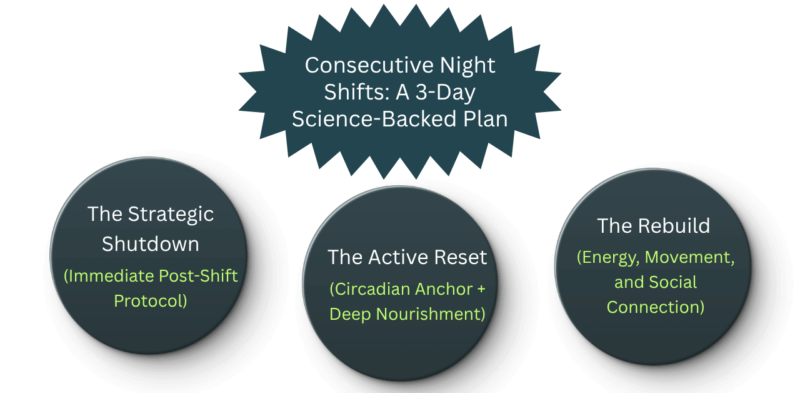
A simple structure to follow after your last night shift in a stretch.
Day 1: The Strategic Shutdown (Immediate Post-Shift Protocol)
- Your Morning Commute: Wear dark amber blue-light-blocking glasses from the moment you leave the building. Do not take them off until you are in your pitch-black room.
- Your Sleep Block (8:00 AM – 3:00 PM): Sleep in a cool, blacked-out, sound-masked room. Target 6-7 hours of core sleep. Do not set an alarm unless you absolutely must, but let your body wake naturally.
- Your Wake-Up Protocol (3:00 PM): Immediately go outside for 15-20 minutes in bright, natural sunlight without sunglasses. Hydrate with a large glass of electrolyte-rich water.
- Your Late Afternoon (4:00 PM): Eat a light, anti-inflammatory meal (e.g., salmon and greens). If you are deeply fatigued, take a 90-minute nap, but no later than 6:00 PM.
- Your Nighttime Wind-Down (12:00 AM – 1:00 AM): Avoid screens for 90 minutes before bed. Take a hot shower, practice your 4-7-8 breathwork, and aim to be in bed by 1:30 AM.
Day 2: The Active Reset (Circadian Anchor + Deep Nourishment)
- Your Morning (9:00 AM): Wake up and immediately go outside for a 30-minute walk in bright sunlight. This is your strongest circadian anchor.
- Your Midday Meal (12:00 PM): A balanced, blood-sugar-stabilizing meal (e.g., quinoa bowl with chicken and avocado). No caffeine after 1:00 PM.
- Your Afternoon (3:00 PM): 20 minutes of gentle, restorative movement: floor-based stretching, foam rolling, or a slow walk. This is to release physical tension, not to build fitness.
- Your Nighttime (10:00 PM): Start your wind-down earlier. Dim all household lights to a warm, amber glow. Half an hour before bed, take a small dose of melatonin (0.5–3 mg). Aim for 11:00 PM as your bedtime.
Day 3: The Rebuild (Energy, Movement, and Social Connection)
- Your Morning (8:00 AM): Wake up at a consistent “normal” time. Go outside for your sunlit walk. You should begin to feel a noticeable lift in your cognitive clarity and physical energy.
- Your Daytime: You can reintroduce a moderate workout today—a 30-minute jog, a bike ride, or a bodyweight circuit. Connect with a friend or family member for a low-key, positive social interaction to rebuild your emotional reserves.
- Your Evening: Focus on a nutrient-dense “Sunday dinner”-style meal. Prepare your food, your schedule, and your mindset for the next work block. Go to bed at a consistent, normal time to solidify your recovered rhythm.
Long-Term Strategy: Prevent Burnout Between Shift Cycles
Weekly shift worker recovery tips to stay healthy
- Protect a consistent core sleep window, even across different shift patterns
- Batch-cook anti-inflammatory meals ahead of a run of night shifts
- Schedule at least one full rest day after every 3–4 consecutive night shifts, where possible
- Keep a simple log of sleep, mood, and energy to catch patterns early
- Build in outdoor daylight time on days off, not just recovery days
Tracking recovery: sleep, mood, and energy markers
A simple daily 1–10 rating for sleep quality, mood, and energy, tracked over a few weeks, can reveal whether your recovery routine is actually working or whether debt is quietly accumulating shift after shift.
When to talk to a doctor about chronic shift-work fatigue
- Fatigue or brain fog that doesn’t improve with consistent recovery days
- Ongoing insomnia even when your sleep environment is optimized
- Ongoing mood changes, anxiety, or depressive symptoms
- Digestive changes, unexplained weight change, or frequent illness
- Any symptom that concerns you or interferes with daily functioning
Reminder: This guide is educational and does not replace individualized medical care. A healthcare provider can evaluate symptoms in the context of your full health history and rule out conditions like shift work sleep disorder.
Key Takeaways
- Recover after consecutive night shifts by addressing sleep debt, inflammation, and circadian misalignment together.
- Prioritize 8–9 hours of quality daytime sleep in a cool, dark room on the first recovery day.
- Use strategic light exposure therapy, timed melatonin for shift workers, and anti-inflammatory nutrition to speed healing.
- Follow the structured 3-day recovery plan rather than hoping rest alone will fix everything.
- Avoid common mistakes like excessive caffeine intake, irregular sleep schedules, and skipping movement.
- Build weekly shift-worker recovery tips into your schedule to prevent long-term burnout.
- Track your sleep, energy, and mood so you can refine your personal approach over time.
FAQs About Night Shift Recovery
Q. How long does it actually take to fully recover from night shifts?
Full physiological recovery depends on the number of consecutive shifts you worked and your individual resilience.
For a block of three to four consecutive night shifts, a dedicated 3-day protocol is typically required to reset your sleep, reduce inflammation, and rebuild energy. However, research on circadian rhythms suggests a full, deep biological resynchronization can take up to a week.
You will likely feel functional after three days, but you should continue prioritizing sleep and light management for several more days to achieve full recovery and prevent cumulative damage.
Q. Can I use melatonin every time I need to recover from a night shift?
You can use melatonin strategically for its chronobiotic effect during recovery transitions, but it should not be a permanent crutch.
Melatonin is a hormone that helps your body adjust its internal clock by signaling “darkness” to your body. Using a low dose for the two or three nights of your recovery transition is a scientifically supported short-term strategy.
However, your goal should always be to entrain your circadian rhythm to your environment using the more powerful tools of light and darkness, rather than relying on a nightly supplement indefinitely. Always consult your doctor before any regular hormonal use.
Q. Why do I feel emotionally fragile or depressed after my shift block?
This is a direct neurological result of circadian disruption and sleep deprivation. The amygdala, your brain’s emotional processing center, becomes hyper-reactive when you’re sleep-deprived, while the prefrontal cortex, which governs rational emotional regulation, is impaired.
This creates a state of emotional volatility where you are more prone to sadness, anxiety, and irritability. This is not a character flaw; it’s a predictable biological state caused by a lack of REM sleep.
Prioritizing your recovery protocol, particularly the deep-sleep environment, is the most direct way to restore your emotional equilibrium.
Q. Is it better to stay awake or take a nap on my second recovery day?
A strategic nap is far better than staying awake and depleting yourself further, but you must do it correctly. If you need a nap, take it in the early afternoon, ideally between 1:00 and 3:00 PM.
Limit it to just 20 minutes or precisely 90 minutes. You can complete a full sleep cycle, including deep sleep, with a 90-minute nap, leaving you feeling rejuvenated. A 20-minute “power nap” provides alertness without sleep inertia.
Avoid a 45-60 minute nap, as waking from the middle of a deep sleep cycle will leave you feeling worse. Do not nap after 4:00 PM, as it will steal from your nighttime sleep drive and delay your circadian reset.
Q. What if my recovery plan is interrupted by family or emergency responsibilities?
The lives of caregivers and parents don’t pause for recovery plans. If your plan is broken, you must adapt, not abandon it. An interrupted plan is not a failed plan. Steal back the micro-moments.
The walk that was supposed to be 30 minutes becomes 10. The nap is replaced by a 5-minute S.T.O.P. mindfulness practice with feet flat on the floor. Avoiding an all-or-nothing mindset is crucial.
Guard the non-negotiables as fiercely as possible: the blue-blocking glasses in the morning and the bright light exposure when you wake up. Do what you can, and let go of the guilt of not being able to follow a perfect protocol.
Q. How do I stop myself from just crashing and sleeping the entire day?
The desire to crash is a legitimate biological drive, but giving into it fully will decimate your next night’s sleep and trap you in a negative cycle. The practical hack is to set a “social or accountability anchor” for the afternoon.
Arrange a non-negotiable, low-key activity with someone who expects you, schedule a 3:00 PM phone call with a friend, or ask your partner to drag you out for a 15-minute walk when they get home.
This external structure will pull you out of bed at a strategic time, preventing you from sleeping so late that your entire rhythm is flipped.
Q. When should I go back to the gym after my night shifts?
Resist the urge to do a punishing workout on Day 1 of your recovery. Your body is in a catabolic, inflammatory state, and intense exercise will spike your cortisol levels, placing additional stress on an already overwhelmed system.
By Day 2, you are ready for gentle, restorative movement, such as walking or stretching. You can safely return to a moderate, full-body strength or cardio session on Day 3, provided you have slept well and feel a genuine return of energy.
Listen carefully to your body’s signals. If you still feel deeply drained, give yourself another day of gentle movement. Recovery is a performance enhancer, not an obstacle.
Conclusion
Recovering after consecutive night shifts is not a passive miracle that happens between your shifts; it is a deliberate, active, and compassionate practice you choose for yourself.
Your body has done something heroic and profoundly unnatural by working through the night, and it now requires a structured protocol to rebuild.
By following this 3-day plan, manipulating light, nourishing strategically, and moving gently, you are not just “catching up”; you are actively rewiring your rhythm, reducing inflammation, and preventing the long-term burnout that claims so many dedicated shift workers.
Start this protocol on your very next day off. Don’t just crash. Take control of the one variable you can manage: your recovery. Print out the 3-Day Plan and stick it on your fridge.
Tell your family what you’re doing and why. Be patient with a body that is trying its best, and be fiercely protective of these recovery days. The energy and clarity you can access on the other side of this planned recovery protocol are not just possible; they are waiting for you to claim them.
To reclaim your energy and break the cycle of exhaustion, start your very next day by blocking out morning light and prioritizing your first recovery sleep. Your body is waiting for the signal to heal.
CureVigor provides general wellness information for night shift and shift workers. Content is not medical advice and is not intended to diagnose, treat, cure, or prevent any condition. Always consult a licensed healthcare professional regarding your individual health needs.
CUREVIGOR.COM
Build Your Own Night Shift Recovery System
Get the full Night Shift Sleep Protocol & 30-Day Tracker — a printable, structured guide to pairing sleep, light, and nutrition strategies with your real shift schedule.
Explore CureVigor Guides →
Read more about night shift workers’ health.
You might like: