

Working out sounds simple until your work schedule turns your day upside down. When you work nights, rotate between shifts, or spend 10–12 hours on your feet, finding the energy to exercise can feel like another job.
You may finish a shift exhausted, sleep during the day, wake up hungry, and then wonder when to fit in a workout. The problem is not always motivation. Shift work changes when you sleep, eat, work, and recover, so your fitness routine has to work around those changes rather than pretending you live on a regular daytime schedule.
Research supports this challenge. A 2026 systematic review of randomized trials involving shift workers found that structured exercise showed promise for improving sleep and some measures of alertness and cognitive function.

However, the researchers also noted considerable differences between studies and concerns about study quality. That matters because exercise can be part of a healthier shift-work routine, but simply telling a tired worker to “exercise more” misses the real issue.
The better approach is to treat your workout energy as a system. Sleep, meal timing, hydration, caffeine, workout intensity, and recovery all influence whether you feel ready to move.
You don’t need a perfect schedule, and you certainly don’t need to force yourself through a hard workout after every difficult shift. Instead, you need a flexible plan with options for high-energy, normal-energy, and low-energy days.
Why Shift Work Can Drain Your Workout Energy
Your body has an internal timing system called the circadian rhythm, which helps coordinate sleep, wakefulness, hormones, body temperature, digestion, and other daily processes.
Night work asks you to stay awake and active when your body is normally preparing for sleep. Then, when your shift ends, you may need to sleep while daylight, household noise, errands, family responsibilities, or hunger compete for your attention.
That mismatch can make exercise feel harder than it normally would. A worker who sleeps seven hours at night and a worker who sleeps seven hours during the day have the same number of hours on paper, but the experience may not be identical.
Shift workers commonly report fatigue and difficulty balancing sleep with work and other responsibilities, and a 2025 systematic review found that knowing what healthy behaviors to follow does not necessarily make them easy to maintain in demanding shift-work environments.
This is why your workout plan should start with a simple question: How much recovery do I actually have today? If you slept reasonably well and feel alert, you may be ready for strength training or a more demanding cardio session.
If you slept poorly and feel like you are dragging yourself through the day, a walk, mobility session, or short strength workout may be a smarter choice.
How Circadian Rhythm, Sleep, and Fatigue Affect Exercise
Think of your circadian rhythm as an internal clock, not a stopwatch. It doesn’t just tell you when to sleep; it influences when your body expects to be awake, active, and resting. Working against that rhythm can make night shifts difficult, especially when you try to sleep during daylight and stay alert overnight.
Sleep quality matters for exercise because your workout is only one part of the process. Training provides the stimulus, but recovery is where your body adapts. If you repeatedly combine demanding workouts with inadequate sleep, you may notice that your normal weights feel heavier, your motivation falls, or your usual walk leaves you unusually tired.
This does not mean shift workers should avoid exercise. In fact, current research is encouraging.
A 2026 review of 10 randomized trials involving 420 shift workers found that several studies reported improvements in measures such as sleep quality, total sleep time, or sleep efficiency following structured exercise.
However, the authors also emphasized that the studies varied considerably and that many had some risk of bias.
The practical lesson is simple: exercise can support your routine, but exercise cannot replace sleep. If your body is repeatedly asking for recovery, listening to that signal is part of being fit.
Common Energy Traps: Dehydration, Poor Nutrition, and Burnout
Some workout-energy problems have surprisingly ordinary causes. You may have gone several hours without drinking enough water, grabbed a sugary snack because it was convenient, skipped a proper meal, or relied on coffee because you were too busy to stop.
By the time you finally have time to exercise, your body is being asked to perform with very little fuel.
Shift work can also change eating patterns. Older research on shift workers found that meal frequency may decrease. At the same time, snacking can increase during night work, with food availability, time pressure, and reduced nighttime appetite all contributing.
Another trap is trying to compensate for exhaustion with more exercise. A hard workout may feel productive, but if you are already severely fatigued, adding more physical stress is not always the best choice. Burnout prevention starts with recognizing that a lighter workout is still a workout.
On a low-energy day, your goal might be to keep the habit alive. Ten minutes of mobility, a brisk walk, or two short sets of basic exercises can be enough to prevent the “I missed one workout, so I have failed” mindset. Fitness builds over weeks and months, not on one difficult Tuesday morning.
When Is the Best Time for Shift Workers to Work Out?
No single clock time works for every shift worker. Your best workout window depends on your shift, commute, sleep period, meal timing, family responsibilities, and how your body responds to exercise. A nurse finishing at 7 a.m. may have a completely different ideal routine from someone working 4 p.m. to midnight or rotating between day and night shifts.
Instead of asking, “What is the perfect workout time?” ask, “When am I most likely to have enough energy without damaging my next sleep period?” That question gives you a much more useful answer.
Current research also supports a personalized approach. The 2026 exercise review specifically noted that structured programs tailored to shift patterns and individual chronotype may be promising, while also calling for stronger research before firm shift-worker exercise recommendations can be established.
Pre-Shift vs. Post-Shift vs. Days Off
Pre-shift workouts can work well when you have already slept and feel reasonably alert. For example, someone starting a night shift at 7 p.m. might train in the late afternoon, eat afterward, shower, and head to work. This can be especially convenient because you finish the workout before the shift’s demands begin.
Post-shift workouts are more complicated. If you finish at 7 a.m. and feel wide awake, you might enjoy light exercise. But if you are struggling to keep your eyes open, forcing yourself through heavy training before bed may not be worth it. Your commute and safety should also come first.
Days off can provide your best opportunity for longer workouts. You can schedule strength training, longer walks, cycling, swimming, or other activities when you have more control over food and sleep. The key is not to treat days off as your only opportunity to exercise, but to use them strategically when your working days are especially demanding.
How to Choose Your Best Workout Window on a Night Shift
Start with your sleep rather than your workout. If you normally sleep from 9 a.m. to 4 p.m., a workout somewhere between waking and starting work may be more practical than exercising immediately after your shift. If you sleep later in the day, your workout window can move accordingly.
Try three possible windows for one or two weeks: after waking, before the shift, and on selected days off. Notice when you have the most energy, when you perform best, and whether exercise affects your ability to sleep afterwards.
Don’t assume a specific number of minutes before or after sleep is ideal for everyone. People respond differently to exercise timing, and shift schedules vary. Your practical target is a workout window that allows you to train without repeatedly cutting into your main sleep period.
If a late workout leaves you wired when you need to sleep, reduce the intensity or move the session earlier. If exercising before work makes you feel stronger and more alert during your shift, that may be your better option. Your schedule should serve your recovery, not the other way around.
How to Boost Workout Energy Before Your Shift

Your workout does not begin when you pick up a dumbbell. It starts earlier, with what you eat, drink, and do during the hours leading up to training. For shift workers, this preparation becomes even more useful because long gaps between meals can happen easily when work gets busy.
A simple pre-workout routine can remove much of the guesswork. Drink some water after waking, eat a balanced meal when appropriate, and give yourself enough time to digest before harder exercise. You do not need an elaborate supplement stack or expensive “energy” product.
The goal is steady energy, not a dramatic spike.
Pre-Workout Nutrition for Steady Energy
A useful pre-workout meal combines carbohydrate with protein and, depending on how close you are to exercise, a modest amount of fat. Carbohydrates provide readily available fuel for exercise, while protein contributes to your overall daily protein intake and supports muscle repair and maintenance.
If you have one to three hours before training, a normal meal may work well. For example, you could have chicken with rice and vegetables, eggs with whole-grain toast and fruit, yogurt with oats and fruit, or another familiar meal that sits comfortably in your stomach.
If you only have 30–60 minutes, keep the portion smaller. A banana with yogurt, fruit with a small serving of cottage cheese, toast with a little peanut butter, or a simple smoothie may be easier to tolerate than a large meal.
Do not turn this into a list of forbidden foods. One meal will not make or break your fitness. Instead, pay attention to patterns. If a very heavy, greasy meal repeatedly makes you sluggish during training, change the meal size or timing.
If sugary snacks leave you hungry again quickly, pair them with a protein source or choose a more balanced snack.
Caffeine, Hydration, and Electrolytes
Caffeine can temporarily increase alertness and reduce the perception of effort, which explains why many shift workers reach for coffee before or during a difficult shift. But caffeine has a major drawback for night workers: the same stimulant that helps you stay awake can make it harder to sleep later.
A controlled sleep study found that 400 mg of caffeine could disrupt sleep even when taken six hours before habitual bedtime. That does not mean every shift worker must avoid caffeine six hours before sleep, because sensitivity and dose vary. It does mean that caffeine timing deserves attention if daytime sleep is already difficult.
Hydration is more straightforward. Keep fluids available throughout your waking period and drink according to thirst, activity, environment, and individual needs.
If you exercise heavily and sweat a lot, electrolytes may be useful, especially in hot environments. For a short indoor workout, however, you usually do not need a complicated hydration strategy.
The 4-Part Workout Energy System for Shift Workers
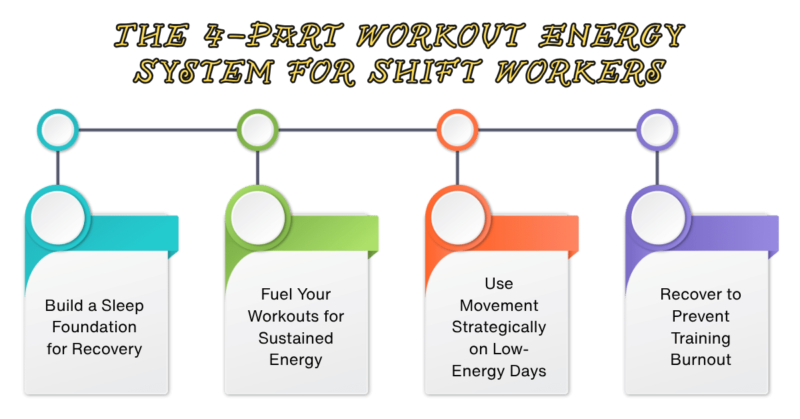
Instead of chasing energy with another cup of coffee, build your routine around four connected pieces: sleep, fuel, movement, and recovery. Think of these as four legs of a table. If one is weak, the whole thing becomes less stable.
You do not need to perfect all four at once. Start with the area causing the biggest problem. If you are sleeping five hours because of a chaotic schedule, fix your sleep opportunity before worrying about whether your pre-workout snack contains the perfect ratio of nutrients.
1. Build a Sleep Foundation for Recovery
Sleep is not the enemy of fitness. It is part of fitness.
For night workers, creating a protected sleep environment can make a noticeable practical difference. Keep the room dark, cool, and quiet when possible. Blackout curtains, an eye mask, earplugs, white noise, and a consistent wind-down routine can all help.
Shift-work sleep research supports tailored strategies because traditional sleep advice does not always fit people who sleep during the day. A 2023 expert consensus project developed shift-worker-specific recommendations covering sleep scheduling, naps, the sleep environment, substances, light exposure, diet, and exercise.
If you need a nap, keep it purposeful rather than letting it accidentally replace your main sleep period every day. Some people benefit from a short nap before work, while others find that naps interfere with their main sleep.
Most importantly, don’t use exercise as an excuse to shorten your sleep repeatedly. A 5 a.m. gym session is not automatically healthier than sleeping another hour when you are already exhausted.
2. Fuel Your Workouts for Sustained Energy
Your body needs energy to train, and shift work can make regular eating difficult. Preparing a few simple meals or snacks ahead of time can prevent the vending-machine decision when you are tired.
Keep practical options available: fruit, yogurt, eggs, nuts, whole-grain wraps, tuna, chicken, milk, oats, or leftovers that reheat easily. The best shift-work food is often the food you can realistically pack, store, and eat.
Before training, consider how long it has been since your last meal. If you ate a balanced meal two hours ago, you may not need anything else. If it has been five or six hours, a small snack may make the workout feel much better.
There is no magic food that instantly creates energy. Consistent meals, adequate total food intake, and sensible timing are more useful than chasing a single “superfood.”
3. Use Movement Strategically on Low-Energy Days
Not every workout needs to leave you sweating on the floor. Some days call for a full-strength session. Other days call for movement that gets your body moving.
When your energy is low, try a 15-minute workout: five minutes of easy cycling or brisk walking, followed by bodyweight squats, wall push-ups, glute bridges, band rows, and gentle mobility exercises. You can perform two or three rounds without turning the session into an exhausting event.
This approach also helps solve a common psychological problem. If your only definition of exercise is “a complete 60-minute gym workout,” missing that hour can make you feel as though the entire day is lost. A short session gives you another option.
Current physical activity guidelines recommend that adults move more and sit less, with a weekly goal of at least 150 minutes of moderate aerobic activity and at least two days of muscle-strengthening activity. You can build toward that amount gradually; you do not have to accomplish everything in one session.
4. Recover to Prevent Training Burnout
Recovery is where many ambitious fitness plans fall apart. You start with five workouts a week, feel motivated for ten days, then a difficult run of shifts arrives, and suddenly the plan becomes impossible.
Instead, create a minimum and a maximum. Your minimum might be two strength sessions and several short walks during a difficult week. Your maximum might include three strength sessions, cardio, and mobility when your schedule and recovery are good.
Rest days are not wasted days. They give you room to recover between harder sessions, especially if your job is physically demanding.
Active recovery can be as simple as walking, gentle cycling, stretching, or mobility exercises. The purpose is not to “burn more calories.” It keeps movement enjoyable while reducing the pressure to train hard every time.
Sample Workout Plans for Different Shift Schedules
A useful shift-worker fitness routine should be flexible enough to survive a bad week. The following examples are templates, not rules. Adjust the days and intensity according to your actual sleep and work schedule.
A 12-Hour Night-Shift Workout Routine
Imagine you work three 12-hour night shifts each week, such as 7 p.m. to 7 a.m. On workdays, you might prioritize a 20–40-minute workout after waking and before getting ready for work.
A sample week could look like this:
| Day | Schedule idea | Workout |
| Day 1 | Before the night shift | 30-minute full-body strength |
| Day 2 | Before the night shift | 15–20-minute walk + mobility |
| Day 3 | Before the night shift | Rest or short strength session |
| Day 4 | After recovery sleep | 30–45-minute strength |
| Day 5 | Day off | Walking, cycling, or another enjoyable activity |
| Day 6 | Day off | Optional strength or cardio |
| Day 7 | Recovery day | Gentle movement |
The exact arrangement can change. If your first night shift follows a normal day, you may have plenty of energy. After the third consecutive night, you may need more recovery.
That is not failure. It is the reality of the schedule.
A 20-Minute Workout for Exhausted Days
When you are tired but still want to move, forget complicated programming.
Spend the first three minutes warming up with easy walking, marching in place, or gentle mobility. Then perform squats or sit-to-stands, push-ups against a wall or sturdy surface, glute bridges, and a resistance-band row if you have one.
Work for about 30–45 seconds, rest as needed, and repeat for two or three rounds. Finish with a few minutes of relaxed stretching or walking.
The purpose of this workout is not to set a personal record. It is to maintain movement when a full training session does not fit your current energy level.
If you are severely sleep-deprived, dizzy, unusually weak, ill, or struggling to stay awake, skip the workout. Turning exhaustion into an injury risk is never productive.

What to Eat and Drink for Better Workout Energy
Food choices do not need to become complicated just because you work nights. In fact, complicated meal plans often fail because they require too much preparation during an already demanding schedule.
Think in terms of building blocks: a source of protein, a source of carbohydrates, vegetables or fruit, and fluids. You can combine those pieces in whatever way fits your culture, budget, appetite, and work environment.
A simple meal of rice, chicken, and vegetables can work just as well as a trendy “fitness bowl.” Eggs and toast can be useful. Yogurt and fruit can be convenient. A homemade sandwich can be perfectly reasonable.
The best plan is the one you can repeat.

Pre-Workout Snacks and Post-Workout Meals
If you need something before exercise, keep the snack relatively simple. Examples include fruit and yogurt, a banana with a small amount of nut butter, oats with milk, or toast with eggs.
After strength training, include a protein-rich food in your next meal. You don’t need to rush to drink a special recovery drink the second your workout ends.
If your workout finishes close to your main sleep period, avoid turning the recovery meal into a huge feast. A comfortable meal that provides protein and enough carbohydrate may be easier to manage than something extremely heavy.
And remember that digestion is individual. If a particular food causes reflux, bloating, or discomfort before training, change it. Your pre-workout meal should support your session, not become another problem to manage.
Creatine, Magnesium, and Vitamin D—What the Evidence Says
Supplements deserve a more careful approach than social media usually gives them.
Creatine has strong evidence for supporting high-intensity exercise performance and strength when used appropriately. Still, it is not a stimulant and should not be presented as a treatment for shift-work fatigue.
Magnesium is a necessary mineral that is involved in numerous bodily functions. However, taking extra magnesium does not automatically solve tiredness, and high supplemental amounts can cause gastrointestinal problems. If you suspect a deficiency, talk to a healthcare professional rather than guessing.
Vitamin D is also important for normal health. Still, supplementation should be based on dietary intake, risk factors, testing when appropriate, and professional advice rather than the assumption that working nights automatically means you need a supplement.
The broader lesson matters: supplements should fill genuine nutritional gaps or serve a specific, evidence-based purpose, not replace sleep, food, hydration, and recovery.
Caffeine, Pre-Workout, and Energy Drinks: A Smart Timing Guide
Caffeine can be useful, but shift workers should treat it as a tool, not a substitute for recovery.
If you use coffee or another caffeinated product before exercise, consider when you expect to sleep afterwards. A dose that feels harmless at 6 p.m. could be a very different story at 6 a.m. when you are trying to sleep after your shift.
How to Use Caffeine Without Disrupting Sleep
The most useful question is not simply, “How much caffeine can I have?” Ask, “How close is this caffeine to my intended sleep?”
A controlled study found that 400 mg of caffeine taken six hours before bedtime could still affect sleep. People vary in sensitivity, so your own response matters too.
If you finish your night shift at 7 a.m. and normally try to sleep at 9 a.m., a large caffeinated drink near the end of the shift may be a poor trade-off. You might feel more alert temporarily, but it can make daytime sleep harder.
Energy drinks deserve the same caution. Check both caffeine and sugar content rather than assuming every product works the same way. A sugar-free energy drink may not produce the same blood-glucose response as a sugary one, but the caffeine can still interfere with sleep.
For many shift workers, better caffeine timing is more useful than simply increasing caffeine intake.
Mistakes That Drain Workout Energy
One of the biggest mistakes is treating every workout as a test of toughness. You had a terrible night, slept badly, and still decided that today’s workout must be your hardest session of the week. Sometimes that mindset builds discipline. Sometimes it simply digs the recovery hole deeper.
Another mistake is skipping meals and relying on caffeine. Coffee can make you feel awake, but it does not provide the nutrients your body needs to train and recover.
A third mistake is trying to follow a rigid Monday-to-Friday fitness schedule while working rotating shifts. If your workdays shift, your workout plan should too.
Instead of saying, “I always train Monday, Wednesday, and Friday,” use a rule such as:
Train when recovery is adequate, aim for two or three strength sessions a week, and use shorter sessions when your schedule gets tight.
Finally, do not compare your energy to someone with a completely different schedule. A daytime office worker who sleeps uninterrupted at night may have very different recovery conditions from someone finishing a 12-hour night shift.
How to Build a Sustainable Shift-Worker Fitness Routine
Sustainability turns exercise from a short burst of motivation into a lifestyle. Your routine needs to survive overtime, rotating shifts, family commitments, poor sleep, holidays, and the occasional week when everything goes wrong.
Start small. If you currently exercise once a week, jumping immediately to six sessions is unnecessary. Add one session, build the habit, then increase gradually.
Use three workout levels:
Green day: You slept reasonably well and feel alert. Do your planned strength or cardio session.
Yellow day: You are tired but functioning normally. Reduce the duration or intensity and keep moving.
Red day: You are severely sleep-deprived, dizzy, sick, unusually weak, or struggling to stay awake. Prioritize recovery and safety over exercise.
This traffic-light system reduces the guilt of flexible training. You are still following your plan; you are simply choosing the appropriate version for today’s conditions.
The long-term goal is not to win every workout. It is to keep showing up.
General physical activity standards recommend that adults do at least two days of muscle-strengthening activity and at least 150 minutes of moderate aerobic activity per week. You can get more benefits at higher levels. But those numbers are a destination, not a reason to punish yourself during a difficult week.
If your job already involves a lot of physical work, your exercise plan may need to account for that workload. If your job is mostly sitting, regular walking and structured exercise may become even more valuable.
Most importantly, build a routine around your real life, not an imaginary perfect week.
Conclusion on Boosting Your Workout Energy
Getting enough energy to work out as a shift worker is less about finding a magical pre-workout drink and more about putting the pieces together. Your sleep schedule, meal timing, hydration, caffeine use, workout intensity, and recovery all interact. When one area is struggling, the solution is not always to push harder.
Start by protecting your main sleep period. Then find the workout window that fits your actual shift rather than copying someone else’s schedule. Eat enough to support your activity, drink regularly, use caffeine carefully, and keep a shorter workout available for days when your energy is low.
You also do not need to exercise perfectly every week. Some weeks may include several strong workouts, while others may be mostly walking and short movement sessions. That flexibility is not a weakness. For a shift worker, flexibility can keep a fitness routine alive.
The goal is simple: train when your body is ready, scale back when recovery is limited, and keep moving consistently over time.
FAQs About Workout Energy for Shift Workers
Q. How do I get energy to work out after a 12-hour night shift?
If you just completed a 12-hour night shift, first consider how much sleep you got and how alert you feel. If you are exhausted or struggling to stay awake, prioritize sleep rather than forcing a hard workout.
If you feel reasonably alert, a short walk, mobility session, or light workout may be appropriate, while a more demanding session may fit better after your next sleep period. The goal is to match workout intensity to your current recovery instead of treating every day the same.
Q. Should I work out before or after my night shift?
For many people, exercising after waking and before the night shift is a practical option because you have already had your main sleep period and can finish training before work. However, this is not a universal rule.
Some people prefer exercising after work, while others find that late exercise interferes with their daytime sleep. Test different windows and choose the one that gives you enough energy to train without repeatedly reducing your sleep.
Q. What is the best pre-workout for night shift workers?
No single pre-workout is best for everyone. A balanced meal or snack with carbohydrates and protein may provide useful training fuel, while water is usually a good starting point for hydration.
Caffeine can improve alertness for some people, but night workers should consider how close it is to their intended sleep period. A complicated supplement routine should never replace adequate food, fluids, sleep, and recovery.
Q. How many days a week should shift workers exercise?
The general adult activity guidelines, which call for at least 150 minutes of moderate aerobic workout per week and at least two days of muscle-strengthening activity per week, are a realistic goal.
Shift workers may need to spread that activity differently because their schedules change. Two or three manageable strength sessions can be a useful starting point, with walking and other movement added according to your energy and available time.
Q. Can I work out when I am tired after a night shift?
It depends on how tired you are. Mild tiredness doesn’t automatically mean you must skip exercise, and a gentle walk or short mobility session may be a reasonable way to stay active.
But severe sleepiness, dizziness, illness, unusual weakness, or difficulty staying awake are reasons to prioritize recovery and safety. Remember, rest is part of training, especially when your work schedule already puts heavy demands on your sleep and recovery.
Q. What is the best workout for night shift workers?
The best workout matches your energy, schedule, and recovery. Strength training, walking, cycling, and short bodyweight workouts can all work well.
On high-energy days, you can follow your planned workout; on low-energy days, choose a shorter or lighter session. The key is to stay consistent without sacrificing sleep or recovery.
Read more about night shift workers’ health.