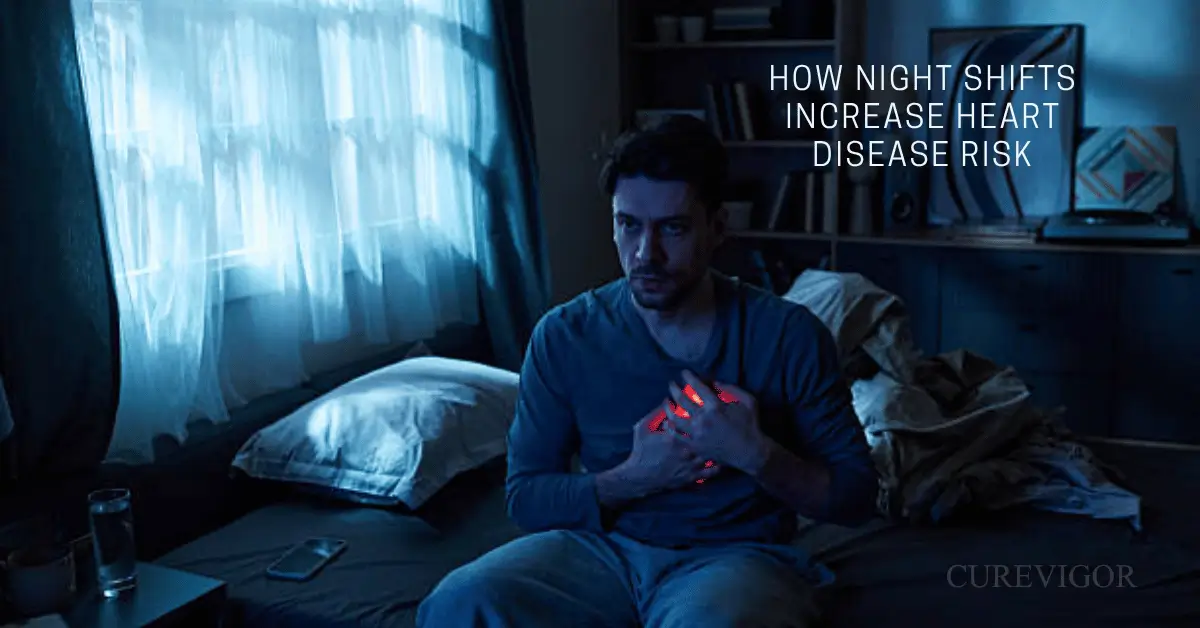
Night shifts may affect heart health by disrupting sleep and the body clock. Explore research, warning signs, and practical ways to protect your heart.
Working night shifts can increase heart disease risk by 15% to 40% because they disrupt the body’s natural 24-hour internal clock, or circadian rhythm.
How Night Shifts Harm the Heart
Increased Inflammation: Night work raises stress hormones like cortisol at the wrong times and triggers chronic low-grade inflammation that damages blood vessels over time.
Circadian Disruption: Living out of sync with the sun confuses your body’s master clock and molecular tissue clocks, which control heart rate and blood vessel tone.
Blood Pressure Issues: Shift workers often miss the healthy, normal drop in blood pressure that usually happens during sleep, leading to sustained high blood pressure.
Metabolic Stress: Eating and working at odd hours causes blood sugar spikes, insulin resistance, higher cholesterol, and a higher risk of type 2 diabetes.

For nurses, drivers, dispatchers, security staff, and other people who work while most of the world sleeps, protecting heart health can feel difficult. Your routine may not fit the usual advice to exercise in the morning, eat dinner at a regular hour, and sleep at night.
The good news is that practical changes to sleep, food, movement, and health monitoring can support your overall well-being. This guide explains what research says, why night work may affect the heart, and what you can do to care for yourself.
Health note: This article provides general information, not a diagnosis or personal medical advice. Discuss your specific risks and treatment plan with a licensed healthcare provider.
How Night Shifts Affect Your Heart
Your body follows an internal 24-hour timing system called the circadian rhythm. It helps regulate sleep and wakefulness, hormone release, body temperature, blood pressure, and metabolism.
Light is one of the main signals that keeps this internal clock aligned with day and night.
Eating, sleeping, and exercising at unusual times can also affect its timing. Night work may disrupt these patterns because you are active when your body expects rest and trying to sleep when your surroundings are bright and busy.
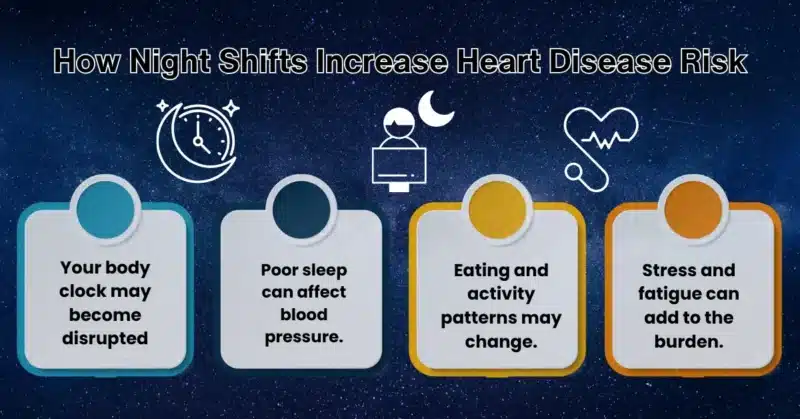
This disruption may affect heart health in several ways.
1. Your body clock may become disrupted
During a night shift, you may be exposed to bright workplace lighting and remain active during hours when your body is preparing for sleep. After work, daylight can make it harder to fall asleep or stay asleep.
When your sleep and activity schedule repeatedly conflicts with your internal clock, your body may struggle to maintain its usual rhythms. This can affect processes involved in cardiovascular and metabolic health.

2. Poor sleep can affect blood pressure.
Daytime sleep is often shorter or more interrupted than nighttime sleep. Noise, sunlight, family responsibilities, and changing work schedules can make it difficult to get enough rest.
Sleep is important for heart health. During normal sleep, blood pressure usually falls. Repeatedly getting too little or poor-quality sleep may interfere with this pattern and is linked with health problems that can increase cardiovascular risk.
3. Eating and activity patterns may change.
Night workers may eat at irregular times, rely on convenient meals, or go for long periods without a proper meal. Fatigue can also make exercise feel harder to manage.
Over time, these challenges may contribute to weight gain, high blood sugar, or unhealthy cholesterol levels in some people. These are important heart disease risk factors, although they do not affect every night worker in the same way.
4. Stress and fatigue can add to the burden.
Night work may involve high workloads, limited staffing, demanding responsibilities, or difficulty balancing work and family life. Fatigue can make it harder to prepare meals, exercise, and maintain a regular sleep routine.
Stress alone does not explain every heart-related risk associated with shift work. However, work-related stress, poor sleep, and unhealthy routines may occur together and deserve attention.
What Research Shows
Research has found associations between night shift work and some heart conditions. However, studies do not all show the same pattern. Results depend on the people studied, how researchers measured night work, and how long they followed participants.
Two studies provide useful insight.
UK Biobank study: Night work and heart conditions
A 2021 study published in the European Heart Journal examined 283,657 UK Biobank participants who were employed or self-employed. 5,777 new cases of atrial fibrillation were reported during the median 10.4-year follow-up period.
An irregular heartbeat known as atrial fibrillation, or AF, can raise the risk of stroke and other problems.
The study found that more permanent night shifts were associated with a greater risk of stroke. They also found associations between some lifetime night-work patterns and coronary heart disease.
The relationship with atrial fibrillation was more complex: the trend across current night-shift categories remained significant, but some individual estimates were less certain after adjustment for other health factors.
The study found no statistically significant associations with stroke or heart failure.
These findings suggest that long-term night work may affect heart health. However, an observational study cannot prove that night work directly caused the conditions.
Danish study: Night work and coronary heart disease
A 2023 study of Danish healthcare workers was published in the International Journal of Epidemiology. It included 100,149 night workers and 153,882 day workers and used payroll records to measure night shifts.
The researchers found an increased incidence of coronary heart disease among male night workers compared with male day workers. They did not find a clear overall increase among female night workers.
However, the study did not find a consistent pattern showing that more monthly shifts, more cumulative night shifts, or more years of night work always led to higher risk.
The authors noted that the population generally had relatively low night-work exposure, which may limit how widely the findings apply.
What should night workers take from these studies?
Together, the studies suggest that night work may be associated with certain heart conditions, but the evidence is not identical across populations or outcomes.
They do not establish that every night worker will develop heart disease, nor do they identify one exact number of night shifts that is safe for everyone.

The practical message is to focus on what you can control, such as sleep, physical activity, food choices, smoking, and regular health checks.
Heart Disease Warning Signs
Heart disease can develop without obvious symptoms. Some people have risk factors such as high blood pressure or high cholesterol for years without knowing it.
However, certain symptoms need urgent attention. Seek emergency medical help if you experience:
- Chest pressure, squeezing, pain, or discomfort that is intermittent or lasts for several minutes.
- Discomfort or pain in the back, neck, jaw, stomach, or one or both limbs.
- Shortness of breath, with or without chest discomfort.
- Cold sweats, nausea, lightheadedness, or sudden unusual weakness.
Heart attack symptoms can vary. Women may also experience unusual tiredness, nausea, or back and shoulder discomfort. Do not dismiss concerning symptoms as ordinary shift-work fatigue.
If you suspect a heart attack, call your local emergency number immediately. In Pakistan, call Rescue 1122 where available. Do not wait to see whether the symptoms disappear.
Natural Ways to Protect Your Heart
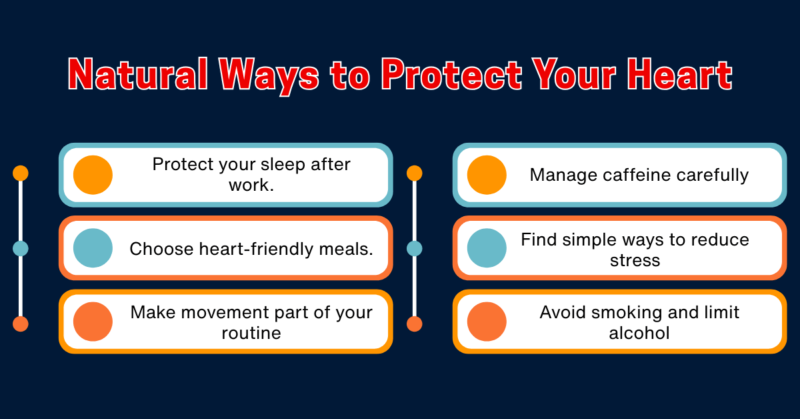
No natural remedy can guarantee protection from heart disease. However, everyday habits can support cardiovascular health and help manage common risk factors.
For night shift workers, the most useful routine fits their actual working hours, not an idealized daytime schedule.
1. Protect your sleep after work.
Sleep is a key part of heart health. Most adults need at least seven hours of sleep in 24 hours, although individual needs vary.
Try to make your main sleep period as consistent as your work schedule allows. After a night shift:
- Make your bedroom dark with blackout curtains or an eye mask.
- Keep the room quiet and comfortably cool.
- Silence notifications and let household members know when you need uninterrupted rest.
- Avoid bright light and stimulating activities close to bedtime.
- Keep a regular sleep window across workdays.
If your schedule changes frequently, aim for a realistic routine rather than repeatedly forcing your body to switch between very different sleep times.

2. Choose heart-friendly meals.
A healthy eating pattern can support blood pressure, cholesterol, and blood sugar. You do not need a special “night shift diet” to make useful changes.
Try to include vegetables, fruit, whole grains, beans, nuts, and protein sources such as fish, eggs, lentils, or lean poultry. Choose unsaturated fats, such as olive or canola oil, more often than foods high in saturated or trans fats.
During a shift, plan meals and snacks when possible. This can reduce the need to rely on highly processed snacks or fast food when you are tired.
A practical approach might be
- Eat a balanced meal before starting work.
- Bring a prepared meal or nourishing snack for your break.
- Drink water regularly.
- Avoid very large meals if they make you uncomfortable or interfere with sleep after work.
No single meal schedule suits every night worker. If you have diabetes, high blood pressure, or any other diet-related condition, pay attention to how your body reacts and seek personalized advice.

3. Make movement part of your routine.
Regular physical activity supports heart health, but it does not have to mean a long gym session after a tiring shift.
Start with weekly activities that you can do, such as swimming, cycling, brisk walking, or basic strength training. If you have never worked out before, start off slowly and work your way up.
You may work out longer on a day off, take quick movement breaks when practical, or go for a stroll before a shift. When you are extremely sleep-deprived or ill, do not push yourself.
Instead of adding more stress to an already taxing schedule, aim to build a habit you can stick to.
4. Manage caffeine carefully
Caffeine can help you feel more alert, but using it too close to your planned sleep time may make it harder to rest.
If you use coffee or tea during a night shift, consider having it earlier in the shift and reducing it as your sleep time approaches. The right cutoff varies because people process caffeine differently.
Avoid relying on energy drinks to overcome ongoing sleep deprivation. If you regularly struggle to stay awake at work or while commuting, talk with a healthcare professional about your schedule and symptoms.

5. Find simple ways to reduce stress
Stress management doesn’t need complicated routines. You can relax with a quick stroll, a quiet break, gentle stretching, or a few minutes of slow breathing.
If work pressure is persistent, consider whether you can discuss breaks, staffing, shift patterns, or recovery time with your employer.
Social support also matters: staying connected with friends and family can help reduce the isolation some night workers experience.
These habits may support general well-being, but they are not a substitute for treatment when you have a health condition.

6. Avoid smoking and limit alcohol
Smoking is a major cardiovascular risk factor. If you smoke, getting support to quit can improve your health. A healthcare professional can help you find a suitable quit plan.
Alcohol can also disrupt sleep and may affect blood pressure and other aspects of health. Avoid using it to fall asleep after work.
Vitamins and Supplements for Night Shift Workers
Night workers sometimes consider vitamins because they spend less time outdoors or have irregular meals. But supplements are not a proven way to prevent heart disease caused by night work.
Supplements may be useful if you have a confirmed deficiency, a dietary gap, or a medical reason to take them. It is best to discuss supplements with a healthcare professional, especially if you take prescription drugs or have a chronic ailment.
Vitamin D
People who sleep during the day may have fewer opportunities for sunlight exposure. However, sunlight exposure varies by season, location, skin tone, clothing, and time spent outdoors.
Most people ages 19 to 70 should consume 600 IU (15 mcg) of vitamin D daily, according to the U.S. National Institutes of Health. For adults over 70, it is 800 IU (20 mcg) per day. These are general intake recommendations, not a personalized treatment dose.
Taking more is not automatically better. High doses can be harmful, and a clinician may recommend testing or a different dose depending on your circumstances.
Vitamin B12 and multivitamins
Vitamin B12 supports normal nerve and blood cell function. Some people may need a supplement because of a restricted diet, absorption problems, or certain medications. Night work alone does not mean you need B12.
Likewise, no multivitamin has been proven to protect night shift workers from heart disease. A balanced diet is the usual starting point. If you suspect a deficiency, ask a healthcare professional whether testing or supplementation is appropriate.
When to Get a Heart Checkup
Do not wait for symptoms to start paying attention to your heart health. A routine appointment can help identify risk factors that are easy to miss, especially if you feel generally well.
Depending on your age, family history, and health, a healthcare professional may recommend checking:
- Blood pressure: High blood pressure often has no noticeable symptoms.
- Cholesterol: A blood test can help identify unhealthy cholesterol levels.
- Blood sugar: Testing may be useful if you have diabetes risk factors.
- Weight and waist measurement: These can help assess some metabolic risk factors.
- Sleep problems: Persistent insomnia, loud snoring, or daytime sleepiness may need further assessment.
Tell your healthcare professional that you work nights. Include your usual shift pattern, how long you have worked nights, your sleep schedule, caffeine use, and any symptoms you have noticed.
There is no universal age at which everyone should stop working night shifts. Work schedule decisions depend on individual health, job demands, personal circumstances, and medical advice.
If night work is affecting your health or safety, discuss possible adjustments with your employer and healthcare professional.
FAQs
Q. Is working night shifts bad for your heart?
Night shift work has been linked with a higher risk of some heart conditions, including coronary heart disease.
However, the risk is not the same for everyone, and research has not proven that night work directly causes heart disease in every case. Sleep, lifestyle, existing health conditions, and work patterns may all play a role.
Q. What effects does working nights have on one’s long-term health?
Long-term night work can disrupt the body clock and make it harder to maintain regular sleep, meals, and physical activity.
Research has associated night work with certain cardiovascular and metabolic conditions, including coronary heart disease, high blood pressure, and type 2 diabetes. These are possible risks, not inevitable outcomes.
Q. How can you stay healthy on night shifts?
Build a routine around your actual working hours. Protect a regular sleep period, prepare balanced meals, stay physically active, drink water, and avoid caffeine close to bedtime.
Regular medical checkups can also help detect conditions like high blood pressure or high blood sugar early.
Q. Why can’t I sleep after a night shift?
Your internal body clock is designed to promote wakefulness during daylight and sleep at night. After a night shift, daylight, noise, family responsibilities, and your circadian rhythm may make it difficult to fall asleep or stay asleep.
A dark, quiet bedroom and a consistent sleep schedule may help. If sleep problems continue, talk to a healthcare professional.
Q. At what age should you stop working night shifts?
There is no specific age when everyone should stop working nights. Your health, sleep quality, job demands, and ability to recover between shifts are more relevant than age alone.
If you experience ongoing fatigue, sleep problems, or health concerns, discuss your work schedule with a healthcare professional.
Q. What are the best vitamins for night shift workers?
No vitamin is especially recommended for night workers. If you are deficient or have specific dietary or medical needs, vitamin D or B12 may be suitable.
Consult a physician to find out whether you need a supplement. Vitamins should not replace a nutritious diet or medical care.
Q. How much vitamin D should night shift workers take per day?
General U.S. recommendations are 600 IU (15 mcg) daily for adults aged 19–70 and 800 IU (20 mcg) for adults over 70.
These amounts are general dietary recommendations, not a treatment plan. Your needs may differ, so ask a healthcare professional before taking high-dose vitamin D.
Q. What is the best sleep medication for night shift work?
No single sleep medication is best for everyone. Some medicines can cause next-day drowsiness, interact with other drugs, or become habit-forming.
Do not start sleeping pills or use someone else’s medication without medical advice. A clinician can help identify the cause of your sleep difficulty and discuss suitable options.
Q. Are multivitamins recommended for night shift workers?
Not routinely. A multivitamin may help if your diet doesn’t provide enough of certain nutrients, but it hasn’t been shown to prevent heart disease caused by night work.
Focus first on balanced meals and ask a healthcare professional whether a supplement is appropriate for you.
Protect Your Heart, One Habit at a Time
Night shifts can make it harder to follow a routine, and research suggests that some night-work patterns are associated with heart disease. But working nights does not mean heart problems are unavoidable.
Start with practical steps: protect your sleep, plan nourishing meals, move regularly, manage caffeine, and schedule routine health checks. If you notice unusual symptoms, don’t assume they are just part of being tired after work.
Ways to Protect Your Heart
- Keep Sleep Consistent: Try to maintain a dark, quiet, cool sleeping environment, aiming for 7 to 9 hours of rest.
- Watch Your Diet: Eat balanced meals, increase your daily fiber, and avoid heavy, sugary, or fatty meals late at night.
- Get Regular Screenings: Ask your doctor to routinely examine your blood pressure, cholesterol, and blood sugar levels.
You may not be able to change your work schedule, but you can take steps to support your health and ask for help when you need it. Small, consistent habits and early attention to warning signs can make a meaningful difference to your overall well-being.
Editorial note: This article summarizes observational research and general health guidance. It does not claim that natural remedies prevent or treat heart disease.
Working nights can make heart care challenging, but small changes can help. Start with one habit that fits your schedule, and speak with a healthcare professional about your personal heart health risks.
Read more about night shift workers.
References
1. Vestergaard et al. (2023)
Vestergaard, J. M., et al. (2023). Night shift work characteristics and risk of incident coronary heart disease among health care workers: National cohort study. International Journal of Epidemiology, 52(6), 1853–1861. Read the research paper.
Wang, N., et al. (2021). Long-term night shift work is associated with the risk of atrial fibrillation and coronary heart disease. European Heart Journal, 42(40), 4180–4188. Read the research paper.