
Dreading the night shift? Discover the hidden night shift health risks no one talks about, from heart health to brain fog, plus science-backed fixes that actually work. Don’t just survive; thrive.
I remember the first time I pulled a full week of overnight shifts. By Thursday, I felt like I was living underwater. My appetite was off, my mood was unpredictable, and no amount of coffee seemed to touch the exhaustion sitting behind my eyes.

What I did not realize at the time was that I was experiencing something far more serious than simple tiredness.
Night shift workers’ health risks and how to fix them are topics I wish someone had handed me a clear, honest guide about back then, because the consequences of ignoring those signals can follow you for years.
If you work nights or rotating shifts, this article is written specifically for you. I have spent considerable time researching the science, speaking with occupational health professionals, and compiling the most current data so you have a complete picture of what shift work actually does to your body and mind, and, more importantly, what you can genuinely do about it.
What Are Night Shift Workers’ Health Risks and Why They Matter
According to Bureau of Labor Statistics estimates, 16% of wage and salary workers in the United States have non-daytime schedules, such as evening, night, or rotating schedules.
That is a significant portion of the workforce operating outside the hours during which the human body is designed to function at peak capacity.
The documented health effects of working night shifts are not minor or temporary for many people.
We are talking about documented, peer-reviewed connections between shift work and serious medical conditions, including heart disease, metabolic disorders, mental health challenges, and even certain cancers.
Understanding what you are up against is the first step toward protecting yourself.

How Shift Work Disrupts Your Natural Body Clock
Your body runs on an internal timing system called the circadian rhythm. This roughly 24-hour biological clock is primarily anchored to light and darkness and governs almost every physiological process in your body, including hormone release, body temperature, digestion, immune function, and sleep-wake cycles.
When you work nights, you are forcing your body to be alert and active precisely when every biological signal is telling it to shut down.
You are also asking it to sleep when daylight, noise, and social activity are all signaling wakefulness. The result is a persistent mismatch between your internal clock and your external schedule, with measurable consequences.
Published research in the journal Occupational and Environmental Medicine found that circadian disruption caused by shift work alters the expression of core clock genes in immune cells, which can compromise immune response and accelerate cellular aging.
This is not a minor inconvenience. It is a fundamental disruption to how your body maintains itself.
Why Night Shift Workers Face Unique Health Challenges Compared to Day Workers
Day workers, even those with stressful jobs or poor sleep habits, still benefit from one enormous advantage: their biology and their schedule are largely synchronized.
Their bodies release cortisol in the morning to promote alertness and melatonin in the evening to promote sleep and metabolize food during hours when the digestive system is primed to process it efficiently.
Night shift workers lose that synchronization entirely. We eat at times when our metabolism is running slow, we try to sleep when our cortisol is elevated, and we spend years accumulating what researchers call “circadian debt.”
A 2019 study in the journal Nature Communications found that even simulated night shifts lasting just three days were sufficient to disrupt the timing of 24 percent of the metabolites circulating in participants’ blood, including ones linked to blood sugar regulation and cardiovascular function.
The Growing Research Linking Shift Work to Serious Long-Term Conditions
The body of research connecting shift work to serious chronic disease has grown substantially over the last two decades. A meta-analysis published in the BMJ found that shift workers had a 23 percent higher risk of heart attack compared to day workers.
Separate large-scale studies have linked long-term night shift work to increased risks of type 2 diabetes, obesity, gastrointestinal disorders, breast cancer, and prostate cancer.
These observations are not outliers. Based on strong evidence from human epidemiological research and sufficient evidence from animal studies, the World Health Organization classified night shift employment as a probable carcinogen in 2007.
Understanding and addressing night shift workers’ health risks and how to fix them is not about being overly cautious. It is about taking your long-term health as seriously as your career.
Sleep Deprivation and Circadian Rhythm Disruption in Night Shift Workers
Of all the health effects of working night shifts, disrupted sleep is both the most immediate and the most consequential.
It sits at the root of nearly every other health challenge shift workers face, which is why I want to spend real time here before we move on to the downstream consequences.
How Working Nights Throws Off Your Circadian Rhythm
Your circadian rhythm does not adapt quickly to a reversed schedule. In fact, for most people, it never fully adapts, particularly if you return to a daily schedule on days off (which most shift workers do).
Your body’s master clock, located in a region of the brain called the suprachiasmatic nucleus, takes its primary cue from light exposure.
As long as you are seeing daylight on your commute home and living a socially active life during daytime hours on weekends, your clock will keep trying to pull you back toward a daytime orientation.
This creates a condition called chronic circadian misalignment, in which your internal rhythms and behavioral schedule are perpetually out of sync.
Melatonin production, which should peak during your sleep window, gets suppressed by morning light. Cortisol, which should be low during sleep, gets triggered by afternoon activity.
The result is fragmented, inefficient sleep that leaves most night shift workers operating in a state of chronic partial sleep deprivation.
The Link Between Chronic Fatigue in Shift Workers and Inadequate Sleep
Shift work sleep disorder symptoms are experienced by an estimated 10 to 38 percent of shift workers, according to research published in the journal Sleep Medicine Reviews.
These symptoms include excessive sleepiness during work hours, insomnia during intended sleep periods, difficulty concentrating, and persistent fatigue that does not resolve with normal amounts of rest.
Chronic fatigue in shift workers is not the same as simply feeling tired. It represents a cumulative neurological impairment that affects reaction time, decision-making, emotional regulation, and physical coordination.
Studies have shown that being awake for 17 consecutive hours produces cognitive impairment equivalent to a blood alcohol concentration of 0.05 percent, a level at which driving would be illegal in many countries.
Short-Term and Long-Term Effects of Sleep Deprivation on the Body
In the short term, sleep deprivation increases inflammatory markers, suppresses immune function, elevates blood pressure, and disrupts appetite-regulating hormones, including leptin and ghrelin.
This hormonal disruption boosts desire and cravings for high-calorie foods, which helps explain why night shift workers have higher rates of obesity and weight gain than day shift workers.
Over the long term, chronic sleep deprivation restructures brain function.
Research from the University of Pennsylvania found that sustained sleep restriction over two weeks produced deficits in cognitive performance as severe as those seen after total sleep deprivation, while participants were largely unaware of how impaired they had become.
For tips for night shift workers’ wellness, addressing sleep quality is not optional. It is the foundation on which everything else is built.
Cardiovascular Health Risks Linked to Night Shift Work
The facts presented here are among the most compelling in occupational health research, and the cardiovascular system is especially susceptible to the effects of shift work.
Why Night Shift Workers Have a Higher Risk of Heart Disease
The 23 percent increased risk of heart attack I mentioned earlier is just the headline number. Drilling deeper, researchers have found that night-shift workers show higher rates of hypertension, elevated triglycerides, reduced HDL cholesterol, and greater arterial stiffness compared with day workers with similar demographics and lifestyle factors.
A large prospective study published in the European Heart Journal followed over 189,000 participants and found that working 10 or more years of rotating night shifts was associated with a significantly elevated risk of coronary heart disease in women.
The mechanisms driving this increased risk are multiple and interconnected. Disrupted sleep raises sympathetic nervous system activity, keeping the cardiovascular system in a state of mild but persistent stress.
Circadian misalignment alters the timing of blood pressure fluctuations, removing the natural “dipping” that should occur during sleep and that is protective against arterial damage.
The Function of Inflammation and Stress Hormones in Cardiovascular Issues
Cortisol and adrenaline, the body’s primary stress hormones, follow a strict circadian schedule under normal circumstances. In night-shift workers, that schedule is disrupted.
Cortisol levels that should be low during nighttime work hours are often elevated as the body attempts to maintain alertness against its own biological preference.
Metabolic and Digestive Health Risks for Shift Workers
One of the most underappreciated areas when we talk about night shift workers’ health risks and how to fix them is what happens to our metabolism and digestive systems.
I have spoken with dozens of people who work rotating or permanent night shifts, and almost all of them describe the same pattern: weight gain that seems to come out of nowhere, bloating, constipation, and a constant feeling that their bodies are fighting themselves. That feeling is real, and the science backs it up.
Why Night Shift Work Increases the Risk of Obesity and Type 2 Diabetes
When we work against our natural circadian rhythm, our hormones go haywire.
According to research that was published in the journal Current Biology, circadian misalignment resulted in a 6% decrease in resting metabolic rate.
If calorie intake remains constant, this amounts to about 12-13 pounds of weight gain over the course of a year.
That is a significant finding, and it helps explain why so many of us who work nights struggle with weight even when we feel like we are eating the same amount as our day-shift colleagues.
Working night shifts has negative health impacts that go beyond weight, such as a markedly increased risk of type 2 diabetes.
According to a meta-analysis that was published in Occupational and Environmental Medicine, night shift workers are 9% more likely than day shift workers to develop type 2 diabetes, and rotating shift workers are considerably more at risk, roughly 42%.
The mechanism involves insulin resistance triggered by poor sleep quality, cortisol dysregulation, and disrupted glucose metabolism.
When our bodies expect to sleep but are instead digesting a midnight meal, the pancreas and liver simply do not perform their jobs as efficiently.
How Irregular Eating Times Affect Gut Health and Digestion
Our gut operates on its own internal clock, often called the gut microbiome circadian rhythm. When I eat at 2 a.m. instead of 7 p.m., I am essentially feeding my digestive system at a time when it has powered down for the night.
Gastric acid production, bile secretion, and intestinal motility all follow predictable daily cycles. Disrupting those cycles leads to bloating, indigestion, acid reflux, and irregular bowel movements, complaints I hear constantly from night shift nurses, factory workers, and emergency responders.
A study in the Journal of Physiology confirmed that disrupted meal timing alters the diversity and composition of the gut microbiome, with downstream effects on immune function, mood, and even cardiovascular health.
This is one of the more invisible health effects of working night shifts, but it matters enormously for long-term well-being.

Foods and Eating Patterns That Help Reduce Metabolic Risks
Here is where tips for night-shift workers’ wellness become genuinely practical. I recommend thinking about three core strategies:
- Anchor your eating window to a consistent 8- to 10-hour period, even if that window falls during unusual hours. Consistency matters more than timing relative to the clock.
- Choose low-glycemic foods during night shifts to prevent blood sugar spikes and crashes. Think oats, legumes, leafy greens, nuts, and lean proteins rather than vending machine snacks.
- Avoid large meals within two hours of your sleep period. Eating heavily right before bed further disrupts the digestive rhythm and impairs sleep quality.
- Stay hydrated with water and herbal teas rather than relying on caffeine throughout your entire shift. Excessive caffeine late in a shift will sabotage your sleep window.
Powerful Fixes to Reduce Night Shift Workers’ Health Risks
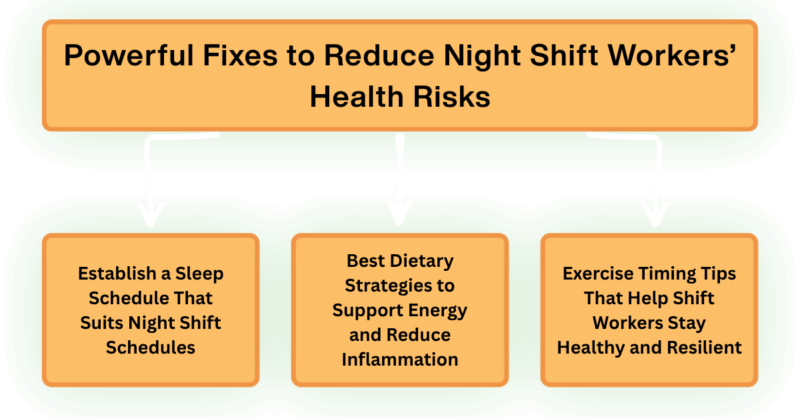
This section is where I want to give you the most actionable guidance possible. Understanding night shift workers’ health risks and how to fix them is not just about awareness; it is about building systems that protect you shift after shift, year after year.
Establish a Sleep Schedule That Suits Night Shift Schedules
Shift work sleep disorder symptoms, including chronic insomnia, excessive daytime sleepiness, and difficulty falling asleep, affect an estimated 10 to 38 percent of shift workers, according to research published in Sleep Medicine Reviews.
The key to managing this is protecting your sleep environment and pre-sleep routine with the same seriousness most people give their nighttime hours.
- To replicate overnight darkness during the day, use white noise machines and blackout drapes.
- Communicate clearly with family members or housemates about your sleep schedule to minimize interruptions.
- Avoid bright natural light on your commute home by wearing blue-light blocking glasses. This tells your brain that nighttime is approaching.
- Even on days off, try to maintain a regular sleep routine. The adaptations your body has worked hard to develop are undone by abrupt changes in your weekend routine, also known as “social jetlag.”
Best Dietary Strategies to Support Energy and Reduce Inflammation
Inflammation is one of the silent drivers behind many health complications on the night shift.
Shift workers show higher levels of C-reactive protein, an inflammatory marker, than day workers across multiple population studies. To counter this, I focus on an anti-inflammatory dietary approach:
- Prioritize omega-3 fatty acids from fatty fish, walnuts, and flaxseeds.
- Include colorful vegetables and fruits rich in antioxidants at every meal.
- Reduce your intake of processed meals, refined carbs, and trans fats—all of which are especially tempting during exhausted late-night breaks.
- Consider timed magnesium supplementation before sleep to support both sleep quality and muscle recovery.
Exercise Timing Tips That Help Shift Workers Stay Healthy and Resilient
Exercise is one of the most powerful tools for staying healthy while working nights, but poor timing can backfire. Vigorous exercise within 3 hours of your intended sleep period can significantly delay sleep onset. Instead, I recommend:
- Scheduling moderate exercise shortly after waking from your daytime sleep period.
- Using light stretching or yoga during shift breaks to maintain circulation and reduce musculoskeletal strain.
- In accordance with American Heart Association recommendations, aim for at least 150 minutes of moderate-intensity aerobic exercise per week.
Workplace and Lifestyle Strategies to Protect Your Health on Night Shifts
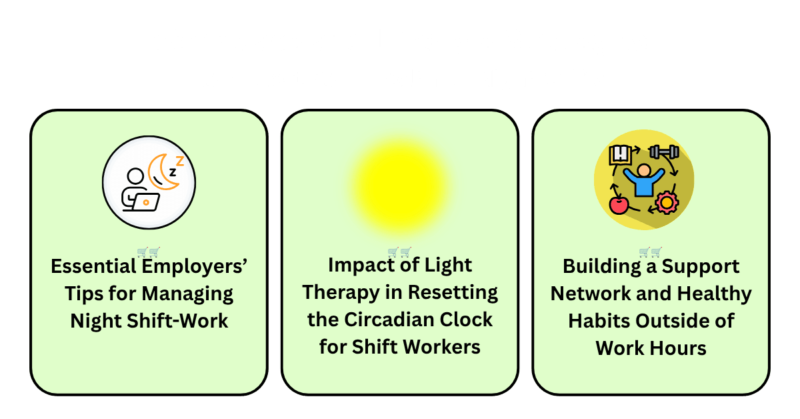
Essential Employers’ Tips for Managing Night Shift-Work
Organizations have a genuine responsibility here. Employers who invest in the health of night-shift workers see measurable returns through reduced absenteeism, lower turnover, and better safety outcomes.
Evidence-based workplace interventions include offering healthy food options in overnight cafeterias, providing access to occupational health nurses during all shifts, scheduling mandatory rest breaks, and reducing consecutive night shift rotations to limit cumulative sleep debt.
Impact of Light-Therapy in Resetting the Circadian Clock for Shift Workers
Light therapy with a 10,000-lux light box has strong research support for shifting the circadian clock in shift workers.
Exposure to bright light at the start of a night shift can help reset the biological clock and reduce symptoms of shift work sleep disorder.
I have seen workers report meaningful improvements in alertness and daytime sleep quality after just two to three weeks of consistent light therapy use.
Building a Support Network and Healthy Habits Outside of Work Hours
Social isolation is a real and underreported risk for night shift workers. When everyone around you is living on a daytime schedule, it takes deliberate effort to maintain relationships and community.
I encourage night shift workers to join online communities specific to their profession or schedule; schedule social time during evening hours before shifts; and speak openly with family about the emotional toll of shift work.
When to See a Doctor About Night Shift-Related Health Problems
Health Symptoms That Shift Workers Should Take Seriously and Not Dismiss
Do not normalize the following symptoms just because they feel common in your workplace:
- Persistent difficulty sleeping despite being off shift for more than 24 hours
- Frequent mood disturbances, anxiety, or depressive episodes
- Unexplained weight gain or digestive problems lasting more than a few weeks.
- Heart palpitations, chest tightness, or high blood pressure readings
Medical Tests and Screenings Recommended for Long-Term Night Shift Workers
I recommend that anyone working nights for more than two years discuss the following with their doctor:
- Fasting glucose and HbA1c testing for diabetes risk
- Lipid panel and blood pressure monitoring for cardiovascular health
- Thyroid function tests, as thyroid disorders are more prevalent among sleep-disrupted populations
- Mental health screening using validated tools like the PHQ-9
How Healthcare Providers Can Help You Manage Shift Work Health Risks Effectively
A knowledgeable healthcare provider who understands circadian medicine can be a powerful ally. They can guide melatonin timing, evaluate whether prescription sleep aids are appropriate for short-term use, and connect you with occupational health specialists who focus specifically on shift-work populations.
Key Takeaways on Night Work Health Risks
- Circadian disruption is the root cause—night shifts force your body to operate against its natural rhythm, affecting hormone production, immune function, and cellular repair processes.
- Cardiovascular risks are real and serious—Shift workers face significantly higher rates of heart disease, high blood pressure, and inflammation due to chronic stress hormone elevation.
- Metabolic health takes a hit—Irregular eating patterns and hormonal imbalances increase the risk of obesity, type 2 diabetes, and digestive disorders among night shift workers.
- Sleep deprivation compounds every issue—inadequate rest doesn’t just make you tired; it impairs cognitive function, weakens immunity, and accelerates biological aging.
- Recovery takes longer than you think—Your body may need up to two weeks to adapt to nights, but returning to a normal schedule can take even longer without strategic recovery practices.
- Multiple fixes work best together—no single strategy is a magic bullet. Combine sleep hygiene, light management, strategic nutrition, exercise timing, and workplace advocacy for real protection.
- Lifespan is affected but not inevitable—While shift work is linked to reduced life expectancy, managing weight, diet, and sleep can offset a significant portion of that risk.
- Your employer plays a role—forward-rotating schedules, adequate rest between shifts, and healthy workplace environments can dramatically reduce health risks.
- Know when to seek help – Persistent fatigue, chest pain, digestive issues, or mood changes are red flags that deserve medical attention, not dismissal.
- You are not powerless—With the right knowledge and consistent habits, you can protect your health and thrive despite the challenges of shift work.
FAQs on Night Work Health Risks and Fixes
Q. Does shift work damage your health?
Yes, the damage goes beyond just feeling tired. Shift work disrupts your body’s internal clock, which regulates everything from hormone release to cell repair. This circadian misalignment has been linked to increased risks of heart disease, type 2 diabetes, digestive issues, and even some types of cancer.
It has an impact on emotional as well as physical health, ultimately resulting in depression, anxiety, and cognitive decline.
Q. What are the risk factors for shift work?
The danger isn’t the same for everyone; it depends on how often you work nights, how long you’ve been doing it, and how quickly your shifts rotate. Workers who log night shifts for decades face significantly higher mortality risks than occasional night workers.
Your age and natural chronotype matter too; older employees and natural early birds struggle more with night work. Poor lifestyle habits like smoking, relying on caffeine, and skipping nutritious meals only compound these risks further.
Q. How long does it take your body to recover from shift work?
Recovery isn’t instant; it can take up to two weeks for your body to adapt to a night schedule, but readjusting back to daytime living often takes even longer.
Even after a full week off, some hormonal rhythms like cortisol may not fully normalize, leaving you feeling off-kilter.
The key is strategic recovery: limit your post-shift sleep to about four or five hours, then stay awake until a late bedtime to reset your sleep pressure. This approach helps your body transition back more smoothly than sleeping all day.
Q. How can you manage the risk of shift work?
Management works best when you combine multiple strategies rather than relying on a single fix. Start by protecting your sleep environment; blackout curtains, white noise, and a cool room can make daytime rest truly restorative.
Use light strategically: expose yourself to bright light when you need to be alert during shifts, and block it completely when you need to sleep.
Advocate for forward-rotating schedules (day-to-evening-to-night) and ensure at least 11 hours between shifts to give your body a fighting chance to recover.
Q. What is the healthiest shift to work?
Day shifts win hands down because they align with your body’s natural sleep-wake cycle, making it easier to maintain rest and alertness.
Among rotating schedules, forward rotations, moving from day to evening to night, are more manageable than backward ones because they follow your internal clock’s natural direction.
Some research suggests that working full weeks of nights followed by full weeks of days allows your body to partially adapt, whereas fast rotations change too quickly for meaningful adjustment but may reduce long-term circadian strain.
Q. Does shift work affect life expectancy?
Yes, the evidence is sobering: shift workers face a measurable reduction in lifespan, with long-term night workers losing nearly a year of life on average compared to day workers.
The overall mortality risk jumps by about 12%, and this isn’t just about accidents or acute illness; it’s driven by accelerated biological aging at the cellular level.
A significant portion of this risk is linked to weight gain and metabolic changes, meaning that managing your diet and fitness can directly offset some of the longevity costs associated with shift work.
Final Thoughts on Night Work Health Risks
Working the night shift is not a choice most people make lightly; it’s often a necessity driven by career demands, financial needs, or family responsibilities.
That reality makes it all the more important to stop treating night work as something you simply “push through” and start treating it as a health condition that requires active management.
The research is detailed: your body pays a price every time you defy its internal clock. But here’s the empowering truth: science has also uncovered powerful, practical ways to minimize that price.
From light therapy and strategic napping to meal timing and exercise scheduling, you have more control than you might think.
This isn’t about perfection. It’s about progress. Start with one change; maybe it’s blackout curtains, maybe it’s packing healthier meals, or perhaps it’s having an honest conversation with your employer about shift rotations. Build from there. Share what works with your colleagues because you’re all in this together.
Your health is your most valuable asset. The night shift may be part of your life, but it doesn’t have to define your future. Protect yourself, advocate for better workplace practices, and remember, every small step toward healthier habits is a step toward a longer, stronger, and more resilient you.
Don’t let the night shift steal your health and years off your life; take control starting tonight. Implement one fix from this guide today, share it with your fellow shift-working colleagues, and subscribe for more science-backed strategies to protect your body and future.
This blog is informational and does not provide medical advice; it is intended solely for educational purposes. Nothing you read here should cause you to disregard or put off obtaining expert medical advice.
Read more about night shift workers’ health.
You might like: