

Know the facts about how these 8 surprising habits are important to give up for rapid mind growth. Your mind does not need to work harder every minute. Sometimes, it needs fewer things working against it.
Constant overthinking, avoiding change, comparing yourself with others, and sacrificing your own well-being can quietly drain your attention and make learning feel harder. The good news? You do not need to reinvent your life overnight.
Sometimes, mental growth begins with letting go of habits that keep you stuck.
Read time: 8–10 minutes
Quick Summary: Habits That Can Hold Your Mind Back
Some everyday habits can make learning, clear thinking, emotional balance, and personal growth more difficult.
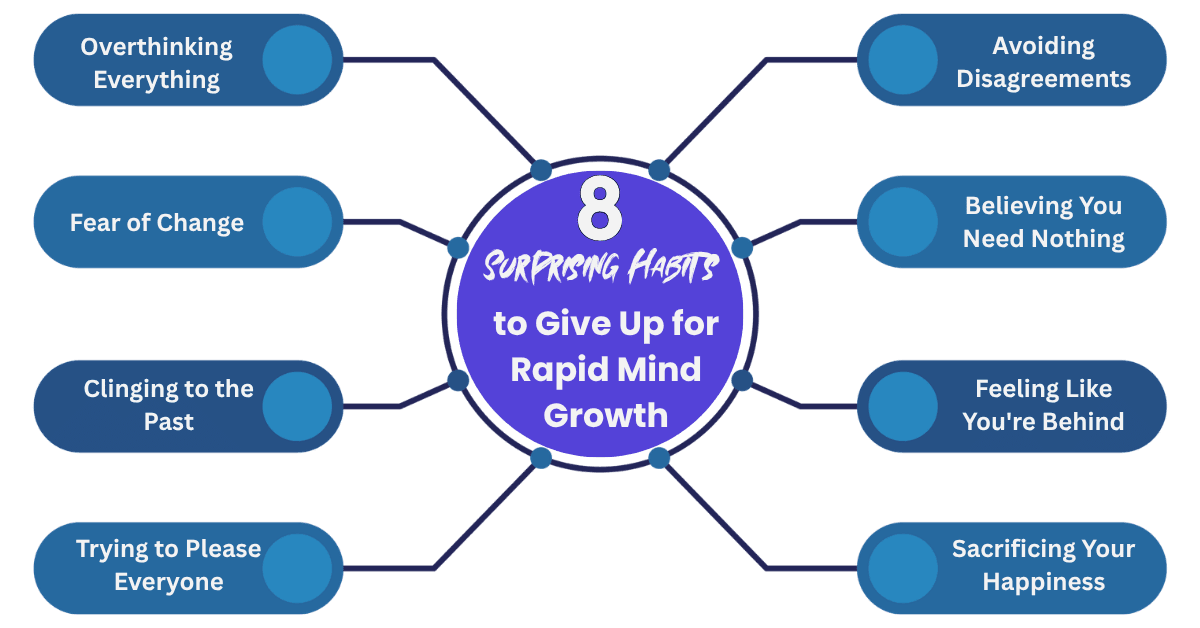
In this article, you will learn how to rethink eight common patterns:
- Overthinking every decision
- Resisting change
- Staying trapped in the past
- Trying to please everyone
- Avoiding healthy disagreement
- Refusing to ask for help
- Constantly feeling behind
- Sacrificing your happiness and well-being
Giving up these habits does not mean becoming a completely different person. It means creating more mental space for learning, flexibility, reflection, connection, and growth.
What Stops Your Mind from Growing?

Mental growth is not the same as becoming “smarter overnight.”
Your brain can continue learning new skills and forming new memories throughout life. Research from the National Institute on Aging also shows that older adults can learn new skills and improve areas such as vocabulary and language.
But learning does not happen in isolation.
Sleep, physical activity, mental stimulation, social connection, emotional well-being, and other lifestyle factors all contribute to overall brain health.
Current public health guidance from the CDC includes mental stimulation, sufficient sleep, physical activity, social connection, and emotional well-being as healthy aging behaviors.
That means improving your mind is not about finding one magical brain hack.
It is about creating conditions that make healthy thinking and learning easier.
8 Surprising Habits to Give Up for Rapid Mind Growth
Habit #1: Overthinking Everything
Thinking carefully can help you make good decisions.
Overthinking is different.
You may replay the same conversation, imagine every possible negative outcome, or keep comparing options without actually moving forward.
The problem is not thinking itself. The problem is getting stuck in a mental loop.
Try This Instead
When you notice yourself going around in circles, ask:
“Is there something I can do about this right now?”
If the answer is yes, choose one small action.
If the answer is no, give yourself permission to pause.
You can also write down your concern. Getting a thought out of your head and onto paper can make it easier to separate a real problem from endless mental speculation.
The goal is not to stop thinking.

It is to make your thinking useful.
Habit #2: Fear of Change
Your brain naturally prefers familiar patterns.
That does not mean every change is good. But refusing every new experience can keep your skills and perspective from developing.
Learning often requires some discomfort.
You may feel awkward when learning a language, starting a new job, using unfamiliar technology, meeting new people, or trying a different approach.
That discomfort does not automatically mean you are doing something wrong.

Try This Instead
Choose one small change instead of trying to transform everything at once.
Try:
- Reading about an unfamiliar topic
- Learning a new skill
- Taking a different route
- Trying a new healthy activity
- Speaking to someone outside your usual circle
- Changing one unhelpful routine
Think of change as an experiment.
You do not have to commit forever.
You are simply giving your mind a chance to experience something different.
Habit #3: Clinging to the Past
Your past can teach you valuable lessons.
But constantly living inside it can keep your attention focused on something you cannot change.
Maybe you made a poor decision.
Maybe someone hurt you.
Maybe you missed an opportunity.
Maybe you wish you had handled something differently.
Reflection can help you learn from those experiences. Replaying them endlessly usually does not change what happened.
Try This Instead
Ask yourself:
“What can this experience teach me?”
Then identify one lesson.
Maybe you learned to communicate more clearly.
Maybe you need stronger boundaries.
Maybe you discovered a skill you need to develop.
Maybe you learned what you do not want in the future.
The past becomes more useful when you turn it into information rather than an identity.
You made a mistake.
That does not mean you are the mistake.
Habit #4: Trying to Please Everyone
Wanting people to be happy with you is understandable.
But constantly changing your decisions to avoid disappointing others can leave very little room for your own needs, values, and goals.
You may say “yes” when you mean “no.”
You may avoid expressing an opinion.
You may take responsibility for problems that are not yours.
Over time, this can become exhausting.
Try This Instead
Before automatically saying yes, pause.
Ask:
“Do I genuinely want to do this, or am I afraid of disappointing someone?”
You can care about other people without making everyone else’s approval the measure of your worth.
Healthy relationships allow room for different opinions, boundaries, and needs.
And sometimes, a respectful “No, I can’t do that” is healthier than an exhausted yes.
Habit #5: Avoiding Disagreements
Not every disagreement needs to become an argument.
But avoiding every difficult conversation can keep you from learning how others think.
Healthy disagreement can challenge your assumptions.
Someone may show you information you had not considered.
You may change your mind.
Or you may better understand why you disagree.
Try This Instead
When you disagree with someone, become curious before becoming defensive.
Ask:
“What am I missing?”
Listen carefully.
Then explain your position without attacking the person.
You do not have to change your opinion simply because someone disagrees with you.
Mental growth can also mean becoming better at holding a different perspective without feeling threatened by it.
Habit #6: Believing You Need Nothing
Independence is valuable.
But there is a difference between being independent and refusing help.
Nobody knows everything.
Teachers, coworkers, friends, mentors, books, courses, and other resources can introduce you to ideas you might not reach on your own.
Asking for help can actually be a sign that you are serious about learning.
Try This Instead
When you get stuck, ask:
“Who or what could help me understand this better?”
Then use the resource.
You might:
- Ask an experienced person
- Take a course
- Read a reliable book
- Watch an educational lesson
- Join a community
- Ask for constructive feedback
- Talk through the problem with someone you trust
Brain growth is not a solo competition.
Sometimes the fastest way to learn is to stop pretending you already know.
Habit #7: Feeling Like You’re Behind
This habit can quietly steal your attention.
You look at someone’s career, home, business, relationships, appearance, or achievements and decide that you should be further ahead.
But you are comparing your complete reality with a small part of someone else’s life.
Constant comparison can make progress feel invisible.
Try This Instead
Compare yourself with your previous self.
Ask:
- What do I understand now that I did not understand before?
- What skill have I improved?
- What difficult situation do I handle better?
- What mistake taught me something valuable?
- What am I doing today that my younger self could not do?
Your timeline does not have to match someone else’s.
Growth is still growth when nobody else notices it.
Habit #8: Sacrificing Your Happiness
This one is easy to misunderstand.
Giving up unhealthy habits does not mean chasing pleasure all day or avoiding responsibility.
Real well-being includes rest, meaningful relationships, purpose, healthy routines, enjoyable activities, and emotional balance.
Ignoring all of these while constantly working can leave you mentally depleted.
And when you are exhausted, learning and concentration can become harder.
Sleep is especially important. The CDC notes that adequate sleep supports attention and memory and recommends consistent sleep habits to support better sleep health.
Try This Instead
Build small moments of recovery into your day.
That might mean:
- Getting enough sleep
- Taking a walk
- Spending time with people you care about
- Reading for pleasure
- Enjoying a hobby
- Taking short breaks from screens
- Spending time outdoors
- Practicing relaxation
- Making room for something that gives you meaning
You do not have to earn every moment of happiness through exhaustion.
A healthier mind needs both recovery and stimulation.
What to Replace These Habits With
Giving up an unhelpful habit works better when you replace it with a healthier behavior.
| Instead of… | Try… |
|---|---|
| Overthinking | Taking one practical action |
| Fearing every change | Trying small experiments |
| Living in the past | Extracting the lesson |
| Pleasing everyone | Setting respectful boundaries |
| Avoiding disagreement | Listening with curiosity |
| Refusing help | Learning from others |
| Comparing yourself | Tracking your own progress |
| Sacrificing well-being | Protecting time for recovery |
The goal is not perfection.
It is better responses, repeated over time.
How to Build a Mind-Growth Routine

You do not need an hour-long “brain training” routine every morning.
Start with a few habits that support learning and overall brain health.
Learn Something New
Read, write, study, practice a skill, learn a language, play an instrument, or explore a subject that genuinely interests you.
Mental stimulation is one component of a broader healthy lifestyle that supports cognitive health.
Move Your Body
Physical activity benefits more than your muscles.
It is also being studied as an important part of maintaining cognitive health and reducing dementia risk. NIH-supported research continues to investigate exercise and other lifestyle interventions for brain health.
You do not have to start with an extreme workout.
A regular walk is a perfectly reasonable place to begin.
Protect Your Sleep
A tired brain is not operating under ideal conditions.
Make sleep a priority rather than something squeezed into whatever time remains after everything else.
Consistent sleep habits, a comfortable sleep environment, and limiting stimulating activities close to bedtime can support better sleep.
Stay Socially Connected
Conversation gives your mind opportunities to listen, remember, interpret, respond, and understand another person’s perspective.
Social connection also supports overall health and well-being. The CDC notes that strong social connections are associated with better health and can help with stress management and sleep.
You do not need hundreds of friends.
A few meaningful relationships can matter.
Manage Stress Instead of Ignoring It
You cannot remove every stressful event from life.
But you can develop healthier ways to respond.
Try walking, breathing exercises, journaling, talking with someone you trust, organizing your priorities, or taking a short break when your mind feels overloaded.
If stress, anxiety, low mood, or persistent worry is interfering with daily life, consider talking with a qualified mental health professional.
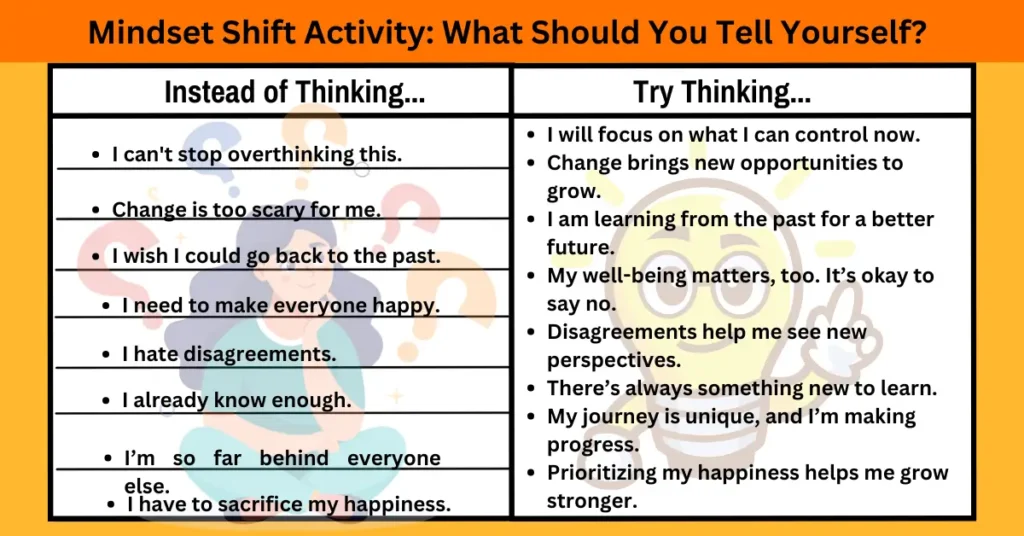
Mindset Shift Activity: What Should You Tell Yourself?
The words you use internally can influence what you do next.
Try turning rigid statements into more flexible ones.
Instead of:
“I am terrible at this.”
Try:
“I am still learning this.”
Instead of:
“I always make mistakes.”
Try:
“I made a mistake. What can I learn from it?”
Instead of:
“Everyone is ahead of me.”
Try:
“I have my own timeline.”
Instead of:
“I can’t handle change.”
Try:
“I can learn how to handle this one step at a time.”
Instead of:
“I have to make everyone happy.”
Try:
“I can care about people while respecting my own boundaries.”
These are not magic affirmations.
They are reminders to replace absolute thinking with more accurate and useful thinking.
A Simple 7-Day Mind-Growth Challenge
Want to start without overwhelming yourself?
Try this for one week.
| Days | Mind-Growth Routine |
| Day 1 | Notice one thought that keeps repeating. |
| Day 2 | Try something slightly different from your normal routine. |
| Day 3 | Learn something new for 15–20 minutes. |
| Day 4 | Ask someone for advice or feedback. |
| Day 5 | Have one respectful conversation where you listen to a different viewpoint. |
| Day 6 | Take time for proper rest or an enjoyable activity without guilt. |
| Day 7 | Write down three ways you have grown, learned, or changed. |
At the end of the week, ask:
“Which habit was taking the most mental energy from me?”
That may be the best place to continue working.
FAQs on Rapid Mind Growth
Q. Can habits really affect brain health?
Yes. Brain health is influenced by multiple factors, including physical activity, sleep, mental stimulation, social connection, diet, cardiovascular health, and other lifestyle behaviors. Research suggests that combinations of healthy behaviors may be more useful than relying on a single “brain-boosting” habit.
Q. How can I improve my mental sharpness naturally?
Focus on the basics: get adequate sleep, stay physically active, keep learning, maintain social connections, manage stress, eat a balanced diet, and address health conditions that may affect cognitive function.
There is no single habit that instantly makes the brain “sharper.”
Q. Does overthinking damage your brain?
Overthinking itself is not a medical diagnosis or a simple measure of brain damage. However, persistent worry and rumination can interfere with concentration, sleep, mood, and daily functioning. If repetitive thoughts are becoming difficult to control or are seriously affecting your life, professional support can help.
Q. Is avoiding change bad for mental growth?
Avoiding every new or challenging experience can reduce opportunities to learn and adapt. However, not all change is beneficial. The goal is not to chase constant novelty but to remain willing to learn, adjust, and consider new approaches when appropriate.
Q. Why is comparing yourself with others mentally exhausting?
Comparison often gives you incomplete information. You see another person’s achievements but usually do not see their setbacks, resources, private struggles, or timeline. Focusing on your own progress can provide a more realistic measure of growth.
Q. Can social connection help your brain?
Social connection is associated with better health and well-being, and research has also linked loneliness with increased dementia risk.
A large NIA-supported analysis published in 2025 found an association between loneliness and higher dementia risk, although this type of research does not prove that loneliness directly causes dementia.
Q. Do brain-training games guarantee better memory?
No. Some forms of cognitive training have shown benefits for particular cognitive skills, but the evidence does not support treating every commercial “brain game” as a guaranteed way to prevent cognitive decline. NIH continues to study which types of cognitive training are genuinely useful.
Conclusion
Mental growth is not about becoming a completely different person overnight.
It is often much quieter than that.
You stop replaying every mistake.
You become willing to try something new.
You ask for help instead of pretending you know everything.
You stop measuring your life against someone else’s timeline.
You listen to opinions that challenge you.
You protect your sleep and make room for recovery.
And little by little, you create more space for learning.
The most important habit to give up may be the belief that you are already as capable as you will ever be.
Your current abilities are a starting point—not necessarily your final destination.
Give your mind room to learn, change, rest, and grow.
Read more informative blogs on health and wellness.
You might like to read: