

The night shift worker’s grocery list: 30 foods for blood sugar stability, slow digestion, and energy that lasts through a long overnight shift. Print and shop.
Why Shift Workers Need This Ultimate Grocery Guide
Most grocery lists were designed for people who eat breakfast at 8 am, lunch at noon, and dinner at 6 pm.
That is not your life.
When you work nights, your body processes food differently. Insulin sensitivity drops. Digestion slows. The wrong foods at the wrong time do not just feel heavy; they make your shift harder, your sleep worse, and your long-term health more at risk.
This list contains 30 foods chosen specifically for what research shows works for night-shift biology, organized by category so you can shop fast and use everything.
Research note: A 2025 study published in Acta Physiologica found that, although night shift workers reduced calorie intake during their shifts, blood glucose spikes and glycemic variability were significantly higher than during day shifts. The foods on this list are chosen specifically to address this.
Print this list. Take it shopping. Stop buying food that works against your schedule.
Why Your Grocery List Needs to Be Different

Before the list, here is the one principle that changes everything.
Your body’s insulin sensitivity is lower during the biological night. This is true regardless of how long you have worked nights. It is not something you adapt out of. The same food your body handles fine at noon can cause a bigger blood sugar spike at 3 am.
The practical result: you need foods that digest slowly, release energy gradually, and do not demand a large insulin response at 2 am when your gut is trying to rest.
Every food on this list was chosen with that in mind.
The Grocery List — 30 Foods in 6 Categories
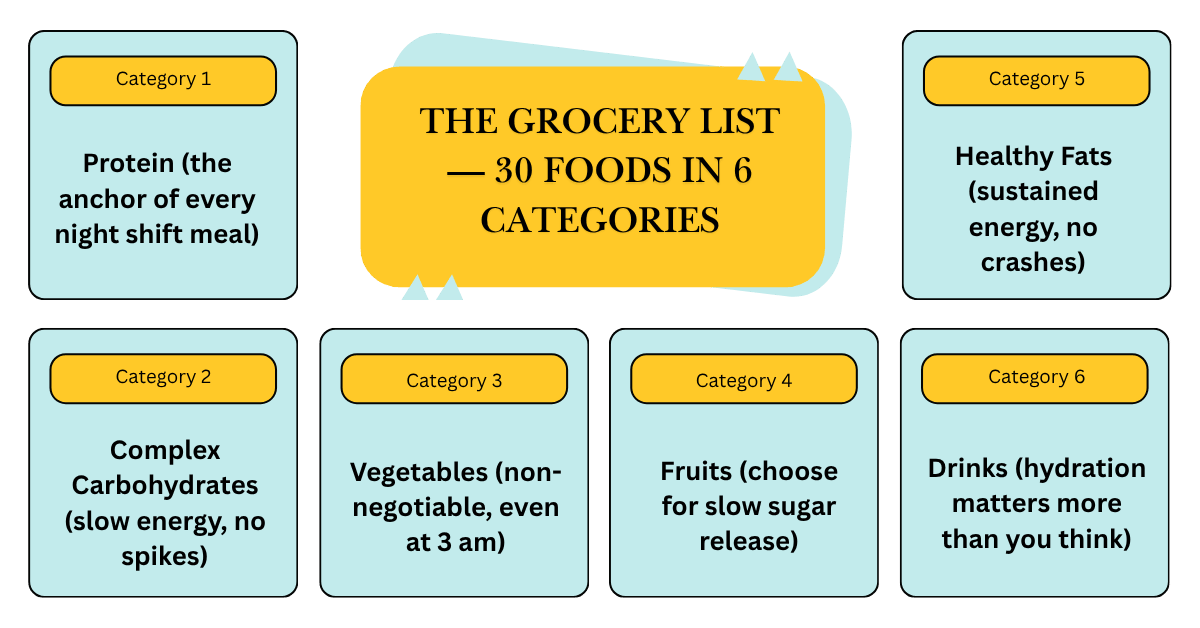
Category 1: Protein (the anchor of every night shift meal)
Protein digests slowly, keeps you full longer, and does not spike blood sugar. It is the most important macronutrient to prioritize on the night shift.
Bottom line: build every pre-shift meal around a protein source.
1. Eggs
The most versatile night shift food. High-protein, fast-to-cook, and containing tryptophan, which supports sleep after your shift. Hard-boil a batch on your day off and keep them in the fridge all week.
2. Chicken breast or thighs
Lean protein that batch-cooks easily. Thighs are cheaper and stay moist after reheating, which is important when you are microwaving a pre-cooked meal before a shift.
3. Tinned tuna or salmon
No cooking required. Pop-top tins mean no can opener needed. One tin with crackers is a complete mid-shift snack, providing 25-30 g of protein. Salmon also provides omega-3s, which help reduce the inflammation associated with circadian disruption.
4. Greek yogurt (plain, full-fat)
High in protein, contains tryptophan, and is one of the best post-shift foods because it digests easily and supports sleep onset. Buy plain versions; flavored versions often contain significant added sugar, which spikes blood glucose.
5. Cottage cheese
Often overlooked, but one of the best night shift proteins. High in casein, a slow-digesting protein that keeps hunger at bay for hours. Eat it as a mid-shift snack with fruit or on crackers.
6. Tinned chickpeas and beans
See our [full guide to protein-packed beans] for the complete breakdown. Chickpeas are high in protein and fiber and have a low glycemic index, meaning they release energy slowly and do not spike blood sugar, even at 3 am.
7. Firm tofu
For plant-based workers. It absorbs flavors well, batch-cooks in a pan in 10 minutes, is high in protein, and has a very low glycemic impact. Works well in stir-fries or as a cold salad topping.
8. Natural peanut butter or almond butter
Buy the variety with no added sugar or palm oil — just nuts. One tablespoon with a banana is a complete mid-shift snack: slow carbs, protein, and healthy fat in one package.
Category 2: Complex Carbohydrates (slow energy, no spikes)
Not all carbohydrates are the problem. Refined carbs, white bread, crisps, and sugary snacks cause rapid blood sugar spikes followed by crashes. Complex carbs release energy slowly and are your friend on night shift.
Bottom line: swap white for whole grain and feel the difference within a week.
9. Brown rice
The cornerstone of night shift batch cooking. Cook a large batch in a pot on your day off, portion into containers, and refrigerate for up to 4 days. Pairs with anything. Has a lower glycemic index than white rice, meaning a slower, more manageable energy release.
10. Sweet potato
Higher in nutrients than a regular potato and has a lower glycemic index. Roast a tray on your day off; they keep well and can be eaten cold or reheated. Naturally sweet, filling, and extremely easy to prepare in bulk.
11. Oats (rolled, not instant)
The best post-shift breakfast food. Prepare overnight oats the evening before your shift; they are ready when you get home. Contains beta-glucan fiber, which helps stabilize blood sugar and supports the immune system, which is consistently under strain in night shift workers.
12. Wholegrain bread
Significantly lower glycemic response than white bread. Use for pre-shift sandwiches and post-shift toast. Check the label: “multigrain” is not the same as “wholegrain.” Look for whole grain as the first ingredient.
13. Wholegrain crackers
The best shift bag food. Non-perishable, portable, and filling when paired with protein (tuna, cheese, nut butter, hummus). Keep a packet in your locker.
14. Quinoa
A complete protein and complex carb in one food. It is higher in protein than rice, slightly higher in calories, and contains all nine essential amino acids. Batch cooking works well and keeps in the fridge for 5 days.
Category 3: Vegetables (non-negotiable, even at 3 am)
A 2024 study of healthcare workers found that total fruit, whole fruit, and vegetable intake decreased significantly during night shifts compared with pre-shift eating.
This is one of the most consistent findings in night shift nutrition research: shift workers eat fewer vegetables because they are harder to access and prepare at 2 am.
The solution is preparation, not willpower.
Bottom line: pre-wash and pre-chop all vegetables before your shift block starts.
15. Spinach
The most nutrient-dense leafy green per gram. High in magnesium, which supports sleep quality and muscle relaxation, something nearly all night shift workers are deficient in. Add raw to pre-made salad or wilt into scrambled eggs.
16. Broccoli
High in fiber, vitamin C, and antioxidants. Roasts in 20 minutes and keeps well for 4 days in the fridge. One of the best vegetables for supporting immune function, which is consistently compromised by shift work and irregular sleep.
17. Cucumber
90% water—doubles as a hydration source. Requires zero preparation beyond washing. Slice and keep in a container with hummus for a mid-shift snack that requires no thought.
18. Carrots
Naturally sweet, non-perishable in a cool bag for a full 12-hour shift, and requiring no preparation beyond washing. One of the easiest vegetables to actually eat at work.
19. Cherry tomatoes
No chopping required. High in lycopene, which has anti-inflammatory properties relevant to the chronic low-grade inflammation associated with shift work. Grab a handful on your break.
20. Bell peppers (red, yellow, or orange) have the highest vitamin C content of any commonly eaten vegetable, higher than that of oranges. Slice it on your day off, then store it in water in the fridge. They stay crisp for 4-5 days.
Category 4: Fruits (choose for slow sugar release)
Not all fruit is equal for the night shift. High-sugar fruits eaten mid-shift can spike blood glucose. Choose fruits with higher fiber content or a lower glycemic index.
Bottom line: whole fruit is always better than fruit juice. The fiber slows sugar absorption.
21. Bananas.
The most practical fruit for shift work comes in its own packaging, does not bruise easily, and is one of the best pre-shift energy sources.
Also contains vitamin B6, which supports serotonin production. Eat before your shift, not at 3 am when blood sugar is hardest to regulate.
22. Berries (fresh or frozen)
Blueberries, strawberries, and raspberries have some of the lowest glycemic indexes of any fruit and are high in antioxidants. Frozen berries are cheaper and just as nutritious as fresh. Add to overnight oats or Greek yogurt, or eat straight.
23. Apples
High fiber content slows sugar absorption significantly. Durable, it survives a full 12-hour shift in a bag without damage. Pairs well with peanut butter for a complete snack.
24. Kiwi fruit
Research specifically on kiwi fruit and sleep onset found that eating two kiwis an hour before sleep reduced the time to fall asleep by 35%. Relevant for post-shift eating when you are trying to sleep quickly after getting home.

Category 5: Healthy Fats (sustained energy, no crashes)
Healthy fats slow digestion and keep you satisfied for longer. They do not cause blood sugar spikes. They are your allies on a long shift.
Bottom line: add a small amount of healthy fat to every meal and snack.
25. Mixed nuts (unsalted)
Almonds, walnuts, and cashews: buy a large bag and portion into small zip-lock bags, one per shift. Contains protein, healthy fat, and magnesium. One of the most researched and consistently recommended night-shift snacks.
Walnuts specifically contain melatonin precursors; a small handful before sleep may support sleep onset.
26. Avocado
High in potassium (more than bananas), healthy monounsaturated fat, and fiber. Keeps hunger away for hours. Eat it with whole-grain toast as a pre-shift meal or slice it into a salad.
27. Olive oil (extra virgin)
Use as your primary cooking fat. Contains oleocanthal, an anti-inflammatory compound that helps offset the chronic low-grade inflammation associated with circadian disruption. Drizzle over pre-shift salads and roasted vegetables.
28. Hummus
Made from chickpeas and olive oil, it combines protein, healthy fat, and fiber in one dip. Pairs with crackers, carrot sticks, or cucumber for a complete mid-shift snack that requires zero preparation at work.
Category 6: Drinks (hydration matters more than you think)
Research from 2025 found that after three consecutive night shifts, morning systolic blood pressure was elevated and plasma cortisol was reduced, both of which were partly linked to inadequate hydration during shifts.
Night shift workers often forget to drink because the thirst signal is itself circadian and weaker during the biological night.
Bottom line: drink before you feel thirsty. If you are thirsty at 3 am, you are already mildly dehydrated.
29. Water (large insulated bottle)
Not a food, but the most important item on this list. Aim for 500 ml before your shift, 500 ml in the first half, and 300-400 ml in the second half. An insulated bottle keeps water cold all shift and makes it more appealing to drink.
30. Herbal tea (chamomile, peppermint, or ginger)
Caffeine-free. Three specific uses on night shift: chamomile before sleep (promotes relaxation), peppermint mid-shift (documented alertness effect; the smell alone is stimulating), and ginger if you experience digestive discomfort from eating at unusual hours.
Keep tea bags in your locker. Hot water is available in almost every workplace break room.
Foods to Leave Off Your Grocery List
Equally important, what not to buy if you work nights.
| Remove this | Why | Replace with |
| White bread | High glycemic spikes cause blood sugar to rise fast | Wholegrain bread |
| Energy drinks | 50-80g sugar plus high caffeine—crash inevitable | Green tea or black coffee |
| Crisps and chips | Empty calories raise core body temperature | Mixed nuts |
| Flavoured yoghurt | 15-20g added sugar per pot | Plain Greek yoghurt |
| Chocolate bars | Sugar spike, then crash at the worst time | Dark chocolate 70%+ (small piece) |
| Instant noodles | High sodium, very low nutrition | Overnight oats or pre-cooked rice |
| Fruit juice | All the sugar of fruit, none of the fiber | Whole fruit or water |
How to Use This List for Batch Cooking
Buying the right food is only half of the solution. The other half is preparation.
Spend 60-90 minutes on your first day off each week:
1. Cook a large batch of brown rice or quinoa and portion it into containers
2. Roast a tray of sweet potato and broccoli; divide across meals
3. Cook protein in bulk: chicken, boiled eggs, or tofu
4. Portion nuts into small bags—one per shift
5. Wash and chop vegetables, store in water in the fridge
6. Prepare overnight oat jars—one per post-shift morning
You now have 5 complete pre-shift meals, 5 post-shift breakfasts, and 5 sets of snacks ready to go. No decisions at 2 pm when you are tired before a shift. No vending machine at 3 am, as nothing else is available.
For a complete four-week meal plan using these foods, including exact portions, recipes, and a weekly grocery list, see our Night Shift Meal Plan.
Your Shopping List — Print Version
Protein:
- Eggs (12-pack minimum)
- Chicken breast or thighs
- Tinned tuna or salmon (6 tins)
- Greek yogurt (plain, full-fat)
- Cottage cheese
- Tinned chickpeas (4 tins)
- Peanut butter or almond butter (natural)
Complex Carbs:
- Brown rice (1kg bag)
- Sweet potatoes (4-6)
- Rolled oats (large bag)
- Wholegrain bread
- Wholegrain crackers
- Quinoa (optional, replaces rice)
Vegetables:
- Spinach (bag)
- Broccoli (2 heads)
- Cucumber (2)
- Carrots (bag)
- Cherry tomatoes (punnet)
- Bell peppers (3-4)
Fruit:
- Bananas (bunch)
- Berries (fresh or frozen)
- Apples (bag)
- Kiwi fruit (4-6)
Healthy Fats:
- Mixed unsalted nuts (large bag)
- Avocados (3-4)
- Extra virgin olive oil
- Hummus (tub)
Drinks:
- Large insulated water bottle
- Herbal tea bags (chamomile, peppermint)
FAQs
Q. What should a night shift worker eat before their shift?
Eat your largest meal 1-2 hours before your shift starts. Focus on protein and complex carbohydrates, for example, chicken with brown rice and roasted vegetables. This front-loads energy when your body is best able to process it, reducing the need to eat heavily mid-shift when digestion is at its slowest.
Q. What is the best snack for night shift workers at 3 am?
The best 3 am snacks are small, protein-forward, and low in refined sugar. Greek yogurt with berries, hard-boiled eggs, a banana with peanut butter, mixed nuts, or hummus with vegetable sticks are all strong options. Avoid high-sugar snacks — blood glucose spikes are harder to manage during biological night hours.
Q. How do night-shift workers avoid weight gain from eating at night?
The key is not avoiding food entirely — it is choosing the right foods and eating at the right times within your shift. Front-load your main meal before the shift, eat small snacks during the shift, and choose low-glycemic-index foods to avoid blood sugar spikes. See our [Night Shift Meal Plan] for a complete structured eating schedule.
Q. Should night-shift workers avoid carbohydrates?
Complex carbohydrates, such as brown rice, sweet potato, oats, and whole-grain bread, are important energy sources and should not be eliminated. be eliminated.
What night shift workers should avoid are refined carbohydrates: white bread, sugary snacks, and processed foods that cause rapid blood sugar spikes. Complex carbs release energy slowly and support sustained alertness through a long shift.
This article is for general educational purposes only. It does not constitute medical advice or a personalized nutrition plan. If you have specific dietary requirements, health conditions, including diabetes, or are taking medication that affects blood sugar, please consult a registered dietitian or your healthcare provider.
Sources:
Acta Physiologica (2025); ScienceDaily/University of Adelaide (2024); PMC/Nutrients (2024); Wiley eFood (2025)
Read more about night shift workers’ health.
You might like: